
There I was, sitting on the crowded VLT train rolling through downtown Rio de Janeiro, staring blankly out the window as the historic buildings blurred past. I had my premium noise-canceling headphones securely over my ears, completely shutting out the chaotic sounds of the city.
I opened my phone, launched my mainstream music streaming app, and pulled up my “Liked Songs” playlist. I hit shuffle.
The first track was an indie-rock anthem from 2014. I skipped it. The second track was a pop hit from 2018. I skipped it. The third was a classic rock song I had literally heard three thousand times since high school. I sighed and skipped that one, too.
I spent the next ten minutes of my commute aggressively tapping the “next” button, desperately chasing a feeling I couldn’t quite capture. My library had over four thousand saved songs, representing years of my life. Yet, I felt a crushing sense of musical starvation. I had a massive buffet of audio right in my pocket, but absolutely nothing sounded appetizing.
I was suffering from a severe case of algorithmic fatigue. I realized that I hadn’t truly discovered a new, mind-blowing artist in almost three years.
The Illusion of Infinite Choice
If you use any of the major music streaming giants, you probably know exactly what I am talking about.
These platforms boast libraries of seventy or eighty million songs. They market themselves on the promise of infinite choice. But the reality of how their recommendation algorithms actually function is incredibly limiting.
The algorithms are designed to keep you comfortable. They look at the data of what you already listen to, find thousands of other people who listen to the exact same things, and simply feed you the overlapping tracks. If you listen to a lot of 90s alternative rock, the app will never, ever suggest a brilliant new underground jazz fusion artist from Tokyo.
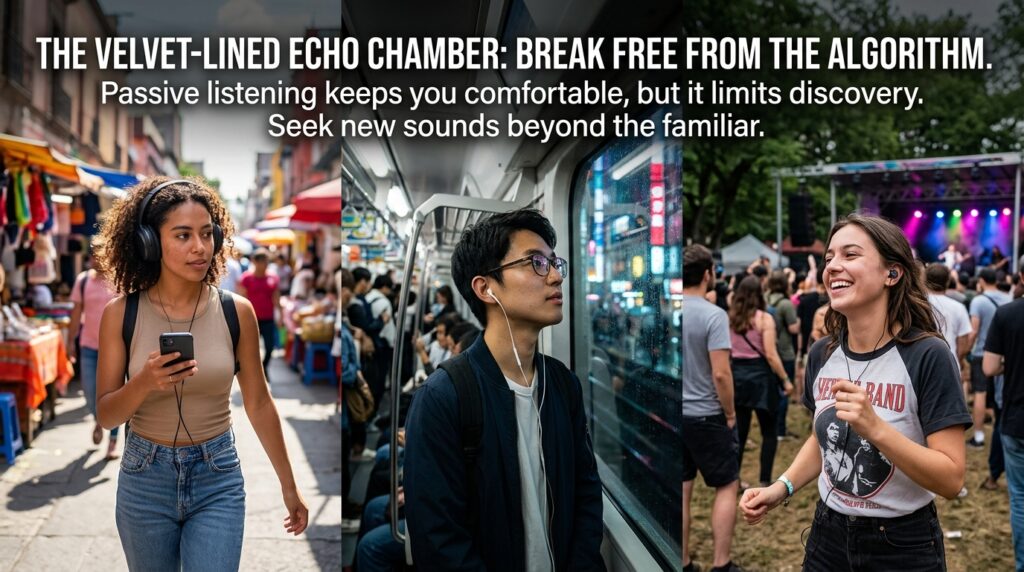
The software builds a velvet-lined echo chamber around your ears. You think you are discovering new music because the app hands you a personalized “Discover Weekly” playlist every Monday. But if you look closely, those playlists are just slight variations of the exact same artists you already know, sprinkled with incredibly safe, mainstream adjacent tracks.
It is passive consumption at its absolute worst. I was letting a mathematical formula dictate my emotional soundtrack.
Clearing Out the Digital Noise
I knew I needed to break out of this rut. My musical taste had become entirely stagnant, trapped in a time capsule of my mid-twenties.
Before I could bring new art into my life, I had to completely change my digital environment. I’ve always believed that a cluttered digital space leads to a cluttered mind, a philosophy I leaned into heavily when writing about the (10 Apps That Helped Me Declutter My Digital Space). Just as I had to delete old files and unused applications to make my phone run faster, I realized I needed to step away from my bloated, disorganized library of 4,000 saved songs.
I didn’t delete my mainstream streaming account—it’s still useful for throwing on a party playlist—but I decided to actively search for a secondary application. I wanted an app built specifically for active discovery, not passive background noise.
That is when a friend who works in audio production recommended a community-driven music platform. (For the sake of this experience, think of platforms centered around independent creators, direct support, and human curation, much like Bandcamp or niche radio aggregator apps).
A Dashboard Built for Humans, Not Algorithms
When I first opened this new application, the interface immediately threw me off guard.
There was no “For You” feed aggressively pushing the latest viral pop hit. There was no algorithmically generated list of safe background beats.
Instead, the home page read like an incredibly well-curated indie music magazine. It featured long-form editorial articles written by actual human music journalists. There was a deep-dive interview with a punk band from Indonesia. There was a spotlight on a community of electronic producers making experimental synth music in Berlin. There was a curated list of the best ambient folk albums released that specific week.
It was intimidating, but in the best way possible.
I tapped on a featured article about the revival of instrumental funk. The app allowed me to stream the album directly from the editorial page. Within thirty seconds of the first track playing, I felt the hairs on my arms stand up. The baseline was gritty, the drums were raw and unpolished, and the energy was infectious.
It was a band with fewer than two thousand total followers. They didn’t have a massive marketing budget. They would have never, in a million years, made it onto one of the polished, corporate playlists on the mainstream streaming apps.
But here they were, front and center, because a human curator recognized that their art was undeniably fantastic.
Setting a New Tone for the Day
Integrating this app into my life required a complete shift in my daily habits.
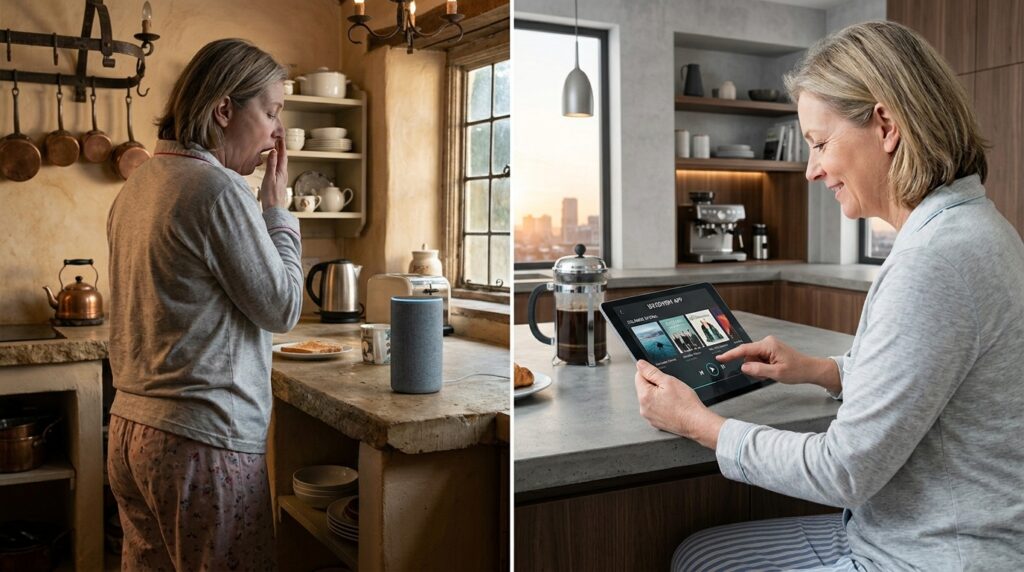
In the past, I would wake up, groggily walk into the kitchen, and tell my smart speaker to play my “Morning Mix.” The smart speaker would just play the exact same acoustic pop songs it played every single morning for the last two years. It was comfortable, but it was incredibly boring. It set a dull, repetitive tone for the rest of my day.
Once I downloaded the discovery app, I intentionally disrupted that cycle. I made it a core part of the strategies I adopted when figuring out (How I Built a Better Morning Routine Using My Phone).
Now, when the coffee is brewing, I don’t rely on voice commands. I open the app on my tablet. I go to the “New Arrivals” section and I filter by a genre I know absolutely nothing about. One morning, I filtered by “Brazilian Psychedelic Rock.” Another morning, I chose “Icelandic Choral Music.”
I select an album cover that looks visually interesting, and I hit play.
Some mornings, the music is completely jarring and I have to turn it off after five minutes. But other mornings, I strike absolute gold. I find a melody that completely wakes up my brain. The act of actively exploring unknown sonic territory forces me to be present. I am no longer sleepwalking through my morning routine; I am actively listening, analyzing, and engaging with fresh art.
The Ultimate Hack for Deep Focus
As I continued to explore the depths of this application, I uncovered an entire universe of music that solved one of my biggest professional struggles.
My job requires hours of deep, concentrated writing and data analysis. I absolutely cannot work in silence; every little noise in my apartment distracts me. But I also cannot work while listening to music with English lyrics, because my brain tries to process the words and I lose my train of thought.
On the mainstream apps, if you search for “Focus Music,” you are usually presented with incredibly sterile, repetitive piano loops that sound like they belong in a luxury hotel elevator. It is boring, lifeless audio.
Through the discovery app, I stumbled into the tags for “Math Rock,” “Post-Rock,” and “Dark Ambient.”
I found massive, sweeping, cinematic instrumental albums produced by independent composers. The music had incredible texture, complex time signatures, and deep emotional resonance, but it completely lacked distracting vocals.
I started building custom collections within the app exclusively for my work blocks. These intricate instrumental soundscapes became my professional anchor. It drastically changed my output, becoming a cornerstone habit that I rely on just as heavily as the techniques I shared in (How I Stay Focused During Long Workdays With Apps). When I put my headphones on and hit play on a 20-minute, slow-building post-rock instrumental, my brain immediately locks into the task at hand. The music doesn’t just block out the noise; it actively drives my momentum forward.
The Power of the “Fan Collection”
Perhaps the most fascinating feature of this specific platform is how it treats the listeners themselves.
On standard streaming platforms, your profile is a private, locked-off island. Nobody cares what playlists you make.
On this discovery app, listener profiles are public and highly celebrated. When you purchase an album or add it to your collection, it appears on your public grid. You can actually click on an underground album, see the tiny square profile pictures of the two hundred other people who bought it, and then click on their profiles to see what else they are listening to.
It turns out, human beings are infinitely better at curating music than algorithms.
If I find a weird, experimental jazz album that I absolutely love, I will look at the other fans who supported that album. Inevitably, I will find a fan whose taste aligns perfectly with mine. I can browse their collection and instantly discover twenty other brilliant albums that I never would have found on my own.
It is the digital equivalent of digging through milk crates at a dusty, independent record store and chatting with the locals about what they are spinning. It recreates the organic, messy, brilliant community aspect of music discovery that the internet had largely stripped away.
Connecting the Artist to the Listener
We have to talk about the economics of the music industry for a moment, because it fundamentally impacts the quality of the art we receive.
The mainstream streaming model pays artists fractions of a single penny per stream. It forces artists to create incredibly short songs, with the chorus hitting in the first ten seconds, just to appease the algorithm and prevent the listener from skipping. It is homogenizing music, turning art into “content.”
The application I am using operates on a completely different model. It encourages direct support. While you can stream music, the primary goal is to allow fans to directly purchase digital albums, vinyl records, or merchandise straight from the artist.
The first time I used the app to buy a digital album directly from a small, independent artist in Scotland, something amazing happened.
About two weeks later, I received an email. It wasn’t an automated, corporate newsletter. It was a direct message from the lead singer of the band, thanking me for buying the album and asking what my favorite track was.
That brief interaction completely changed how I valued the music. I wasn’t just consuming a disposable audio file; I was participating in a transaction of art. I was directly funding someone’s ability to pay their rent and continue making the music I loved.
When you feel connected to the creator, the music sounds better. You listen to it with more grace and more attention. You read the liner notes. You appreciate the cover art. You treat the album as a cohesive, important piece of work, rather than just background noise to fill the silence.
Final Thoughts on Reclaiming Your Ears
It has been roughly a year since I made the conscious decision to change how I consume music.
If I look at the dashboard of my old, algorithmic streaming app, it still suggests the exact same alternative rock bands from ten years ago. It still thinks my musical taste froze in time.
But my new app tells a completely different story. My collection is now a vibrant, chaotic, beautiful patchwork of global art. I have obscure electronic music from South Africa, traditional folk recordings from the Andes, and blistering punk rock from underground venues in London.
I am excited about music again. I actively look forward to Fridays, not because of what the mainstream pop charts are doing, but because I want to see what my favorite independent curators have discovered this week.
If you are feeling a sense of dread when you put your headphones on, if you are tired of skipping through your own library, I urge you to recognize that the problem isn’t a lack of good music in the world. We are living in a golden age of independent creation.
The problem is the pipeline you are using to access it.
Step outside the velvet-lined echo chamber. Download an app that prioritizes human curation over algorithmic safety. Follow a random fan whose taste you admire. Buy a digital album for five dollars from an artist who has never heard of a Billboard chart.
It requires a little bit of effort, a little bit of patience, and a willingness to occasionally listen to something you hate. But the reward is rediscovering the profound, life-altering joy of hearing a perfect song for the very first time. Your ears deserve better than an algorithm. Feed them something real.
