
I used to wear my sleep deprivation like a badge of honor. In my early twenties, operating on four hours of sleep and three cups of espresso wasn’t just a habit; it was my entire personality. I convinced myself that resting was a waste of time and that true productivity only happened at two in the morning while the rest of the world was quiet.
But the human body keeps a meticulous ledger, and eventually, the debt comes due.
A few years ago, the crash hit me hard. I wasn’t just tired; I was completely, biologically depleted. My memory was failing, my mood was constantly irritable, and my physical energy was non-existent. I would go to bed at a reasonable hour, spend eight hours under the covers, but wake up feeling like I had run a marathon in my sleep. I would drag myself to my laptop, stare blankly at the screen, and wonder why my brain felt like it was wrapped in thick fog.
I realized that spending time in bed doesn’t automatically equate to actual, restorative rest. Just like tracking my budget or monitoring my daily chores, I needed hard data to understand what was going wrong while my eyes were closed.
I started treating my phone not as a distraction, but as a diagnostic tool. In my quest to optimize my waking hours—a journey I documented deeply in (A Lifestyle App That Made Me Rethink My Daily Routine)—I discovered that true daytime focus is entirely dependent on nocturnal recovery. If your nights are chaotic, your days will be a struggle.
If you are waking up groggy, tossing and turning at 3:00 AM, or simply curious about the mysterious third of your life spent unconscious, you don’t necessarily need an expensive medical sleep lab. You just need the right software. Here are the 12 apps that finally helped me understand, track, and dramatically improve my sleep.
1. Sleep Cycle (The Smart Wake-Up)
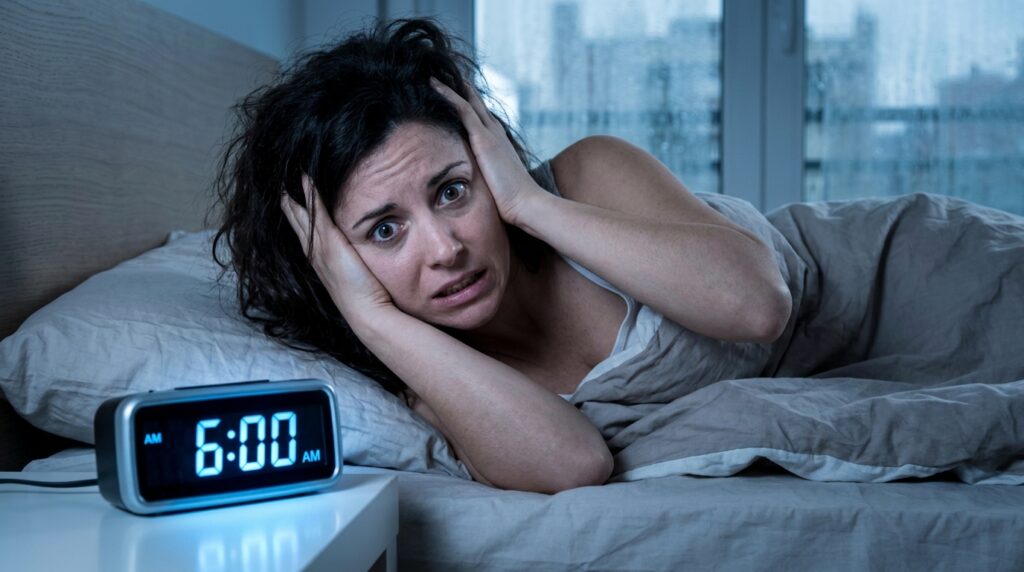
The absolute worst way to wake up is being violently jolted out of a deep dream by a blaring, obnoxious alarm clock. It triggers a massive spike in cortisol, sends your heart racing, and practically guarantees you will feel groggy for hours. Sleep Cycle entirely revolutionized my mornings by eliminating this shock.
The app uses your smartphone’s microphone and accelerometer to listen to your breathing and movement, mapping your sleep phases throughout the night. You give the app a 30-minute window to wake you up (for example, between 6:30 AM and 7:00 AM). The app waits until you naturally transition into your lightest sleep phase before gently sounding the alarm. It feels less like an alarm clock and more like waking up naturally on a Saturday morning.
2. AutoSleep (The Apple Watch Powerhouse)
If you own an Apple Watch, AutoSleep is the undisputed heavyweight champion of sleep data. What makes this app brilliant is its absolute lack of friction; you don’t have to press a single button or open the app before bed. You just wear your watch to sleep, and the software automatically calculates everything in the background.
In the morning, you are presented with a staggering amount of information, from your heart rate variability (HRV) to your exact minutes of Deep, REM, and Light sleep. It even calculates your “Sleep Debt,” telling you exactly how many hours of rest you owe your body to get back to a baseline. It is perfect for data nerds who want to dive deep into their vital signs.
3. SleepScore (Clinical Accuracy Without a Wearable)
A lot of people hate the idea of wearing a bulky smartwatch or fitness tracker to bed. It feels restrictive. SleepScore is the perfect solution for those people.
It uses incredibly advanced, patented sonar technology. You place your phone on your nightstand, pointing toward your chest, and the app emits completely inaudible sonar waves that bounce off your body. It tracks your physical movements and breathing rate with astonishing accuracy. It doesn’t just give you a messy graph; it gives you a definitive “Sleep Score” out of 100, along with actionable, scientifically backed advice on how to improve your sleep hygiene. It is as close to a clinical sleep study as you can get using just a smartphone.
4. Pillow (The Aesthetic Tracker)
For iOS users who appreciate stunning design and visual clarity, Pillow is an absolute joy to use. While it tracks all the standard metrics using your Apple Watch or iPhone sensors, its standout feature is its audio recording capability and beautiful interface.
Pillow actively listens for sleep talking, sleep apnea gasps, and snoring, presenting you with clean, beautifully animated charts in the morning. Being able to actually listen to a crystal-clear audio clip of yourself snoring or mumbling in the middle of the night is both hilarious and incredibly revealing. It’s a great tool if you suspect environmental noises are waking you up.
5. SleepWatch (The AI-Powered Coach)
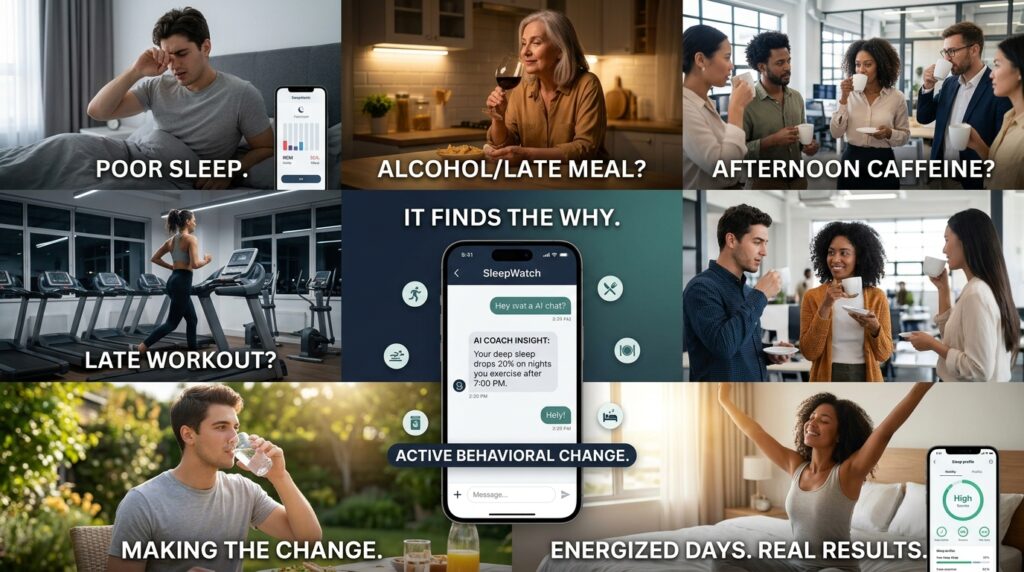
Data is entirely useless if you don’t know what to do with it. SleepWatch separates itself from the pack by acting as an AI-powered health coach. It doesn’t just show you that you had terrible REM sleep on a Tuesday; it actively searches for the why.
It correlates your sleep data with your daily habits, allowing you to manually input lifestyle factors like late-night meals, alcohol consumption, or afternoon caffeine. Over time, the algorithm learns your body and might send you a push notification saying, “Your deep sleep drops by 20% on nights you exercise after 7:00 PM.” It is a phenomenal tool for active behavioral change.
6. Sleep as Android (The Customization King)
If you are deeply embedded in the Android ecosystem, this is the only app you will ever need to download. Sleep as Android is an absolute powerhouse of customization.
It integrates seamlessly with almost every major wearable device, smart bulb, and Spotify playlist on the market. It features a smart alarm, anti-snoring interventions (the app can literally vibrate your smartwatch to prompt you to roll over if you start snoring heavily), and a massive library of binaural beats to help you fall asleep. It is built from the ground up for people who want total control over their nocturnal environment.
7. Oura (The Holistic Readiness Engine)
While Oura technically requires the purchase of their proprietary smart ring, the accompanying mobile app is the true star of the show and completely transformed my perspective on rest.
The Oura app doesn’t just look at sleep in a vacuum; it calculates a daily “Readiness Score.” It analyzes your body temperature, resting heart rate, and overnight sleep quality to tell you exactly how hard you should push yourself the following day. Mastering this balance became essential when I was writing about (How I Built a Better Morning Routine Using My Phone), because building a sustainable routine requires knowing how much physical energy you actually have in the tank before you step out of bed.
8. ShutEye (The Ultimate Wind-Down Hub)
Sometimes, the primary problem isn’t tracking the sleep; it is actually managing to fall asleep in the first place. ShutEye is a brilliant hybrid app that addresses both issues.
Half of the app is a robust tracker that monitors your sleep cycles and nocturnal noises. The other half is an expansive, highly customizable library of relaxation tools. It features a brilliant sound mixer, allowing you to manually blend white noise, heavy rain, and a crackling fireplace to create the perfect sonic environment for your brain. It also offers guided sleep meditations and bedtime stories, making it a fantastic all-in-one hub for shutting out the world.
9. SnoreLab (The Silent Assassin Tracker)
Snoring is the silent assassin of sleep quality, not just for you, but for whoever happens to be sharing a bed with you. SnoreLab is an app entirely dedicated to addressing this specific, highly disruptive problem.
You leave your phone plugged in by your bed, and it records your audio all night long. In the morning, it gives you a “Snore Score,” showing you a graph of exactly when and how loudly you snored. But the true genius of the app is its variable testing feature. You can log whether you used a nasal strip, slept on your side, or skipped the evening glass of wine, and the app will track which remedies actually reduce your snoring volume over time.
10. BetterSleep (The Anxiety Reducer)
Formerly known as Relax Melodies, BetterSleep focuses heavily on the psychological aspect of insomnia. If your brain is racing with anxious thoughts about upcoming work deadlines or financial stress, tracking your heart rate isn’t going to help you calm down.
BetterSleep features an incredible array of immersive soundscapes and “Sleep Tales” narrated by soothing, professional voice actors. It essentially distracts your conscious mind with a gentle, unchallenging narrative long enough for your physical body to succumb to exhaustion. Once you are out, the app silently tracks your movement to give you a basic overview of your night.
11. Calm (The Travel Companion)
While primarily known across the world as a meditation app, Calm has aggressively expanded its sleep-tracking and sleep-assistance features over the last few years. I rely heavily on Calm when I am traveling across time zones and dealing with severe jet lag.
The familiarity of their guided sleep meditations acts as a neurological anchor. It tells my brain that it is time to shut down, regardless of what time the clock says it is outside. Integrating this app into my travel habits profoundly changed my ability to focus on the road, a strategy I applied heavily when figuring out (The Productivity App That Changed How I Work Every Day). A well-rested brain, no matter where you are in the world, is the ultimate productivity hack.
12. Apple Health (The Frictionless Native Tool)
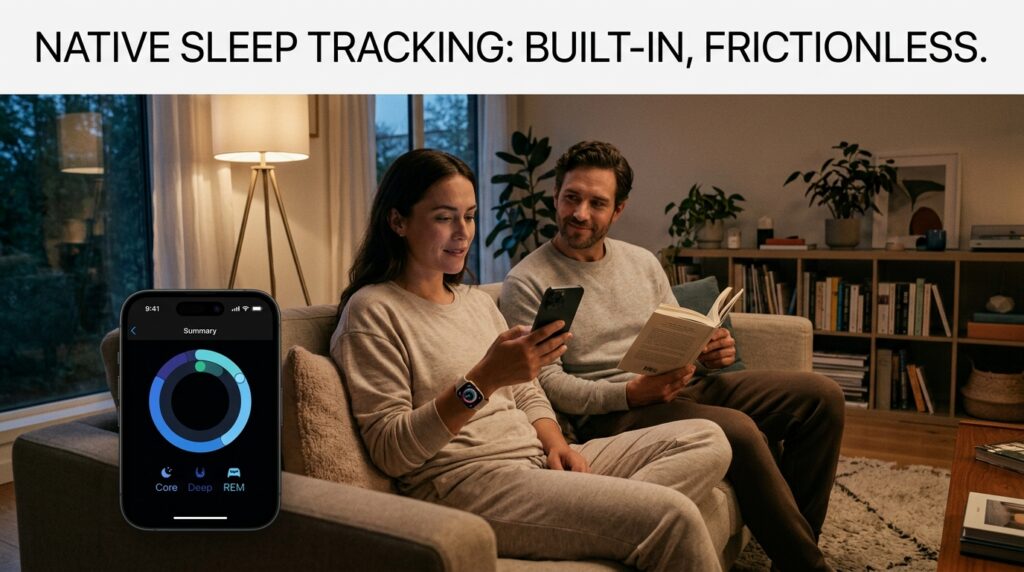
Finally, it is worth mentioning the tool that comes pre-installed on every modern iPhone. Over the last few iOS updates, Apple has completely overhauled its native sleep tracking capabilities, and it deserves serious recognition.
If you don’t want to pay for a subscription or deal with third-party interfaces, the built-in Sleep app is incredibly solid. It seamlessly sets up “Wind Down” shortcuts on your phone, automatically dims your screen, hides your incoming notifications, and uses your Apple Watch to accurately track your Core, Deep, and REM sleep stages. It is the perfect, entirely frictionless entry point for anyone looking to start monitoring their rest without downloading a single new piece of software.
Final Thoughts on Protecting Your Rest
For a very long time, I treated sleep as an annoying biological hurdle. It was just a frustrating blank space that stood in the way of getting more things done.
But once I started looking at the daily graphs, the lifestyle correlations, and the hard data provided by these mobile apps, my mindset shifted entirely. Sleep is not a passive state of doing nothing; it is an active, intensely busy state of biological repair. It is when your brain cleans out toxins, processes memories, and repairs cellular damage.
If you want to be sharper, happier, more patient, and more resilient in your waking life, you have to fiercely protect your sleeping life.
You don’t need to live in the dark about what happens when you close your eyes. Download one of these apps tonight. Place your phone on your nightstand, follow the prompts, and let the software map the hidden journey your brain takes every single night. The insights you gain tomorrow morning might just change the entire trajectory of your day.
