
Let me be completely honest with you about the graveyard of my good intentions.
If you were to look through my apartment a few years ago, you would have found the physical evidence of a dozen abandoned identities. There was the expensive acoustic guitar gathering dust in the corner. There was the stack of thick, untouched classic literature on my nightstand. In the kitchen, a high-end blender sat quietly, a monument to the week I decided I was going to be the kind of person who drank kale smoothies at 6:00 AM.
I was an absolute master at starting new habits. I loved the rush of the first day. I would buy the gear, download the premium software, and ride a massive wave of motivation. But inevitably, day seven or eight would roll around. I would be tired from a long day at work. It would be raining outside. My brain would whisper, “It’s fine, you can just skip today. You’ll pick it back up tomorrow.”
But tomorrow never came. A missed day turned into a missed week, and soon the guitar was just a piece of furniture again.
I blamed myself. I thought I was fundamentally flawed, lacking the iron-clad discipline that successful people seemed to possess. It wasn’t until I started studying behavioral psychology that the hard truth hit me: relying on willpower is a losing game. Willpower is like a battery; it drains every time you make a decision, deal with stress, or resist a temptation. By 7:00 PM, your willpower battery is dead.
You don’t need more willpower. You need infrastructure. You need systems that hold you accountable when your motivation is completely empty.
Since my smartphone was the one thing I carried with me 24/7, I decided to turn it from a distraction machine into my personal accountability partner. I spent years testing dozens of trackers, discarding the ones that were too complicated or too rigid.
If you are tired of the endless cycle of starting and stopping, you are not broken; your system is. Here are the 8 apps that finally helped me build better habits and make them stick.
1. Streaks: The Power of Not Breaking the Chain
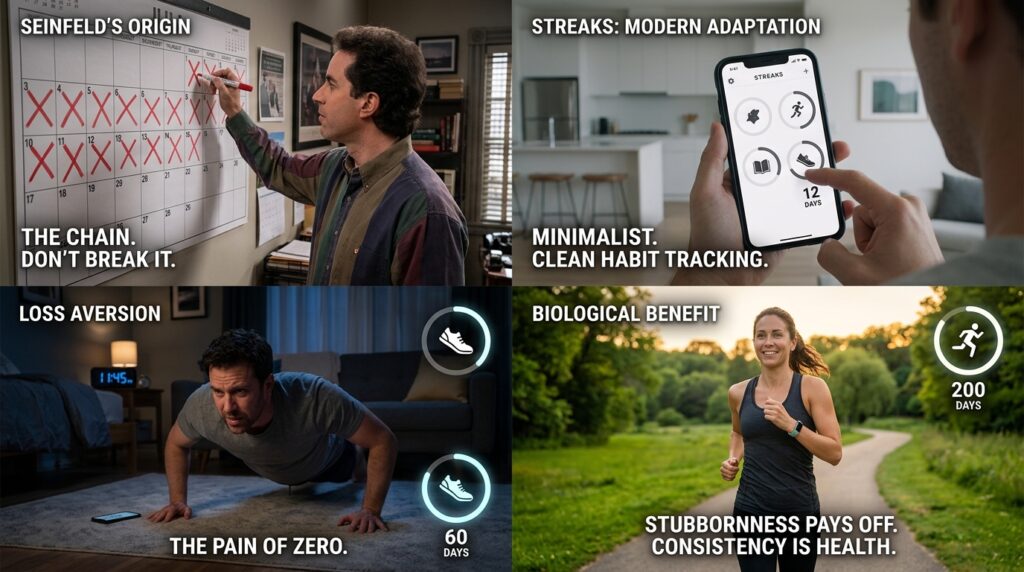
The comedian Jerry Seinfeld famously attributed his writing success to a massive wall calendar. Every day he wrote a joke, he put a big red “X” over that day. After a few days, he had a chain. His only rule was: Don’t break the chain.
The app Streaks is the beautiful, modern, digital equivalent of Seinfeld’s red marker.
It is designed with an aggressive minimalism that I absolutely love. You get a clean screen with up to six circular icons representing your core daily habits. Did you read for twenty minutes? Tap the book icon. The circle fills in, and your streak goes up to 12 days.
The psychology behind this is called “loss aversion.” Humans hate losing things we have built. Once you get a streak up to 30 or 40 days, the thought of letting that circle reset to zero is physically painful. I have literally dragged myself out of bed at 11:45 PM to do ten pushups on the living room rug, simply because I refused to let my 60-day exercise streak die. It leverages your own stubbornness for your biological benefit.
2. Habitica: Gamifying the Boring Stuff
Let’s face reality: washing the dishes, flossing your teeth, and drinking enough water are deeply boring activities. They provide zero immediate dopamine to your brain.
Habitica asks a wild question: What if doing your laundry earned you a virtual broadsword?
This app turns your real life into an 8-bit Role-Playing Game (RPG). You create a little pixelated avatar. Your real-world habits become your “quests.” Every time I remember to take my vitamins or finish a work project, I check it off in the app, and my character earns gold coins and experience points. I can use that gold to buy virtual armor, pets, or magical skills.
It sounds ridiculous for an adult to care about a digital pet dragon, but it works flawlessly. Furthermore, you can join a “party” with other real users to fight boss monsters. If you skip your daily habits, the monster damages your real-life friends. The peer pressure is a phenomenal motivator.
3. Forest: Breaking the Habit of Distraction
Sometimes, building a good habit is secondary to breaking a terrible one.
My worst habit was the doom-scroll. I would sit down to write, encounter a difficult paragraph, and instantly pick up my phone to check social media. An hour would vanish. When I was figuring out (How I Reduce Distractions Using Mobile Apps), Forest was my absolute gateway drug to deep focus.
Forest is a timer, but it comes with a catch. When you want to focus, you open the app and plant a virtual seed. You set the timer for 45 minutes. If you leave your phone alone, the seed grows into a beautiful digital tree. But if you exit the app to check Twitter or answer a text, your tree instantly withers and dies, leaving a dead, brown stump on your screen.
It manufactures immediate, visual guilt. The simple friction of not wanting to kill my little digital pine tree was enough to stop my thumb from mindlessly opening Instagram. Over time, you grow a lush forest representing hours of unbroken, highly productive habits.
4. Fabulous: The Behavioral Science Coach
If you are the kind of person who tries to change ten things about your life on the same day, you need Fabulous.
Developed in Duke University’s Behavioral Economics Lab, Fabulous understands that the human nervous system rejects massive, sudden changes. Instead, it focuses on building “journeys.”
When you first download it, the app will not let you set a goal to run a marathon. Instead, your only goal for the first three days is to drink a glass of water when you wake up. That is it. Once you prove you can do that, it celebrates your victory and adds a second tiny habit—like eating a healthy breakfast.
It teaches you “habit stacking,” a concept where you tie a new habit to an existing one. This concept is foundational to (How I Built a Productive Daily Routine Using Apps). Fabulous acts less like a tracker and more like a gentle, patient life coach slowly rewiring your basal ganglia.
5. Loop Habit Tracker: The Data Nerd’s Dream
Many habit apps are bloated with social feeds, premium subscriptions, and unnecessary notifications. Loop is the exact opposite.
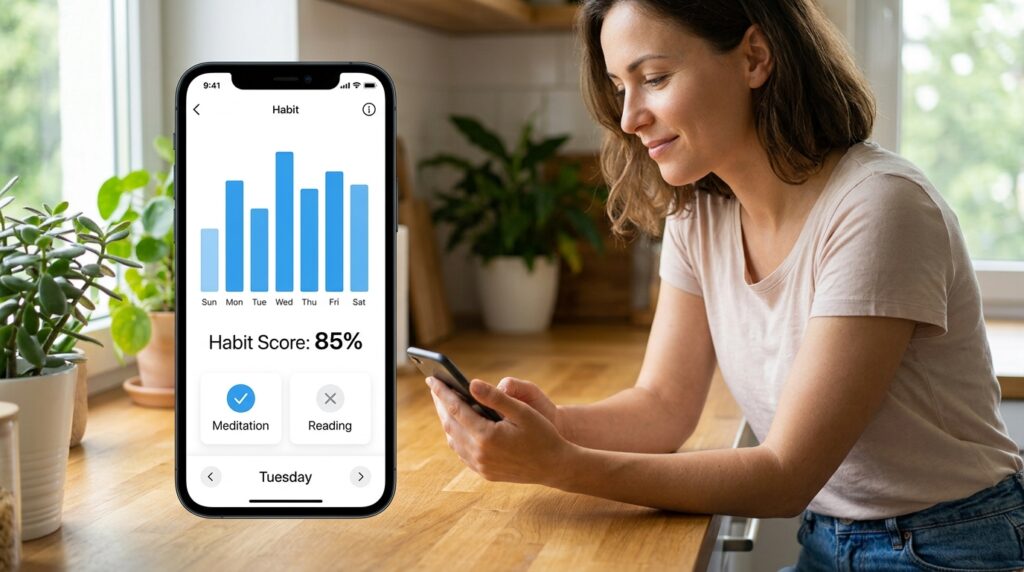
It is an open-source, completely free app for Android that focuses entirely on clean, beautiful data. You input your habits, and it provides you with stunning, detailed graphs of your long-term performance.
What I love about Loop is its “Habit Score” algorithm. Unlike Streaks, where missing one day drops you to zero, Loop calculates the overall strength of your habit. If you have been running every day for a year and you miss one Tuesday because you have the flu, your score only drops a tiny fraction. It is incredibly forgiving of the realities of human life. It teaches you that consistency is about the long-term trendline, not a demand for robotic perfection.
6. Beeminder: Putting Your Money Where Your Mouth Is
If gentle encouragement and virtual trees aren’t enough to get you off the couch, it might be time for the nuclear option.
Beeminder is an app that literally charges your credit card if you fail to complete your habits. You connect the app to your other data sources (like your Fitbit, Duolingo, or a manual entry). It draws a “Yellow Brick Road” on a graph. As long as your data points stay on the road, you are safe.
If you get lazy and derail from the road, Beeminder charges you five dollars. If you fail again, it charges you ten. Then thirty.
I wanted to learn to code for years but kept putting it off. I hooked Beeminder up to my coding lessons. Let me tell you, the sheer panic of potentially losing my hard-earned cash cured my procrastination instantly. It is brutal, it is stressful, but if you have a high-stakes habit you absolutely must lock in, there is nothing more effective.
7. Day One: The Keystone Habit of Reflection
We rarely fail at habits for the reasons we think we do. We think we skipped the gym because we are lazy, but the truth is usually that we skipped the gym because we slept poorly, had an argument with our boss, or ate a terrible lunch that spiked our blood sugar.
To build good habits, you have to become a detective of your own behavior. Day One is the premier journaling app, and it became my keystone habit.
Every evening, I spend exactly five minutes writing down what went well and what went wrong that day. It isn’t a dear-diary emotional dump; it is an objective audit. I realized through journaling that I always skipped my evening reading habit on days I drank alcohol. Once I saw the data clearly written out, I was able to adjust the systemic issue. You cannot fix a behavioral leak if you don’t track where the water is going.
8. Strides: The Architect of Versatility
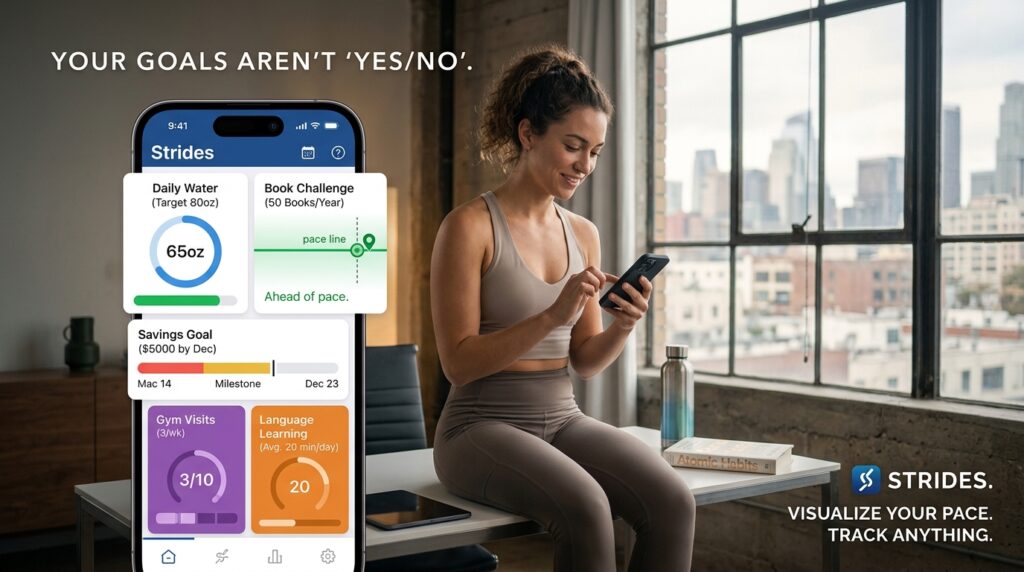
Not all habits are built the same. Reading ten pages of a book is a “Yes or No” habit. But drinking 80 ounces of water is an “Average” habit. Saving $5,000 by December is a “Target” milestone.
Most apps force all your habits into the same “Yes/No” checkbox format. Strides is the only app I’ve found that perfectly accommodates the complex geometry of a real human life.
When you set up a goal in Strides, you choose the specific metric. It then creates a color-coded dashboard with a “pace line.” If you are trying to read 50 books in a year, it calculates exactly where you should be today. If you are ahead of pace, the dashboard is green. If you fall behind, it turns red. If you want a deep dive into the psychology of this visual pacing, I previously wrote about (How to Stay Motivated With Habit Tracker Apps). Strides is the ultimate command center for anyone managing a diverse portfolio of life goals.
Final Thoughts on Designing Your Life
The most dangerous lie we are taught about success is that it requires a monumental, superhuman effort. We see the author with a published book, or the athlete crossing the finish line, and we assume they possess some magical inner fire that we lack.
They don’t. They just have better systems.
A book is just the result of the boring, unsexy habit of writing 500 words a day. A marathon is just the result of lacing up your shoes four mornings a week, even when it is raining. Excellence is not an act; it is a habit.
Your smartphone is a tool. You can use it to numb your brain with endless scrolling, or you can use it to build the architectural scaffolding of the life you actually want to live.
Don’t download all eight of these apps today. Pick one. Identify the single, smallest habit that would make your day marginally better—drinking a glass of water, walking for ten minutes, reading a single page—and track it. Let the software hold your hand while you build the neural pathways.
Once that first habit clicks into place, and you realize that you actually can trust yourself to follow through, the entire world opens up.
