
If you had told me five years ago that I would be writing a passionate defense of a digital meditation tool, I probably would have laughed until my sides hurt.
For most of my adult life, I firmly belonged to the camp of the deeply skeptical. When I pictured meditation, my brain immediately conjured up a very specific, stereotypical image. I imagined people sitting cross-legged on expensive silk cushions in dimly lit rooms, surrounded by clouds of patchouli incense, trying desperately to levitate through sheer force of will.
I considered myself a practical, pragmatic person. I liked spreadsheets, strong black coffee, and measurable results. My daily routine was a chaotic blur of deadlines, meetings, and endless to-do lists. To me, sitting completely still and doing absolutely nothing for ten minutes didn’t just feel boring; it felt like an irresponsible waste of highly valuable, billable time.
Why would I sit and breathe when there were a hundred emails in my inbox waiting for a response?
But here is the harsh reality that nobody tells you about running your engine at one hundred miles per hour all day, every day: eventually, the engine catches fire. And when my personal engine finally overheated, it forced me to completely reevaluate my prejudices and look for a lifeline in the most unexpected of places.
The Breaking Point and the Background Hum
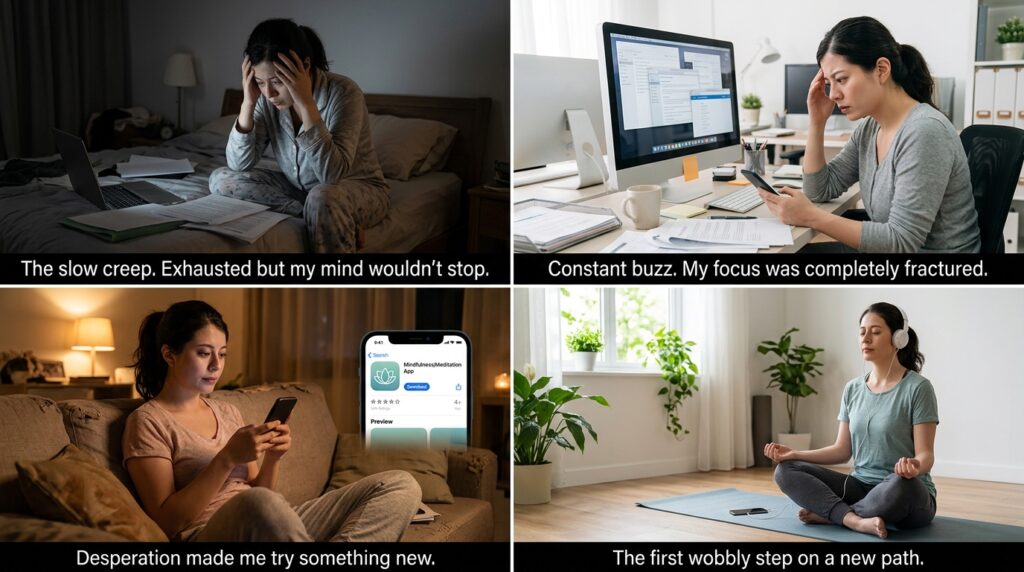
My descent into burnout wasn’t a sudden crash. It was a slow, insidious creep.
It started with my sleep. I would lie in bed staring at the ceiling, my heart beating at an uncomfortably fast rhythm, while my brain played a highlight reel of everything I had done wrong that day and everything I had to do tomorrow. I was physically exhausted, but my nervous system was stuck in overdrive.
During the day, I developed a constant, low-grade sense of panic. It was like a refrigerator humming in the background of a quiet room; you get so used to the noise that you stop registering it, but it’s always there, subtly grating on your nerves. I found myself snapping at my friends over minor inconveniences. I couldn’t watch a movie without simultaneously scrolling through my phone. My attention span had fractured into tiny, unusable splinters.
I knew I needed to make a change, but I didn’t know where to start. Therapy felt too expensive and time-consuming to set up. A vacation wasn’t possible with my workload.
One evening, while mindlessly browsing the app store looking for a distraction, I stumbled upon a highly-rated meditation app. The reviews were filled with people claiming it had cured their anxiety and changed their lives. I rolled my eyes, feeling that familiar wave of skepticism wash over me. But desperation is a funny thing. It makes you willing to try things you would normally dismiss.
I downloaded the app, figuring I had nothing to lose but a few megabytes of storage space. If you are currently in that exact same head space and wondering where to even begin, I highly recommend checking out some foundational tips in this guide on (How to Use Mindfulness Apps to Reduce Stress). For me, downloading it was the first wobbly step on a very long staircase.
The Agony of the First Three Minutes
The very next morning, I decided to give it a try. I sat on the edge of my bed, closed my eyes, and tapped play on the “Beginner Basics” course.
I fully expected to be greeted by soothing pan flutes and a gentle voice telling me to imagine a white light washing over my body. Instead, the voice that came through my headphones was remarkably normal. It sounded like a calm, intelligent teacher.
The instructions were deceptively simple: “Pay attention to the physical sensation of your breath. When your mind wanders, notice that it has wandered, and gently bring your attention back to the breath.”
“Easy enough,” I thought.
I took a deep breath. I felt the air hit my nostrils. I felt my chest expand. Wow, I’m meditating, I thought to myself. I’m naturally great at this.
Then, about four seconds later, a thought popped up. Did I leave the coffee maker on? Then another. I need to reply to Sarah’s email before noon. Then another. My left knee feels a little weird today. Is it raining? I should check the weather app.
Suddenly, I realized I hadn’t thought about my breath in over a minute. I felt a massive surge of frustration. I mentally scolded myself. You can’t even sit still for three minutes without failing! What is wrong with you?
Those first three minutes were absolute agony. When the timer finally chimed, indicating the end of the session, I opened my eyes feeling more stressed than when I started. I was convinced that my brain was simply too broken, too fast, and too chaotic for mindfulness. I was ready to delete the app and never look back.
The Paradigm Shift That Kept Me Going
But I didn’t delete it. Mostly because I had accidentally paid for an annual subscription and my stubbornness refused to let the money go to waste.
I tried again the next day. And the next. For the first two weeks, it felt like a chore. It felt like doing mental push-ups in a brain that was entirely out of shape.
The real turning point—the moment that fundamentally shifted my entire relationship with meditation—happened during a session in week three.
I was sitting on my living room floor, and my mind was racing out of control. I was thinking about a stressful project at work, and I was getting physically tense. I was just about to open my eyes and quit the session early in frustration, when the instructor’s voice came through the audio.
“You might be feeling frustrated right now,” the voice said, almost as if he were watching me through the screen. “You might feel like you are failing because your mind keeps wandering. But the moment you notice that your mind has wandered—that precise moment of waking up and realizing you are lost in thought—that is the meditation. That is the bicep curl for your brain. You are not failing. You are doing it perfectly.”
I literally gasped.
It was a complete paradigm shift. For my entire life, I thought the goal of meditation was to clear the mind completely, to achieve a state of blank emptiness. But that is physiologically impossible. The brain is an organ designed to produce thoughts, just like the heart is designed to pump blood. You cannot force it to stop.
The goal wasn’t to stop thinking. The goal was simply to notice that I was thinking, rather than being dragged away by the thoughts without realizing it. Every time I got distracted and brought my focus back, I was scoring a point. I wasn’t failing; I was succeeding.
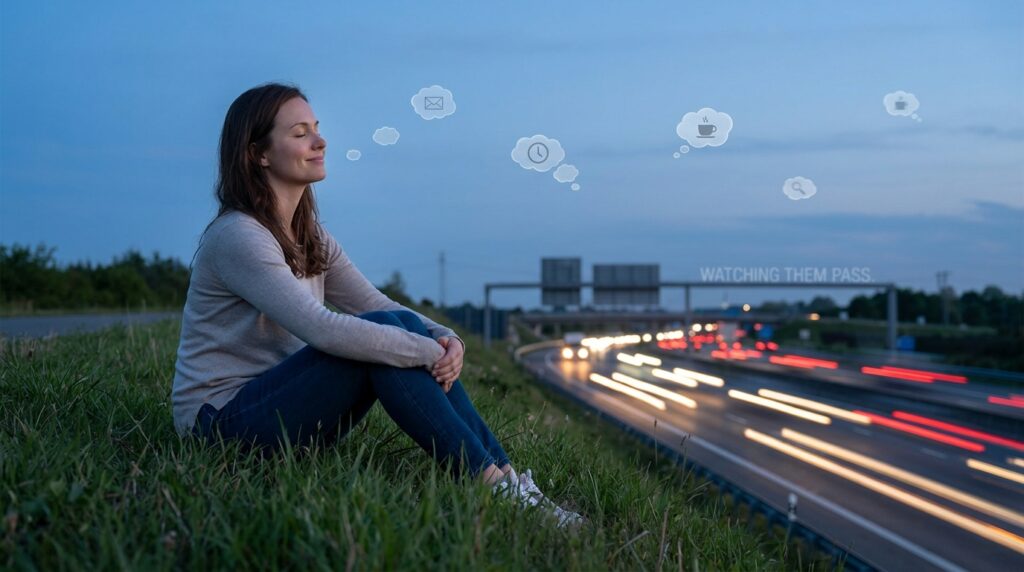
Once I removed the pressure of trying to achieve a “perfect” blank mind, the entire experience changed. I stopped fighting my thoughts and started simply watching them pass by, like cars on a busy highway.
Exploring the Unexpected Toolkits
As I grew more comfortable with the basic daily practices, I started exploring the deeper layers of the application. I realized it wasn’t just a timer with a voiceover; it was a comprehensive library of cognitive tools.
One evening, after a particularly brutal day of back-to-back meetings, I felt that familiar tight knot in my chest. I opened the app, not wanting to do a full ten-minute sit, and discovered a section dedicated to “SOS” emergencies.
These were short, two-minute audio clips designed specifically for acute moments of panic or overwhelming stress. I tapped one labeled “Overwhelmed.” The instructor guided me through a rapid grounding exercise, forcing me to focus on the physical sensation of my feet on the floor and the sounds in the room. It didn’t solve my work problems, but it dramatically lowered my heart rate and allowed me to approach the rest of my evening with a clear head.
I also stumbled upon features that completely optimized my workflow. If you are someone who struggles with productivity, you might be surprised by the crossover between mindfulness and work. I highly recommend reading about the (Hidden Features in Meditation Apps That Improve Focus), because discovering the “Focus” soundscapes in this app was a revelation for me.
Instead of listening to distracting music while I worked, I started playing the app’s ambient, looping audio tracks—like distant rainfall or rhythmic hums. Combining these specific sound frequencies with the mental discipline I was building during my morning sits turned me into a remarkably focused writer. My ability to sit at my desk and resist the urge to check social media skyrocketed.
The Real-World Impact: The Space Between Action and Reaction
The true test of any lifestyle change isn’t how you feel while you are doing it; it’s how it affects you when you are not doing it.
About three months into my daily app usage, the real-world benefits began to manifest in ways I never anticipated.
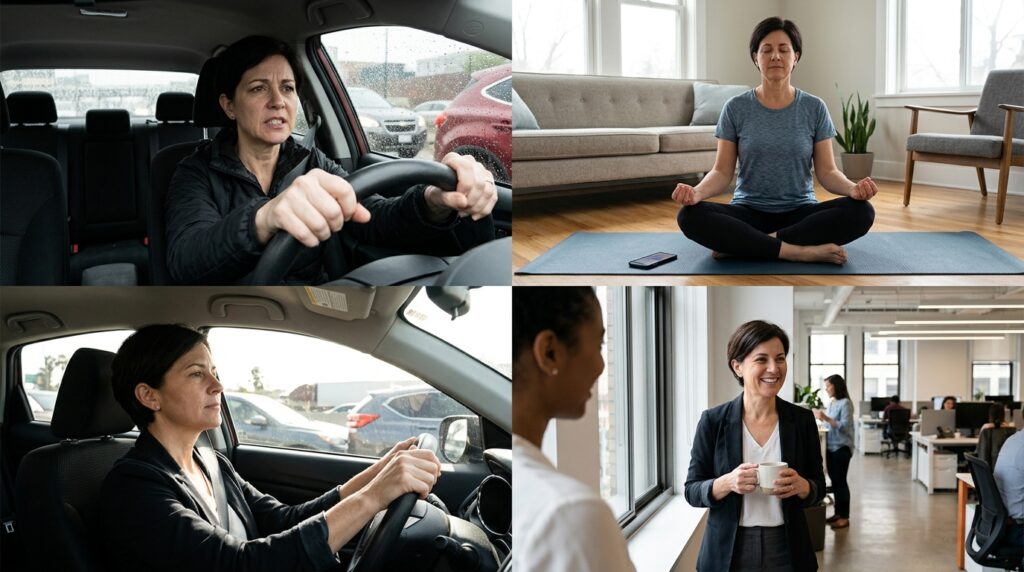
I live in a city with famously aggressive traffic. Someone cutting me off on the highway used to ruin my morning. I would grip the steering wheel, my blood pressure would spike, and I would carry that angry, defensive energy into my first meeting of the day.
One Tuesday, a car aggressively swerved into my lane without signaling, forcing me to slam on the brakes. The familiar rush of adrenaline hit my chest. My mouth opened to shout something colorful.
But then, something incredible happened.
In the fraction of a second between feeling the anger and reacting to the anger, there was a tiny, imperceptible pause. It was a micro-second of awareness. In that tiny gap, a thought drifted through my mind: Oh, look. I am experiencing anger right now. My chest is tight.
Because I had spent the last ninety days practicing how to observe my thoughts without immediately identifying with them, I was able to observe my own road rage as a third-party spectator.
I took a deep breath. I relaxed my grip on the steering wheel. I exhaled. And the anger just… dissolved. It washed over me and disappeared. I didn’t yell. I didn’t carry it with me to the office. I just kept driving, completely at peace.
That was the moment I realized the app had literally rewired my brain’s default pathways. It had given me the superpower of a “pause button” in real life. It taught me the difference between reacting blindly to my emotions and choosing how to respond to them.
Final Thoughts on Embracing the Pause
I am now on a 400-day continuous streak inside this app. It is the very first thing I do when I wake up, before I look at a screen, before I check my email, before I even pour my coffee.
I am still a pragmatic person. I still love spreadsheets and measurable results. But I now understand that the most valuable asset I possess isn’t my time; it’s my attention. If my attention is scattered, anxious, and reactionary, all the time management hacks in the world won’t save me.
This little piece of software sitting on my home screen didn’t magically solve all my life’s problems. I still get stressed. I still have bad days. But it gave me a toolkit to navigate the chaos with grace. It taught me how to step out of the rushing river of my own anxiety and watch the water flow by from the safety of the riverbank.
If you are a skeptic, if you think you are too busy, or if you believe your brain is simply too loud for mindfulness, I challenge you to test that assumption. The benefits are profound, which is exactly (Why I Recommend This Mindfulness App to Everyone I Know).
You don’t need a silk cushion. You don’t need to burn incense. You just need a smartphone, a quiet corner, and the willingness to be terrible at sitting still for three minutes a day. The peace of mind waiting for you on the other side of that initial frustration is worth more than you could ever imagine.
