
If you want to understand the exact mechanics of human delusion, look no further than someone downloading a habit tracker app on a Sunday night.
I used to be the world’s leading expert at this. I would lie in bed, staring at my phone, completely overwhelmed by a sudden, intense desire to reinvent my entire life. I would open the app store, download a sleek, highly-rated habit tracker, and immediately begin programming my new, flawless existence.
I would add “Wake up at 5:00 AM.” Then, “Drink a gallon of water.” Next, “Run three miles,” followed by “Read fifty pages,” “Meditate for twenty minutes,” and “Learn French.”
By the time I fell asleep, I was convinced that the software was going to magically transform me into a highly productive, superhuman monk.
Monday would go reasonably well. Tuesday would be a struggle. By Thursday, I would be exhausted from a long day at the office. At 9:00 PM, my phone would buzz, presenting me with a terrifying list of twelve uncompleted tasks. The red notification badges stared back at me, silently judging my lack of discipline. Overwhelmed with guilt, I wouldn’t just skip a habit; I would delete the app entirely.
I was stuck in a brutal cycle of extreme aspiration followed by inevitable burnout. I blamed myself. I assumed I just didn’t have the inherent willpower that successful people possessed.
It took me years of trial and error to realize a profound truth: Motivation is not a personality trait; it is a temporary emotion. You cannot build a sustainable life on a foundation of fleeting feelings. If you want to change your behavior, you don’t need more motivation. You need a better system.
Your smartphone can be the ultimate accountability partner, but only if you know how to use the software correctly. If you are tired of watching your own ambitions fizzle out after three days, here is exactly how to stay motivated with habit tracker apps, avoiding the common traps that set us up for failure.
Rule 1: The “Embarrassingly Small” Protocol
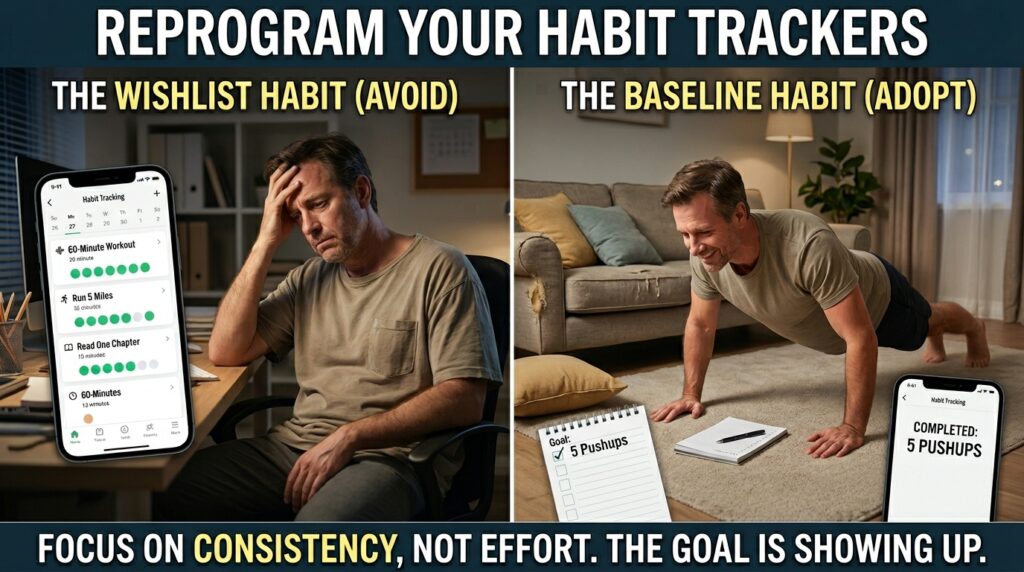
The biggest mistake we make with habit trackers is treating them like a wishlist instead of a baseline.
When you add a habit to your app, you should not program it for your absolute best day. You must program it for your absolute worst day. You have to ask yourself: Can I still do this if I am exhausted, if I have a headache, or if I am stuck at work until 8:00 PM?
Instead of setting a goal to “Workout for an hour,” set a goal to “Do five pushups.” Instead of “Read a chapter,” set your tracker to “Read one single page.”
The goal here is not to build massive muscles or finish a novel in a week. The goal is to build the identity of someone who shows up every single day. When I finally cracked the code on (How I Track My Progress and Stay Motivated Every Day), the secret was lowering the barrier to entry so drastically that failing felt more difficult than succeeding.
Once you open the book to read one page, you will usually read ten. Once you get on the floor to do five pushups, you will probably do twenty. The friction is always in the starting. Use your habit tracker to track the start, not the marathon.
Rule 2: Harness the Power of Loss Aversion
Human beings are wired with a psychological quirk called “loss aversion.” Biologically, the pain of losing something we have is roughly twice as powerful as the joy of gaining something new.
Habit trackers use a brilliant user interface trick to hack this biological quirk: The Streak.
Whether you use an app like Streaks, Everyday, or Habitify, they all rely on building a visual chain. Every day you complete your task, the chain gets longer. A circle fills in. A bar graph rises.
For the first few days, you won’t care. But once that streak hits 14, 20, or 30 days, a massive psychological shift occurs. You have built something of value. You have invested your time and energy into that unbroken line of green checkmarks.
I have literally dragged myself out of bed at 11:45 PM, stood in the dark kitchen, and chugged a glass of water simply because my app notified me that my 45-day hydration streak was about to die. I didn’t care about the water; I cared about the chain. I was deeply invested in protecting the data.
When your internal motivation is completely empty, the stubborn refusal to break your digital streak will drag you across the finish line.
Rule 3: Visual Proof Changes Your Identity
We often fail at our goals because we view them as chores. “I have to go for a run” feels like a punishment.
The true power of logging your data into a smartphone app is that it provides objective, undeniable proof of your changing identity. You stop being “someone who is trying to exercise” and you become “an athlete.”
When you open a beautifully designed app and look at a calendar covered in completed habits spanning six months, your brain cannot argue with the reality of the situation. The data proves that you are a consistent, disciplined person.
This visual feedback loop is critical. We often forget our own progress because human memory is incredibly flawed. We focus on the one day we messed up and forget the twenty days we succeeded. This is why curating a specific set of tools is vital, a journey I highlighted when I discussed (8 Apps That Helped Me Build Better Habits). A good app acts as an objective historian, reminding you of your own competence when you are feeling discouraged.
Rule 4: The “Never Miss Twice” Forgiveness Clause
This is the rule that will save your sanity.
If you track a habit for 60 days, and then you get the flu and miss a day, your streak will break. The app will reset your counter to zero. For many people, this is a fatal blow. They feel so demoralized by seeing the zero that they abandon the habit entirely, convinced that all their previous work was ruined.
You must internalize the “Never Miss Twice” rule.
Missing one day is an anomaly. It is just a blip on the radar of a busy human life. Missing two days in a row is the beginning of a new, negative habit.
If your streak breaks, do not panic. Do not delete the app. Accept that the perfect streak is dead, forgive yourself immediately, and focus entirely on making sure tomorrow is a success.
Some of the best habit trackers (like Loop Habit Tracker on Android) actually use a “Habit Score” instead of a strict streak. If you perform a habit consistently for months and miss one Tuesday, your score only drops a fraction of a percent. It calculates your overall trend line rather than demanding robotic perfection. Find an app that forgives you, or learn to forgive the app.

Rule 5: Gamify the Boring Stuff
Let’s be honest: flossing your teeth, taking your vitamins, and clearing out your email inbox are fundamentally boring activities. They provide absolutely zero immediate dopamine to your brain, which is why we avoid them.
Video games, on the other hand, are engineered by psychologists to provide constant, satisfying hits of dopamine through leveling up, earning points, and unlocking rewards.
You can use apps to apply this exact video game psychology to your boring real-life chores.
Apps like Habitica turn your daily routines into an 8-bit Role-Playing Game. You create a tiny digital avatar. Your real-world habits become your “quests.” When I finally finish writing a difficult report or remember to drink my protein shake, I check the box in the app. My little character earns virtual gold coins and experience points. I can use that gold to buy a new virtual sword or a pet dragon.
It sounds entirely ridiculous for a grown adult to care about a pixelated sword, but it works flawlessly. Our brains are hardwired to love immediate rewards. By linking a boring physical task to an immediate digital reward, you short-circuit your own procrastination.
Even better, Habitica lets you form “parties” with your real-life friends. If you skip your habits, your character takes damage—and so do your friends’ characters. The social accountability is immense. You will find yourself doing the dishes at midnight just so you don’t hurt your friend’s digital health points.
Rule 6: Anchor Your App Notifications
A habit tracker is useless if you only remember to open it once a week. You need the app to trigger your behavior at the exact right moment.
However, setting random alarms throughout the day is a terrible strategy. If an alarm goes off at 2:00 PM telling you to “Stretch,” but you are in the middle of a client meeting, you are going to swipe the notification away and forget about it.
You must practice “Habit Stacking.” This means tying your new digital habit to an existing physical anchor in your daily routine.
For example, you already brush your teeth every single morning. That is an unbreakable anchor. Set your habit tracker to send you a push notification to “Read two pages” at the exact time you are usually finishing up in the bathroom.
When establishing the workflows I outlined in (How I Use Habit Tracker Apps to Stay Consistent), I realized the notification shouldn’t be a generic alarm; it should be highly contextual. I set my app to notify me to “Log Expenses” the moment I connect to my car’s Bluetooth after leaving the grocery store.
By tying the digital reminder to a physical location or an existing routine, you dramatically increase the odds that you will actually follow through.

Final Thoughts on Engineering Your Environment
We put far too much pressure on ourselves to be spontaneously excellent. We consume motivational content, read self-help books, and pray for a sudden burst of energy that will transform our lives.
But excellence is not an act; it is a habit. It is the boring, unsexy, invisible work of showing up and doing the tiny things correctly, day after day.
Your smartphone is a neutral tool. If you let algorithms control it, it will steal your attention and derail your life. But if you take control of it, it becomes the ultimate architectural scaffolding for the person you want to become.
Do not download a tracker today and add twenty new goals. Download one app. Add one single, embarrassingly small habit. Drink a glass of water. Read a page. Walk around the block. Tap the circle on your screen, watch the color fill in, and let the software handle the heavy lifting of keeping you accountable.
Over time, those tiny daily taps will compound into a mountain of undeniable progress.
