
A few years ago, I fell for the ultimate fitness trap. I was scrolling through social media, feeling sluggish and out of shape, when I saw a fitness influencer selling his “Ultimate Muscle Building Blueprint” as a downloadable PDF. He looked incredible, so I blindly assumed his routine would make me look incredible, too.
I paid fifty dollars, downloaded the spreadsheet, and walked into my local gym on a Monday evening feeling highly motivated.
The motivation lasted exactly forty-five minutes.
The routine required me to do complex Olympic lifts I had never attempted, perform six different exercises per muscle group, and commit to being in the gym six days a week for two hours at a time. I was a full-time professional with a commute, a family, and an achy lower back. By Thursday, I was so physically destroyed and mentally exhausted that I skipped the gym entirely. I didn’t go back for two months.
I felt like a failure. But the truth was, I hadn’t failed the routine; the routine had failed me.
The fundamental problem with generic fitness plans—whether they are from a magazine, a YouTube video, or an influencer’s PDF—is that they are not built for you. They do not know that you have a bad left knee, that you only have thirty-five minutes to work out before your kids wake up, or that you only have access to a pair of adjustable dumbbells in your garage.
Fitness is not a one-size-fits-all endeavor. To actually see results, you need a routine that perfectly contours to the specific realities of your daily life.
This is where the supercomputer in your pocket completely changes the game. Modern fitness applications are no longer just glorified stopwatches. They are highly adaptable, algorithm-driven personal trainers that can help you design a completely custom regimen. If you are tired of trying to force your life to fit a generic workout plan, here is exactly how I use fitness apps to build a personalized routine that actually sticks.
Step 1: Honest Data Input (The Discovery Phase)
You cannot build a personalized routine if you lie to yourself about your current capabilities and your available resources. The very first step of using a modern fitness app is feeding it the raw, honest data of your life.
When I first started experimenting with digital routines, I bounced between a dozen different platforms, an exhausting journey I documented in I Tried 5 Fitness Apps — Only One Kept Me Motivated. What I learned was that the smartest apps on the market—like Fitbod or BodBot—start with a deep-dive interrogation.
When you download the app, do not skip the onboarding questionnaire.
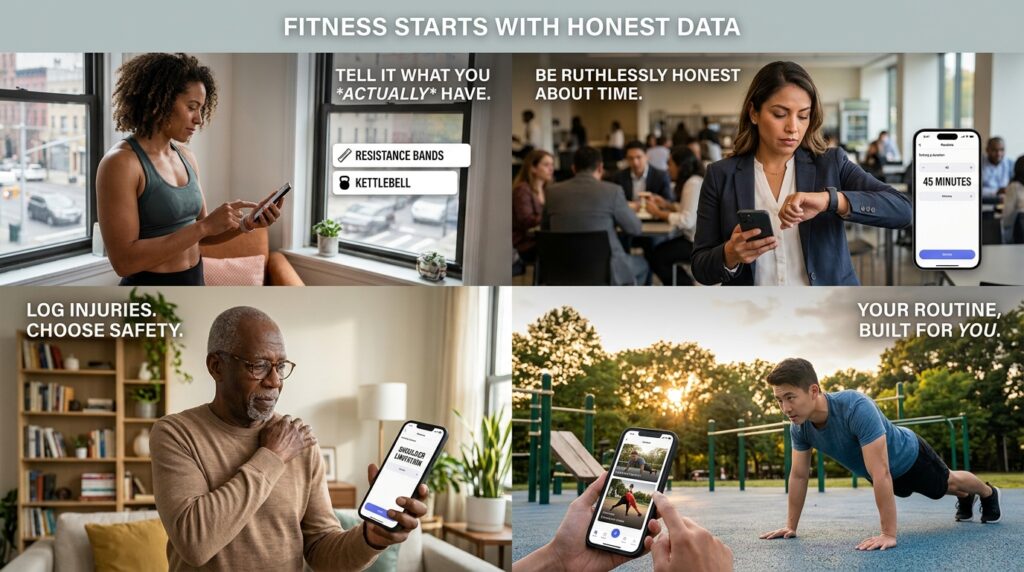
First, tell the app exactly what equipment you have. If you work out in a massive commercial gym, select everything. But if you are in a tiny apartment, tell the app you only have resistance bands, a kettlebell, and your own body weight.
Next, be ruthlessly honest about your time constraints. If you tell the app you want to work out for ninety minutes, but you know deep down you only have forty minutes on your lunch break, you are setting yourself up to quit. I set my app to generate workouts that last exactly 45 minutes, warm-up included.
Finally, log your physical limitations. If you have a shoulder impingement or a bad lower back, input that into the software. The app’s algorithm will immediately filter out heavy barbell back squats or overhead presses, replacing them with joint-friendly alternatives. By inputting this data, you have instantly created a safer, more realistic starting point than any generic internet PDF could ever provide.
Step 2: Choosing Your “Engine” Based on Your Experience Level
To build a personalized routine, you have to select an app that matches your current knowledge of fitness. I divide fitness apps into two main categories: “The Brains” and “The Notebooks.”
The Brains (Algorithmic Generators): If you are a complete beginner and have no idea what a superset is or how to pair muscle groups, you need an app that does the thinking for you. Apps like Fitbod, Freeletics, or Nike Training Club are perfect for this. You just press a button, and the AI generates a balanced workout for the day based on what muscles are rested and what equipment you have available. It takes the terrifying guesswork out of walking onto the gym floor.
The Notebooks (Blank Slate Trackers): If you already have a basic understanding of strength training but want to build your own highly customized splits, you need a blank slate. I eventually graduated to apps like Strong and Hevy. These apps don’t tell you what to do; they just provide a beautifully clean, frictionless interface for you to build your own routine from their massive exercise libraries.
I use Hevy to build my custom “Push/Pull/Legs” split. I drag and drop my favorite exercises, set my target rest timers, and save it as a template. When I walk into the gym, I just tap “Start Routine” and the app guides me through the exact workflow I designed for myself.
Step 3: Integrating the Routine With Your Reality
A personalized routine is completely useless if it exists in a vacuum. A workout routine has to be integrated into your actual, chaotic daily schedule.
One of the biggest breakthroughs I had was treating my workouts like non-negotiable medical appointments. Once my fitness app generated my ideal three-day-a-week routine, I had to anchor it to my calendar.
I opened my Google Calendar and looked at my week. I found three 45-minute windows—Tuesday morning, Thursday evening, and Saturday afternoon. I created recurring calendar blocks called “Gym” and set them to “Busy.”
If a friend asks me to grab drinks on Thursday evening, I look at my calendar and say, “I can’t do 5:30 PM, I have an appointment. Can we do 7:00 PM?”
I do not rely on motivation. I rely on the structure I built. Your fitness app tells you what to do, but your calendar dictates when you do it. If you struggle to balance the intense data of heart rates and calorie burns with your actual life schedule, simplifying your approach is vital. This is exactly what I focused on when writing Tips for Tracking Your Fitness Without Feeling Overwhelmed. Anchor the habit to a specific time, and the data will take care of itself.
Step 4: The Magic of Progressive Overload Tracking
Here is the absolute, undeniable biological secret to changing your body: Progressive Overload.
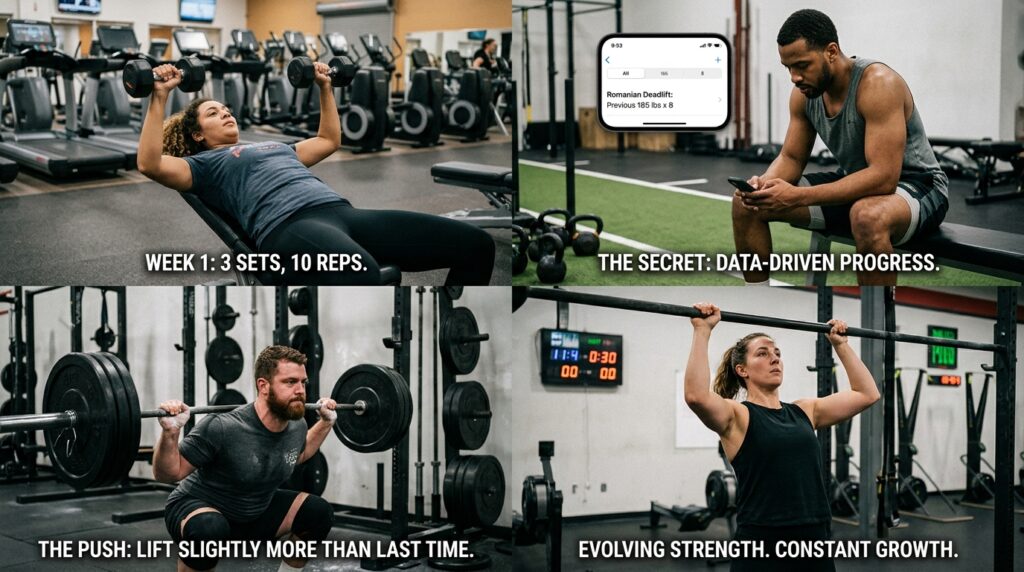
Your body is an incredibly adaptive machine. If you do three sets of ten pushups every single week for a year, your chest will stop growing after the second week. Your body has adapted to that specific stress, and it has no reason to expend energy building new muscle. To see continuous results, you have to force your body to do just a tiny bit more than it did last time.
Tracking progressive overload in your head is impossible. When you are tired, out of breath, and sweating, you will not accurately remember if you lifted 40-pound dumbbells or 45-pound dumbbells last Tuesday.
This is why a personalized app routine is so powerful.
When I open my routine in the gym, the app looks at my first exercise—let’s say, Romanian Deadlifts. Right underneath the title, the app displays a critical piece of data: Previous: 185 lbs x 8 reps.
That single line of text dictates my entire strategy. I know, mathematically, that to force my body to adapt, I either need to lift 190 pounds for 8 reps, or I need to lift 185 pounds for 9 reps. The app removes all the emotion, laziness, and guesswork from the equation. It forces me to constantly push my own personal boundary, ensuring that the routine is always evolving alongside my strength.
Step 5: Iteration and the “Swap” Feature
A truly personalized routine is a living document. It should never be static.
Sometimes, you will build a routine, walk into the gym, and realize that a specific exercise just feels terrible. Maybe barbell bench presses hurt your shoulders, or maybe Bulgarian split squats make your knees ache. In the past, if a generic PDF routine told you to do an exercise that caused you pain, you either pushed through the pain (risking injury) or quit the routine entirely.
Modern fitness apps have a feature that I use constantly: the “Swap Exercise” button.
If my app tells me it is time to do barbell bench presses, but my left shoulder is feeling weird that day, I simply tap “Swap.” The app instantly brings up a list of alternative exercises that target the exact same muscle group but use different mechanics. I select “Dumbbell Floor Press” instead.
I still get a fantastic chest workout, I protect my joints, and my routine remains perfectly intact. The ability to pivot and adapt your routine in real-time on the gym floor is the ultimate luxury of digital fitness tracking. It empowers you to listen to your body rather than blindly following a rigid script.
Step 6: Tracking the Micro-Wins to Protect the Habit
When you build a personalized routine, the initial excitement will eventually wear off. Around week four, the workouts will start to feel like work. The mirror won’t show massive, immediate changes, and the temptation to sleep in will be intense.
To make your routine stick permanently, you have to use your app to track micro-wins.
We often define fitness success purely by the scale or the mirror. These are “lagging indicators.” They take months to show movement. If you only focus on lagging indicators, you will get demoted and quit.
Instead, I use my apps to focus on “leading indicators.” A leading indicator is a metric I can control today. Did I show up? Did I lift five more pounds than last week? Did I complete my three scheduled workouts?
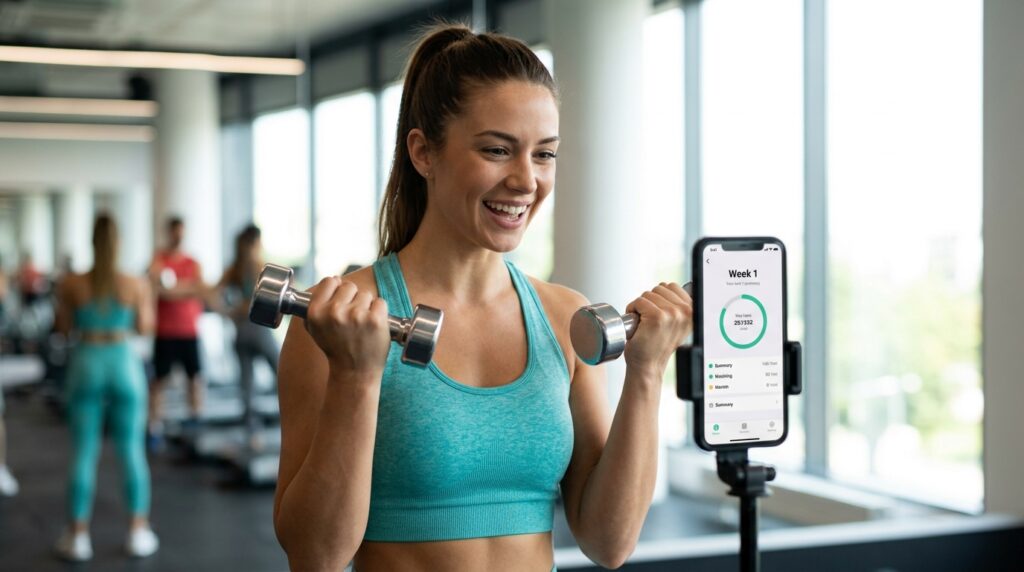
My app provides a beautiful visual chart of my workout consistency. When I see that I have successfully completed 12 workouts in a row over the last month, it builds a massive sense of internal pride. Building a long-term habit requires visualizing this momentum, a psychological strategy I leaned into heavily when explaining How I Track My Progress and Stay Motivated Every Day. I am no longer just “trying to get in shape.” The data in the app proves that I am a consistent, dedicated athlete.
Final Thoughts on Becoming Your Own Coach
We live in a culture that loves to overcomplicate fitness. We are bombarded with conflicting information about optimal heart rate zones, fast-twitch muscle fibers, anabolic windows, and hyper-specific dietary protocols. It is enough to make anyone want to throw their hands up and stay on the couch.
But at its core, fitness is incredibly simple. It is just the act of showing up, applying a measured amount of physical stress to your body, recovering, and then doing it again slightly harder next time.
You do not need to pay an expensive personal trainer, and you certainly do not need to buy a generic, punishing PDF from an Instagram influencer.
Your smartphone has all the tools you need to become your own coach. Take twenty minutes today to download a reputable tracking app. Input your honest equipment limitations, define your available time, and let the software build a baseline.
Once you have that baseline, treat it like a science experiment. Track your numbers, swap out the things that hurt, and slowly mold the routine until it fits perfectly into the contours of your daily life. When your workout routine is built exclusively for you, the friction disappears, the consistency locks in, and the results finally, inevitably, follow.
