
We were sitting at a crowded, brightly lit tapas restaurant in Copacabana, surrounded by laughing friends and empty plates. It was a beautiful Friday night. But as the waiter approached our table carrying the little leather booklet with the bill, my stomach instantly dropped.
I pulled my smartphone out of my pocket under the table.
I opened my primary personal finance app, held my breath, and waited for the dashboard to load. A giant, bright red pie chart aggressively filled the screen, informing me that I had already blown past my “Dining Out” budget for the month. My heart rate spiked. I paid my share of the bill, but the rest of my evening was completely ruined by a lingering cloud of financial guilt.
For years, this was my exact relationship with money management software.
I downloaded these tools because I wanted to feel in control of my life. I wanted peace of mind. Instead, the apps became a source of constant, low-grade terror. They were digital taskmasters that yelled at me every time I bought a cup of coffee. I felt like I was constantly failing a test I hadn’t studied for.
One Sunday morning, sitting quietly at my kitchen island with a notebook and a cup of black coffee, I realized the problem wasn’t the software. The problem was my setup.
I was letting the apps dictate my emotions rather than using them as passive, helpful tools. I decided to completely overhaul my digital environment. I needed a system that kept me informed without sending me into a panic spiral.
If opening your banking or budgeting app makes you want to throw your phone into the ocean, you are doing it wrong. Here are the practical, real-world tricks to use finance apps without the crushing stress.
1. Silence the Real-Time Notification Nightmare
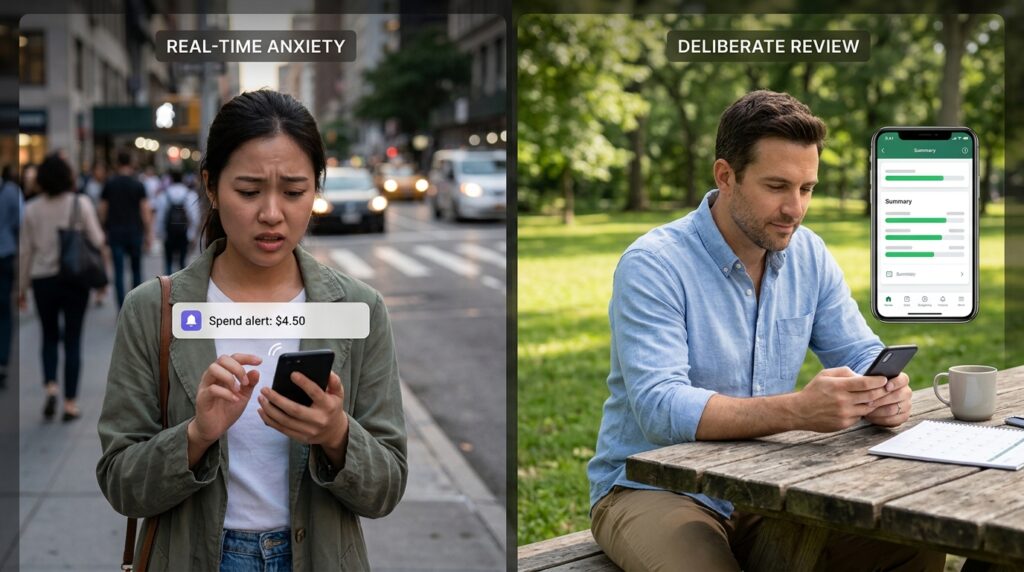
The absolute worst thing you can do for your financial anxiety is allow your money apps to send you real-time push notifications.
When I first downloaded my budgeting tracker, I left all the default settings on. Every single time I swiped my debit card at the pharmacy or paid for a bus ticket, my phone would immediately buzz. A banner would drop down from the top of the screen: “You spent $4.50 at the Transit Authority. You have $42 left in Transportation.”
It felt like someone was tapping me on the shoulder all day long, constantly reminding me that my money was draining away. It created a scarcity mindset.
I went into my smartphone’s settings and ruthlessly disabled every single push notification for my finance apps. No banners, no sounds, no badges.
If there is actual suspected fraud, my physical bank will text me. But I do not need my budgeting app interrupting a walk in the park to tell me a $12 recurring Netflix subscription just hit my account. Silencing this noise was the first crucial step in my journey, a boundary I explored heavily when breaking down 6 Apps That Help Me Track My Finances Without Stress You dictate when you look at your money; the app doesn’t dictate it for you.
2. Transition to the “Weekly Money Date”
Because my phone was no longer buzzing every time I spent a dollar, I had to create a new routine for checking my accounts.
In the past, I would obsessively open my finance apps three or four times a day. I would check it while waiting in line at the grocery store, or while sitting in traffic. This is highly toxic behavior. Your net worth and your budget do not change fast enough to warrant daily monitoring. Checking it constantly just breeds anxiety.
I changed the background of my financial life. I moved it from the chaotic, stressful environment of my daily commute to the quiet, peaceful environment of my living room couch.
I instituted the “Weekly Money Date.”
Every Sunday evening, I sit on my couch, pour a glass of wine or make a cup of tea, and put on some soft background music. I open my finance app intentionally. I spend exactly fifteen minutes reviewing my transactions for the week, making sure everything is categorized correctly, and looking at what bills are coming up.
By tying the administrative chore of money management to a relaxing physical environment, I completely rewired my brain’s association with the app. It stopped feeling like a punishment and started feeling like a calm, organized ritual.
3. Blur the “Net Worth” Dashboard
Most modern financial apps love to slap a massive, bold number right at the very top of the home screen: Your Total Net Worth.
If you have a mortgage, student loans, or credit card debt, seeing a giant negative number staring you in the face every single time you open the app to simply check your grocery budget is profoundly demoralizing. Even if your investments are doing well, the daily fluctuations of the stock market can make that massive number swing wildly, causing unnecessary emotional whiplash.
You do not need to look at your net worth on a Tuesday afternoon.
Many of the best finance apps have a “Privacy Mode” or a specific toggle that allows you to hide or blur the overarching net worth total. I immediately turned this on.
When I open my app now, the big, scary numbers are hidden behind a blurred graphic. I only unblur it once a month when I am doing a deep dive into my long-term goals. For daily and weekly operations, I only look at the small, manageable numbers: my checking account balance and my weekly spending limits.
4. Create “Slush Fund” Categories
The main reason budgeting apps cause stress is because we set them up to be completely unrealistic.
When I first started, I created a rigid, unforgiving budget. I allotted exactly $50 for gas, $100 for groceries, and $20 for entertainment. If I bought a $4 coffee that wasn’t perfectly accounted for, the app would flash red warnings at me, making me feel like a complete failure.
Human life is inherently unpredictable. You will forget a friend’s birthday and need to buy a last-minute gift. You will get a flat tire. You will have a Tuesday where you are just too tired to cook and need to order takeout.
I removed the stress from my software by intentionally building a “Slush Fund” (or “Buffer”) category into the app.
I allocate $100 a month to a category literally named “Whatever.” When random, unpredictable expenses pop up, I don’t have to break my rigid budget to accommodate them. I just categorize the transaction into the Slush Fund. Learning how to properly pad my categories completely changed my relationship with my money, a strategy I detailed in How to Budget Your Money With a Finance App. It gives the software the flexibility to handle real, messy human life.

5. Shift the Focus from Restrictions to Goals
If you only use a finance app to track the things you can’t buy, you are going to hate opening the app.
It becomes a digital parent telling you “No.”
I decided to completely flip the psychology of the interface. Instead of obsessing over the expense categories (like “Dining Out” or “Clothing”), I moved my Savings Goals to the very top of my dashboard.
I set up visual trackers inside the app for things that actually excited me. I created a goal with a picture of a beach for my upcoming vacation to Bahia. I created another visual goal for a new laptop I wanted to buy.
Now, when I sit down at my desk during my lunch break and open the app, the very first thing I see is a progress bar filling up with green, slowly inching closer to that beach vacation. The app stops being a tool of restriction and becomes a tool of momentum.
When I decide to skip an expensive dinner out, I instantly transfer that money into my vacation goal inside the app. Watching the progress bar jump forward provides a massive dopamine hit. This shift from negative tracking to positive reinforcement was the breakthrough I wrote about in How This Finance App Made Me Understand My Spending Habits. You have to give yourself a reason to be excited about your money.
6. Automate the Tedious Data Entry
Nothing causes app fatigue faster than manual data entry.
Years ago, I used an app that required me to manually type in the date, the merchant name, the category, and the exact dollar amount of every single thing I bought. I would go to the grocery store, buy twenty items, and then sit in my car in the parking lot painstakingly typing the receipt into my phone.
It was exhausting. Eventually, I would fall three days behind, feel completely overwhelmed by the backlog of receipts, and abandon the app entirely.
If your finance app requires manual entry, delete it immediately.
We live in an age of open banking APIs. You need to use an app that securely syncs directly with your bank and credit card providers. My app automatically pulls in every transaction overnight. It automatically categorizes the local supermarket as “Groceries” and the gas station as “Auto.”
During my Weekly Money Date on the couch, my only job is to simply review the list and approve what the software already did. The app acts as my personal assistant, doing all the heavy lifting in the background so I can focus on the big picture.
7. Embrace the “Good Enough” Philosophy
Finally, you have to let go of the idea of mathematical perfection.
For the longest time, if my app showed a balance of $1,050.45, but my actual bank account showed $1,051.00, I would spend an hour furiously clicking through weeks of transactions trying to find that missing fifty-five cents. I would lose sleep over it.
I eventually realized that my time and my mental health were worth significantly more than a few pennies.
If my finance app is off by a dollar or two at the end of the month due to a weird pending transaction or a rounding error, I no longer care. I just hit the “Reconcile” button, let the app make an automatic adjustment to fix the math, and move on with my life.

Final Thoughts: Making the Software Serve You
Later that year, I was sitting on a quiet park bench, enjoying a rare sunny afternoon. My phone was in my pocket. I knew exactly how much money I had, I knew my bills were paid, and I knew my savings goals were growing.
I hadn’t opened my finance app in four days, and I felt absolutely zero anxiety about it.
Finance apps are incredibly powerful tools, but they are just that—tools. They have no moral authority over you. They are not scorecards for your worth as a human being.
If the app you are using is causing you stress, the solution isn’t to work harder at the app. The solution is to change the parameters. Turn off the notifications that make your heart race. Hide the massive numbers that cause you anxiety. Build a slush fund for the unpredictable messiness of daily life, and tie your tracking to goals that actually make you smile.
When you strip away the alarm bells and the rigid restrictions, you are left with a quiet, efficient digital ledger. It stops being a source of fear, and finally becomes the foundation of your financial freedom.
