
For years, I practiced a highly specialized, entirely dysfunctional financial strategy that I liked to call “Schrödinger’s Bank Account.”
The rules were incredibly simple. As long as I actively refused to open my mobile banking app, my balance existed in a state of quantum superposition. I was simultaneously broke and wealthy. If I didn’t look at the numbers, the numbers couldn’t hurt me.
I would go out with friends on a Friday night, tap my debit card with a completely unearned sense of confidence, and then spend the entire weekend experiencing a low-grade, suffocating dread. By Monday morning, opening my bank app required taking a deep breath and bracing myself for impact, peering through half-closed fingers like I was watching a horror movie.
The stress wasn’t just about a lack of money; it was the absolute lack of clarity. I was earning a decent living, but my money felt like sand slipping through my fingers. I was living reactively, paying bills the second they arrived in a panic, and relying entirely on the “hope” method for my savings.
I finally realized that the anxiety wasn’t coming from the act of spending money—it was coming from the dark void of the unknown. To conquer the anxiety, I needed to turn on the lights.
It is amazing what happens to your stress levels when you stop relying on your flawed human memory and start leaning on well-designed software. I knew I had to completely overhaul my digital ecosystem, a realization I documented thoroughly when I wrote about (How This Finance App Made Me Understand My Spending Habits). I needed tools that were deeply intuitive, highly automated, and completely devoid of judgment.
If logging into your bank account makes your heart race, you don’t need to make more money right now. You need a better system. Here are the 6 finance apps that finally helped me track my money without the suffocating stress.
1. YNAB (You Need A Budget): The Philosophy Changer
I have to start with the heavyweight champion of financial peace of mind. YNAB is not just a software application; it is a fundamental rewiring of how your brain processes money.
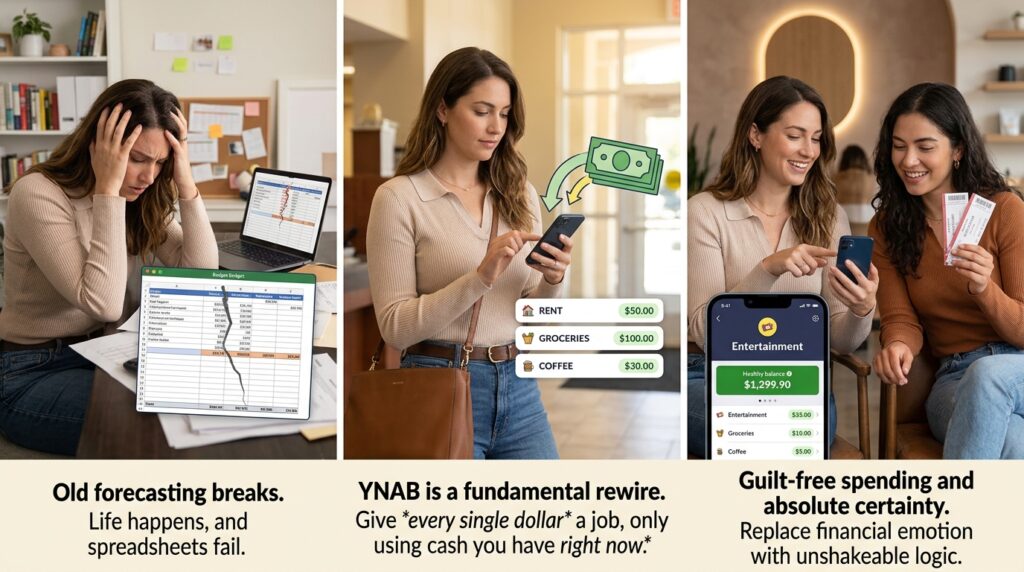
Before YNAB, I tried standard budget templates. I would forecast my month, writing down that I planned to spend $300 on groceries and $150 on dining out. But life doesn’t care about your spreadsheet. A car repair would pop up, I would overspend on a dinner, and my entire spreadsheet would break by the 12th of the month. I would feel like a failure and abandon the budget entirely.
YNAB uses a system called Zero-Based Budgeting, which completely eliminates the stress of forecasting.
The app only allows you to budget the exact dollars sitting in your checking account right this second. You cannot budget money you haven’t earned yet. When I get paid, the app prompts me to give every single dollar a job. Some dollars get the job of paying next week’s rent. Some get the job of buying groceries. And crucially, some get the job of buying guilt-free takeout coffee.
The stress relief comes from absolute certainty. If a friend asks me to go to a concert, I don’t look at my total bank balance and guess if I can afford it. I open YNAB, look at my “Entertainment” category, and see if the money is there. If it is, I buy the ticket with zero guilt. If it isn’t, I move money from a different category, or I decline. YNAB took the emotion out of my spending and replaced it with confident, unshakeable logic.
2. Copilot: The Aesthetic Powerhouse
There is a massive, unspoken truth in the world of personal software: if an app is ugly, clunky, and slow, you are not going to use it.
For a long time, personal finance apps looked like they were designed for accountants in 1998. They were filled with dense grids, aggressive red fonts, and overwhelming data points. Looking at them felt like doing homework.
Copilot changed the game by bringing world-class, premium design to personal finance.
This app is exclusively for iOS and Mac, and it is arguably the most beautiful piece of financial software ever created. It uses smooth animations, gorgeous color palettes, and incredibly intuitive swipe gestures. But beneath the pretty interface is a remarkably powerful artificial intelligence engine.
When you link your accounts, Copilot’s AI automatically categorizes your transactions with frightening accuracy. If it isn’t sure about a purchase, it asks you to confirm it. Over time, the app learns your exact habits. It tracks your recurring subscriptions, monitors your investment portfolios, and provides a daily dashboard that is genuinely a joy to look at.
Checking my finances shifted from a chore into a seamless, satisfying morning habit. If you want to dive deeper into how removing friction helps you stick to your goals, I wrote extensively about this in my guide on (Tricks to Use Finance Apps Without Stress). Copilot proves that when tracking your money feels elegant, the anxiety naturally dissolves.
3. Rocket Money: The Subscription Slayer
We live in the era of the “convenience tax.” Everything is a subscription. We subscribe to streaming services, meal kits, fitness apps, digital newspapers, and premium cloud storage.
Companies rely heavily on human forgetfulness. They know that if they sign you up for a free trial, there is a very high probability you will forget to cancel it, allowing them to quietly siphon $14.99 out of your account every month for eternity.
I used to stress about my bank statements, convinced I was bleeding money to ghost subscriptions, but I never had the time to sit down with a highlighter and hunt them all down.
Rocket Money acts as a highly aggressive digital bouncer for your checking account.
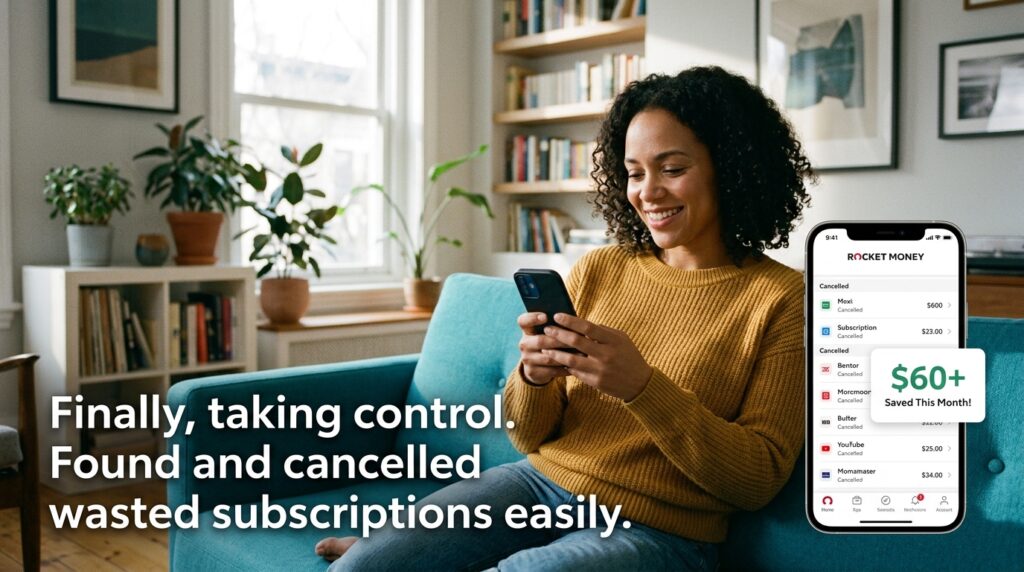
When you connect your bank, the app instantly scans your transaction history and isolates every single recurring charge. It presents you with a comprehensive, categorized list of your subscriptions. The first time I opened it, I was horrified. I was still paying for a specialized yoga app I had downloaded two years prior and a digital magazine I hadn’t read since 2021.
But the best part? Rocket Money has a concierge service. For many of these subscriptions, you don’t even have to navigate the company’s confusing cancellation process. You just tap a button inside Rocket Money, and their team will literally cancel the subscription on your behalf. In one afternoon, I instantly clawed back over $60 a month in wasted expenses, bringing a massive sense of relief to my monthly cash flow.
4. Monarch Money: The Collaborative Command Center
Money is inherently stressful, but managing money with a partner can feel like navigating a minefield blindfolded.
My partner and I used to have constant, low-level friction about our finances. We weren’t arguing about massive purchases; we were stressing over the invisible administrative load. “Did you pay the electric bill?” “How much is left in the vacation fund?” “Are we on track for our savings goal?”
We were trying to manage two separate financial lives through a chaotic mix of text messages and passing comments. We needed a unified command center.
Monarch Money is simply brilliant for couples. It was built from the ground up with household collaboration in mind. We both installed the app and linked our individual accounts, as well as our joint accounts.
We each have our own login, but we share a single, unified dashboard. We can both see our combined net worth, our shared budget categories, and our upcoming bills. We can even comment on specific transactions. If I see a weird charge at a hardware store, I can tag my partner in the app and ask, “Was this you, or is this fraud?”
It completely eradicated the financial miscommunication in our home. We are no longer guarding our own spreadsheets; we are operating as a completely transparent team. The stress of the “money talk” is gone because all the data is already sitting in our pockets.
5. Oportun (formerly Digit): The Invisible Savings Engine
If you are like I was, the concept of “putting money into savings” is highly stressful because it feels like a sacrifice.
Every time I manually transferred $100 from my checking to my savings account, I felt a pang of loss. I would stare at my lower checking balance and immediately start worrying about whether I would have enough to cover a surprise expense later in the week. Because it felt painful, I avoided doing it.
Oportun removes the psychological pain of saving entirely by making the process completely invisible.
The app connects to your checking account and analyzes your income, your upcoming bills, and your daily spending patterns. Once its algorithm understands your specific financial rhythm, it starts quietly siphoning tiny, mathematically safe amounts of money from your checking account into a digital savings vault.
It might pull $2.14 on a Tuesday, $5.60 on a Thursday, and $1.10 on a Sunday. Because the amounts are so incredibly small, you literally never notice the money is gone. Your daily lifestyle does not change.
I set the app up and completely forgot about it for four months. When the transmission in my car suddenly started acting up, I felt the familiar wave of panic wash over me. But then I opened Oportun and found over $600 quietly sitting in my vault. The app had built an emergency fund for me in the background while I was busy living my life. It turns the stress of saving into the joy of a pleasant surprise.
6. Goodbudget: The Digital Envelope System
Before the digital age, a very popular way to manage money was the physical envelope system. You would cash your paycheck, put $300 in a paper envelope labeled “Groceries,” and $100 in an envelope labeled “Gas.” When the envelope was empty, you stopped spending. It was tactile, unyielding, and incredibly effective.
However, carrying around wads of cash today is neither safe nor practical. Goodbudget takes this highly effective psychological system and digitizes it perfectly.
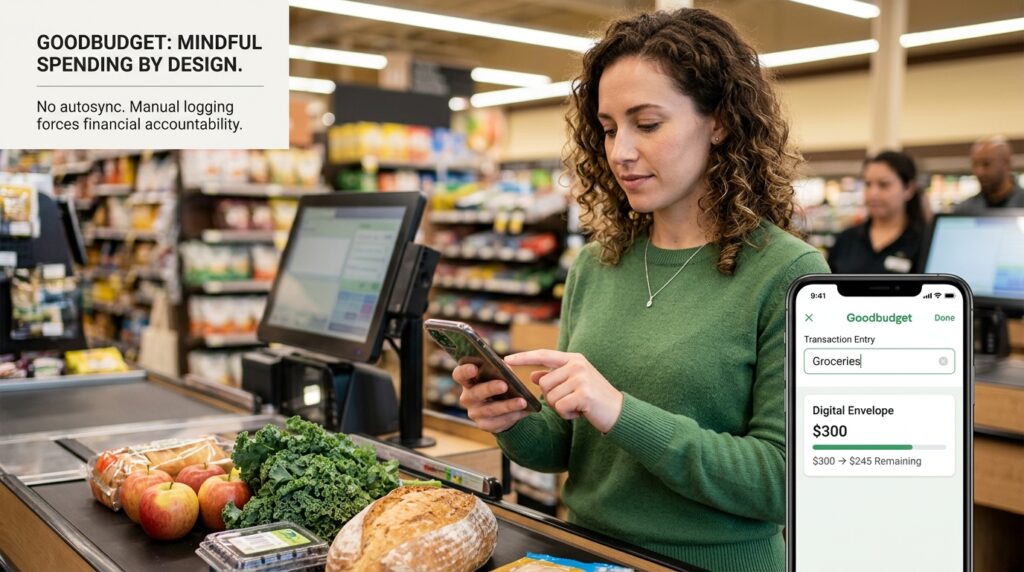
What makes Goodbudget unique—and incredibly low-stress—is that it does not automatically sync to your bank accounts.
For some people, having an app download every single transaction automatically makes them feel detached from their spending. They just swipe their card and ignore the notifications. Goodbudget forces you to be mindful. When you buy groceries, you have to physically open the app and log the transaction, watching the digital “envelope” deplete on your screen.
When my finances were at their absolute tightest, I needed this level of manual friction. Keeping yourself accountable is a massive part of personal growth, an idea I explored thoroughly in (How I Track My Progress and Stay Motivated Every Day). That physical act of typing in the numbers forced me to confront my spending in real-time, pulling me out of autopilot and putting me firmly back in the driver’s seat.
Final Thoughts on Finding Financial Peace
Money is an incredibly emotional subject. It is tied to our sense of security, our ego, and our survival. It is completely normal to feel stressed when things feel out of control.
But you have to remember that your bank balance is not a reflection of your moral character. It is simply data. And right now, you are trying to process thousands of data points using only your memory and willpower. That is an impossible task for a human brain.
You don’t need to be a math genius or a Wall Street accountant to achieve financial peace. You just need to delegate the administrative burden to the right software.
If you are feeling overwhelmed today, do not try to download all six of these apps. Pick just one. If you are terrified of your subscriptions, download Rocket Money. If you want to learn how to budget safely, try YNAB. If you want invisible savings, set up Oportun.
Take one small, digital step toward clarity. The moment you force the data into the light, the monster hiding in the dark completely disappears. You stop being a passive victim of your financial circumstances, and you become the active, confident architect of your own future.
