
There is a very specific flavor of modern panic that happens when you are staring at a blinking cursor on your laptop, your phone is vibrating with three different group chat notifications, you have a meeting in four minutes, and you suddenly realize you forgot to breathe.
I call it the “digital suffocation” moment.
A couple of years ago, I was experiencing these moments multiple times a day. My mind felt like a chaotic browser window with eighty tabs open, and music was autoplaying from one of them, but I couldn’t figure out which one it was. I was physically present at my desk, at the dinner table, and in conversations with my friends, but mentally, I was lightyears away, agonizing over a typo in an email or projecting catastrophic scenarios about the future.
My nervous system was completely fried. I was reactive, irritable, and constantly exhausted.
When friends suggested I try meditation, I would politely smile and change the subject. In my head, I was rolling my eyes. I believed mindfulness was an aesthetic, not a practice. I pictured people sitting on expensive woven cushions in perfectly sunlit rooms, drinking matcha, and pretending they didn’t have deadlines. I was a busy, pragmatic person. I didn’t have time to sit cross-legged and “empty my mind.”
But sheer exhaustion has a funny way of making you open-minded. When my stress began manifesting physically—as a tight band of tension around my chest that never seemed to loosen—I finally gave in.
I downloaded a mindfulness application, fully expecting to hate it. Instead, it fundamentally rewired my brain, saved my sanity, and became the single piece of software I aggressively force upon every person I care about.
Dismantling the “Empty Mind” Myth
The biggest barrier preventing people from trying mindfulness is a fundamental misunderstanding of what it actually is.
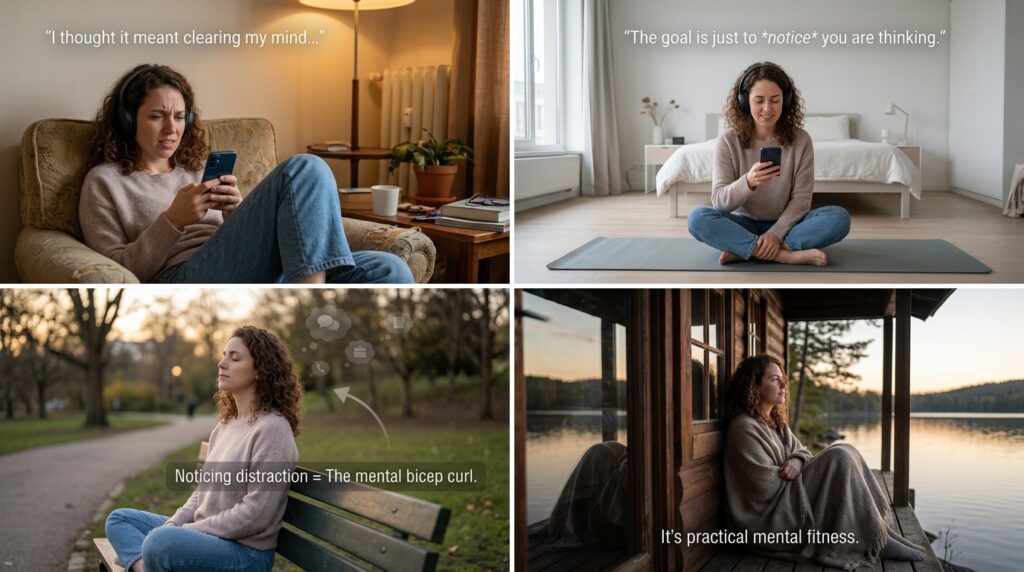
The very first time I opened this app, I braced myself for a soft, whispery voice telling me to float on a cloud and banish all thoughts from my head. I knew I couldn’t do that. My brain is loud. If you tell me not to think about my to-do list, my to-do list will instantly be broadcast in neon letters across my vision.
To my absolute shock, the instructor on the app’s foundational course addressed this immediately.
In a normal, conversational tone, the guide explained: “The goal here is not to clear your mind. You cannot stop your brain from thinking any more than you can stop your heart from beating. The goal is simply to notice that you are thinking, and gently bring your attention back to the present moment.”
That single sentence shattered my entire preconceived notion of meditation.
I wasn’t failing when a random thought about my grocery list popped into my head during a session. According to the app, noticing that distraction was the actual workout. It was the mental equivalent of a bicep curl. Every time my mind wandered and I caught it, I was strengthening my brain’s ability to focus.
This practical, neuroscience-backed approach removed all the mystical pressure. It turned mindfulness from an esoteric spiritual practice into a highly accessible, totally logical mental exercise.
The Magic of the “Micro-Dose”
My second major excuse for avoiding meditation was time. I convinced myself I didn’t have a spare thirty minutes in my day to just sit still.
What makes this specific app so brilliant is its understanding of modern attention spans. It doesn’t demand half an hour of your day. In fact, it actively encourages you to start with just three minutes.
Three minutes is nothing. It is the time it takes to brew a cup of coffee. It is the time you spend waiting for the subway. It is the time you waste scrolling past three videos on social media.
I started sneaking these three-minute “micro-doses” of calm into the chaotic margins of my day. I would sit in my parked car for three minutes before walking into the grocery store. I would lock the bathroom door, put my headphones in, and run a quick breathing exercise before a highly stressful conference call.
These tiny pockets of structured stillness acted like a circuit breaker for my anxiety. They stopped the momentum of my stress before it could spiral out of control. If you are someone who feels entirely overwhelmed by the prospect of sitting still, you absolutely have to explore (How to Use Mindfulness Apps to Reduce Stress) using these micro-sessions. It lowers the barrier to entry so much that you literally have no excuse not to do it.
The “SOS” Feature for Real-World Panic
Life does not happen on a meditation cushion. It happens in infuriating traffic jams, during heated arguments with your spouse, and in the middle of medical waiting rooms.
The feature that truly cemented my loyalty to this app is the emergency “SOS” library.
These are ultra-short, highly targeted audio sessions designed for acute moments of distress. There are specific tracks labeled “Panicking,” “Overwhelmed,” “Frustrated,” and “Losing Your Temper.”
A few months after downloading the app, I received some incredibly upsetting news via email right in the middle of a workday. I felt that familiar hot flush of adrenaline. My breath got shallow, and I was about to fire off a highly emotional, deeply unprofessional reply.
Instead, I grabbed my phone, walked out of the office, and hit the “Panicking” SOS button.
For three minutes, the app guided me through a rapid “box breathing” technique—inhale for four seconds, hold for four, exhale for four, hold for four. It mechanically forced my parasympathetic nervous system to engage. By the time the track ended, my heart rate had plummeted back to normal. The anger hadn’t completely disappeared, but the urgency of the anger was gone. I was able to walk back to my desk and draft a calm, measured response.
That single intervention probably saved my professional reputation. It proved to me that this app wasn’t just a relaxation tool; it was a tactical emotional shield.
Finding Focus in a Distracted World
While stress reduction was what brought me to the app, I was surprised to discover that it was equally effective as a productivity tool.
I work from home, which means I am surrounded by endless distractions. The laundry needs folding, the dog needs walking, and the refrigerator is always calling my name. I used to struggle immensely with “task switching,” jumping from a spreadsheet to a YouTube video to an email draft, never fully concentrating on anything.
I started utilizing the app’s focus-enhancing features, a strategy I delved into deeply when writing about the (Hidden Features in Meditation Apps That Improve Focus).
The app includes a massive library of ambient soundscapes and lo-fi beats specifically engineered by neuroscientists to encourage deep concentration. But it goes beyond just background noise.
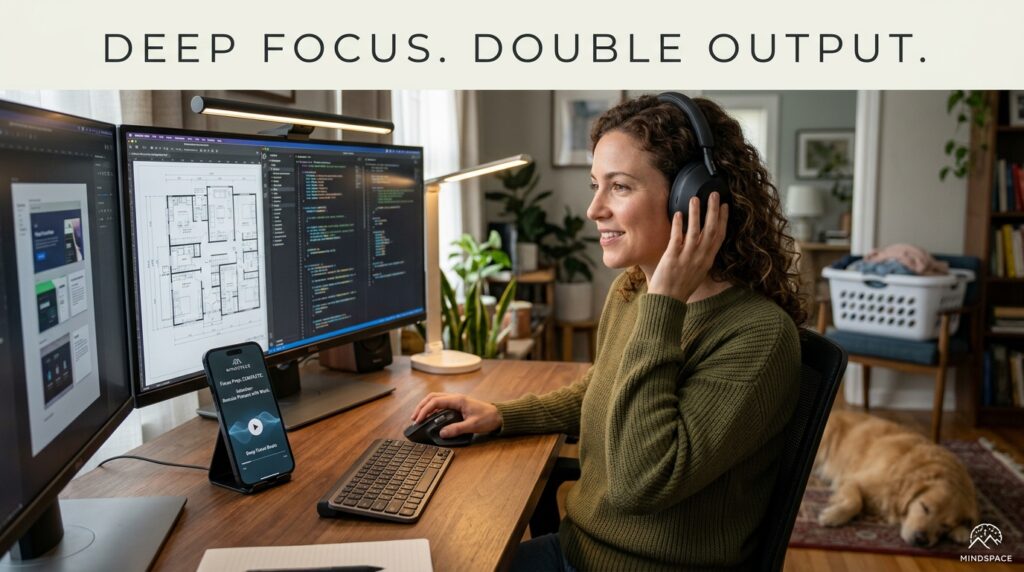
Before I tackle a difficult, cognitively demanding project, I play a specialized “Focus Prep” meditation. It’s a two-minute exercise that asks you to visualize the exact task you are about to do, recognize the distractions that might pull you away, and set a firm intention to remain present with the work.
It creates a psychological boundary. It is a ritual that tells my brain, “We are done scrolling now. We are entering the deep work zone.” This subtle shift in mindset effectively doubled my daily creative output.
Overhauling the Nightly Wind-Down
If my days were chaotic, my nights were a disaster.
I suffered from classic “revenge bedtime procrastination.” Because I felt like I didn’t have any free time during the day, I would stay up until 1:00 AM mindlessly scrolling through the internet, exhausted but unable to turn off my brain. When I finally did turn the lights out, my mind would instantly start replaying awkward conversations from seven years ago.
The sleep section of this mindfulness app entirely cured my insomnia.
I started utilizing their “Sleepcasts”—which are essentially bedtime stories for adults. They aren’t traditional audiobooks, which often have gripping plots that keep you awake to find out what happens next. Instead, they are highly descriptive, non-linear audio journeys.
A narrator with an impossibly soothing voice will describe a sleepy coastal village in the rain, or a slow train ride through the snowy Alps, or an antique shop filled with ticking clocks. The audio is meticulously layered with ambient sound design.
Because the narrative is engaging enough to distract my anxious mind, but boring enough that I don’t actually care how it ends, I rarely make it past the fifteen-minute mark.
I completely overhauled my evenings. The moment I get into bed, the phone screen goes dark, and the sleep audio turns on. This became the anchor of my new schedule, acting as the perfect bookend to the strategies I outlined in (How I Built a Better Morning Routine Using My Phone). You cannot conquer your mornings if you do not surrender to your nights, and this app finally taught me how to surrender.
The Profound Ripple Effect on Relationships
When I try to convince my friends to download this app, I don’t tell them it will make them happier. Happiness is fleeting. I tell them it will make them less reactive.
This is the greatest, most profound gift the app has given me: the pause.
Before I practiced mindfulness, there was zero space between a stimulus and my reaction. If someone cut me off in traffic, I was instantly furious. If my partner made a sarcastic comment, I instantly snapped back. I was a passenger in my own emotional vehicle, completely at the mercy of whatever external event happened to trigger me.
Consistent use of this app stretched that microsecond of time.
Now, when an annoying or stressful event occurs, there is a tiny, perceptible gap. In that gap, I can observe the emotion rising in my chest. I can say to myself, “Oh, I am feeling incredibly defensive right now.”
Because I can observe the emotion without immediately identifying with it, I get to choose my response. I can choose to take a breath and let it go, rather than escalating the argument.
This hasn’t just made my life more peaceful; it has drastically improved my relationships. I am a better, more patient partner. I am a more empathetic friend. I am a vastly more resilient human being.
Making It Stick: The Truth About Streaks
I would be lying if I said I never missed a day. I am human. But the app’s gentle gamification plays a crucial role in keeping me accountable.
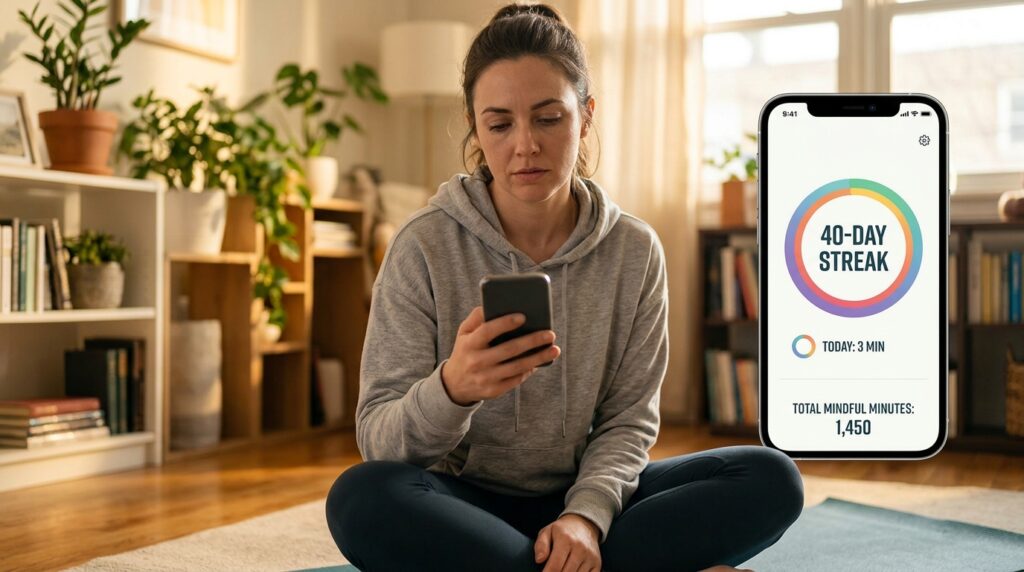
It tracks my “mindful minutes” and my current daily streak. While I usually advocate against apps that use digital guilt to keep you hooked, this app handles it beautifully. If you break a streak, it doesn’t send you a passive-aggressive notification. It simply resets, offering a gentle reminder that every single moment is a new opportunity to start again.
Seeing my total minutes accumulate over the months is incredibly validating. It is concrete, undeniable proof that I am actively investing in my own mental health. On the days when I absolutely do not want to sit and breathe—the days when my anxiety is telling me to just run away and distract myself—seeing that 40-day streak on my screen is usually just enough motivation to make me open the app and sit down for three minutes.
Final Thoughts: The ROI of Stillness
We spend hundreds of dollars on gym memberships, running shoes, and organic food to take care of our physical bodies. We spend thousands on courses, books, and seminars to improve our careers.
Yet, we drastically underinvest in the one tool that interprets our entire reality: our mind.
Your brain dictates how you experience joy, how you process grief, how you connect with others, and how you handle adversity. If the lens of your mind is smeared with anxiety, exhaustion, and reactivity, your entire life will look blurry and chaotic, regardless of how successful you are on paper.
This app is the absolute best return on investment I have ever made.
It isn’t a magic pill. It won’t make your problems disappear. Your boss will still be annoying, traffic will still exist, and life will still throw deeply unfair curveballs at you.
But what this little piece of software will do is hand you a psychological toolkit to navigate that chaos with grace. It will teach you how to step out of the rushing river of your own thoughts and watch the water flow by from the safety of the riverbank.
If you are feeling breathless, overwhelmed, and constantly tethered to the stress of modern life, do yourself a massive favor. Put down your email. Stop scrolling. Download the app, put your headphones in, and just breathe for three minutes. You have absolutely no idea how good you are actually capable of feeling.
