
There was a specific Tuesday evening last year that completely changed how I view the device in my pocket.
I was lying on my couch, feeling a familiar, low-grade sense of exhaustion. I had just closed out of a social media app after what felt like five minutes of scrolling. On a whim, I opened my phone’s digital wellbeing settings to check my actual screen time.
The number staring back at me was an absolute gut punch: 4 hours and 12 minutes.
I hadn’t just spent five minutes on my phone; I had spent the equivalent of a part-time job staring at a glowing rectangle. And the worst part wasn’t the sheer volume of time—it was the profound emptiness I felt afterward. I couldn’t remember a single piece of meaningful information I had consumed during those four hours. It was just a blur of viral videos, angry comment sections, and perfectly curated vacation photos from people I hadn’t spoken to in a decade.
For years, I had been telling myself a very convenient lie: “I just don’t have the time to learn anything new right now.” I told myself I was too busy to read, too overwhelmed to learn a new language, and too tired to pick up coding.
The screen time report destroyed that excuse completely. I had plenty of time. I was just giving it all away to algorithms designed to harvest my attention.
A smartphone is a piece of neutral hardware. It contains more processing power than the computers that guided the Apollo missions to the moon. It has access to the sum total of human knowledge. Yet, we treat it like a digital pacifier.
I decided that night to stage an intervention on my own digital habits. I wasn’t going to throw my phone in the trash—that is impossible in the modern world. Instead, I was going to systematically re-engineer it. I was going to turn my biggest distraction machine into a portable university.
If you feel like your brain is slowly turning to mush from endless scrolling, you have the power to change the channel. Here is the step-by-step guide on how I completely transformed my smartphone into a powerful, frictionless learning tool.
Step 1: The Home Screen Audit (Evicting the Squatters)
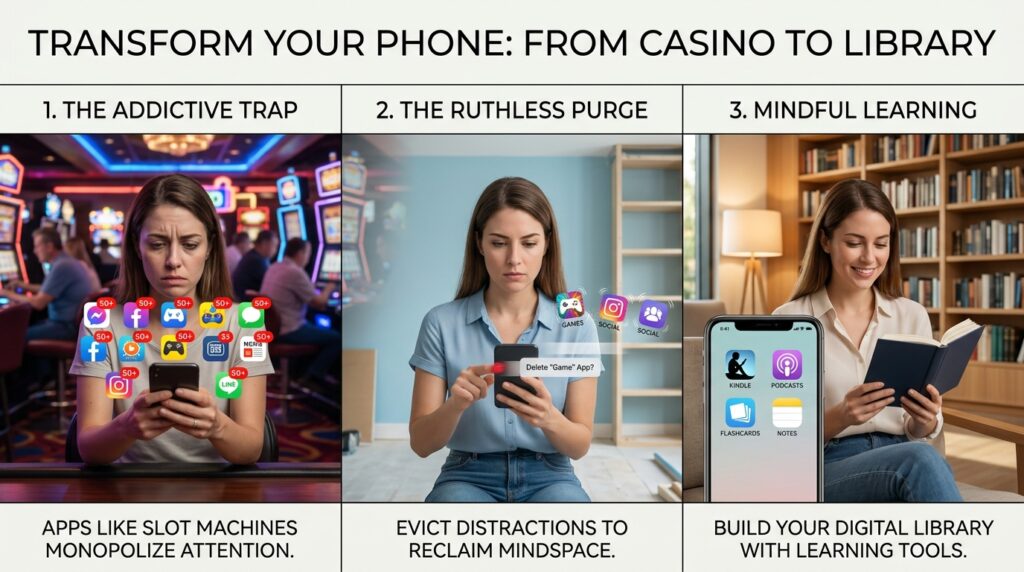
You cannot build a library inside a casino.
Before you can turn your phone into a learning tool, you have to ruthlessly evict the apps that are currently monopolizing your attention. Think about your home screen as the most valuable digital real estate in your life. Whatever sits on that first page dictates your daily behavior.
My first page used to be littered with social media icons, news aggregators, and mindless mobile games. Every time I unlocked my phone to check the weather, those bright red notification badges would scream for my attention.
I initiated a massive digital purge. I didn’t delete my social media accounts, but I deleted the apps from my phone. If I wanted to check Instagram or Twitter, I forced myself to log in through the mobile browser. It sounds like a tiny inconvenience, but that extra five seconds of friction was enough to break the automatic, zombie-like habit of opening the apps fifty times a day.
With the slot machines gone, I rebuilt my home screen. I populated the first page exclusively with tools that would feed my brain. I moved my Kindle app, my podcast player, my flashcard apps, and my digital notebook to the center of the screen.
Now, when I unlock my phone out of sheer boredom, the path of least resistance leads me straight to a book or an educational audio track instead of a social media feed.
Step 2: Weaponizing “Dead Time”
One of the greatest myths about learning as an adult is that you need massive, uninterrupted blocks of time to do it. We tell ourselves that if we can’t find two quiet hours to sit at a desk with a textbook, there is no point in trying.
This mindset completely ignores the reality of modern life. Your day is filled with microscopic pockets of “dead time.”
Think about it. You wait seven minutes in line at the coffee shop. You sit for twelve minutes on the train. You spend ten minutes waiting for a meeting to start. You wait fifteen minutes for your pasta water to boil.
Historically, I used this dead time to play mindless games or scroll through my feeds. Once I restructured my phone, I started using this time for “Micro-Learning.”
I downloaded apps specifically designed for short-burst education. Instead of playing Candy Crush in the grocery store checkout line, I opened an app called Drops and learned five new Spanish vocabulary words. While waiting for a friend at a restaurant, I opened Blinkist and read the core insights of a 300-page non-fiction book summarized in just fifteen minutes.
If you want to dive deeper into these specialized platforms, I compiled a master list of (10 Apps That Make Learning New Skills Easier) to help you get started. When you start harvesting these tiny, five-minute pockets of dead time, they compound rapidly. You can easily accumulate an hour of high-quality learning every single day without ever feeling like you sacrificed your free time.
Step 3: The Audio University (Learning While Living)
There are large chunks of our day where our hands and eyes are busy, but our brains are completely disengaged.
Driving to work. Folding the laundry. Walking the dog. Doing the dishes. These are mundane, physical tasks that require very little cognitive effort.
I decided to transform my daily commute and my household chores into an audio university. I invested in a comfortable pair of wireless earbuds and made a rule: I am not allowed to do household chores in silence or while watching television. I must be listening to something educational.
I curated my podcast app with surgical precision. I subscribed to shows that broke down complex historical events, interviewed leading neuroscientists, and explained the mechanics of the global economy. I downloaded the Audible app and started churning through biographies of historical figures and books on behavioral psychology.
The transformation was astonishing. I actually started looking forward to doing the dishes, because it meant I got thirty minutes of uninterrupted time to listen to a brilliant author explain the universe. I was absorbing the equivalent of a college curriculum every single month, simply by changing the audio track of my daily chores.
Step 4: Building a “Second Brain”
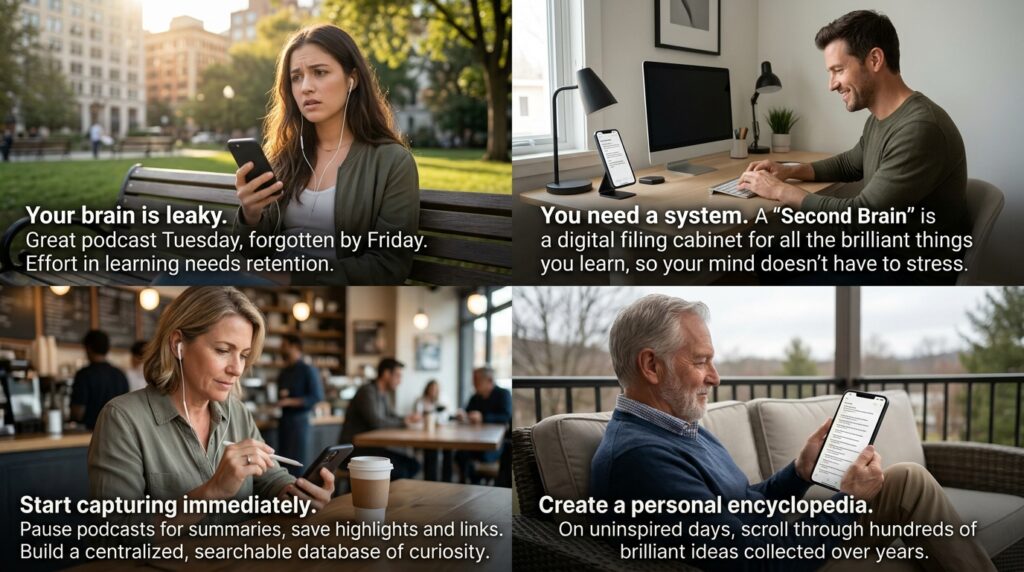
When you start turning your phone into a learning tool, you are going to encounter a frustrating problem very quickly: human memory is incredibly leaky.
You will listen to a mind-blowing podcast on a Tuesday, and by Friday, you won’t be able to remember the core concept. You will read a profound quote in an eBook, highlight it, and then completely forget it exists.
If you are going to put the effort into consuming high-quality information, you need a system to retain it. You need a “Second Brain.”
A second brain is simply a digital filing cabinet where you store all the brilliant things you learn so your actual brain doesn’t have to stress about remembering them.
I downloaded a powerful note-taking app and put it right on my phone’s dock. Whenever I heard a fascinating statistic on a podcast, I would pause the audio, open my notes app, and type a quick summary. Whenever I read a great article, I would copy the link and paste it into a specific folder labeled “To Read Later.”
Capturing these fleeting thoughts is critical, a workflow I perfected when exploring (Apps That Help Me Take Notes and Organize Ideas Quickly). By building a centralized, searchable database of my own curiosity, I created a personal encyclopedia. On days when I feel uninspired, I simply open my notes app and scroll through hundreds of brilliant ideas I have collected over the years.
Step 5: Gamifying the Hard Stuff
There are some subjects that are notoriously difficult to learn because they require rote memorization and intense repetition. Things like learning the syntax of a new programming language, or memorizing human anatomy, or studying for a professional certification.
In the past, this meant hauling around stacks of index cards and boring yourself to tears.
Your smartphone allows you to hack this process through gamification. The human brain loves to play. It loves earning points, maintaining streaks, and seeing a visual representation of progress.
To memorize complex information, I downloaded an app called Anki. It is a digital flashcard app that uses a spaced repetition algorithm. Instead of showing you the same flashcards every day, it analyzes your performance. If you struggle with a specific concept, it will show you that card more frequently. If you master it, the app hides the card for a month so you don’t waste your time studying things you already know.
The app tracks your daily study streaks, turning a boring memorization task into a compelling daily challenge. It leverages the exact same psychological hooks that video games use to keep you addicted, but it points that addiction toward your own personal growth.
Step 6: Erecting the Digital Fences
All of this learning infrastructure is completely useless if you cannot protect your focus.
The biggest challenge of using a smartphone as a learning tool is that the device is inherently schizophrenic. You will be deeply immersed in reading a fascinating article about quantum physics, and suddenly, a banner drops down from the top of the screen telling you that your aunt just liked your photo on Facebook.
Your concentration shatters instantly.
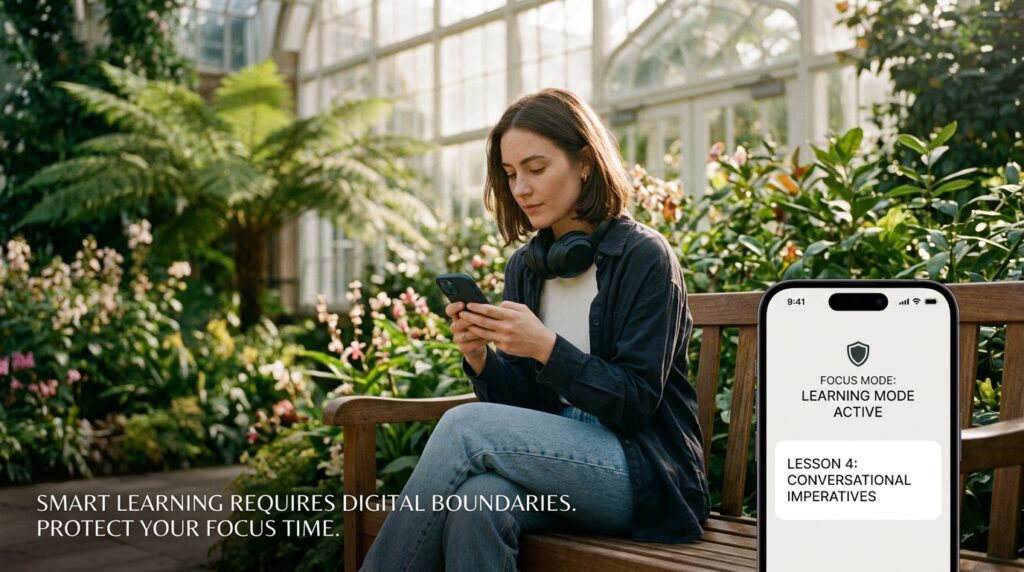
To survive this, you need digital boundaries, a concept I broke down thoroughly in my guide on (How I Reduce Distractions Using Mobile Apps). You must configure your phone to protect your learning time.
I use the “Focus Modes” built into my smartphone’s operating system. I created a specific profile called “Learning Mode.” When I activate this mode, my phone undergoes a radical transformation. All social media notifications are silenced. Email alerts are muted. The only people who can break through the barrier are my immediate family members in case of an emergency.
When I sit down with my phone to study a language or read an eBook, I tap the “Learning Mode” button. The device stops being a communication hub and becomes a quiet, isolated, dedicated study environment.
Final Thoughts: The Ultimate Leverage
We are living in the most astonishing era of educational accessibility in the history of the human race.
Two hundred years ago, if you wanted access to the world’s best information, you had to be incredibly wealthy, and you had to travel to a physical library in a major university. Today, the accumulated knowledge of humanity is beamed wirelessly through the air and captured by a piece of glass sitting in your pocket.
It is the greatest tool for upward mobility and self-improvement ever invented, yet we routinely use it to argue with strangers and watch cat videos.
You do not have to accept the default settings of the modern digital world. You are in complete control of the software you consume. You can choose to be a passive consumer, letting algorithms drain your time and spike your anxiety, or you can choose to be an active learner.
Start small today. Delete one app that makes you feel bad. Download one app that teaches you something new. Put on a podcast the next time you wash the dishes. When you fundamentally shift your relationship with your smartphone from a toy to a tool, the entire world opens up to you.
