
I have a confession to make, and it feels a little hypocritical given how much I talk about optimizing time and digital wellness.
About four months ago, I was stuck on a bus in the middle of a torrential downpour here in Rio. Traffic was completely gridlocked. I had already cleared my email inbox, I had finished my audiobook, and I was staring out the window at the gray, unmoving line of cars.
I was bored out of my mind.
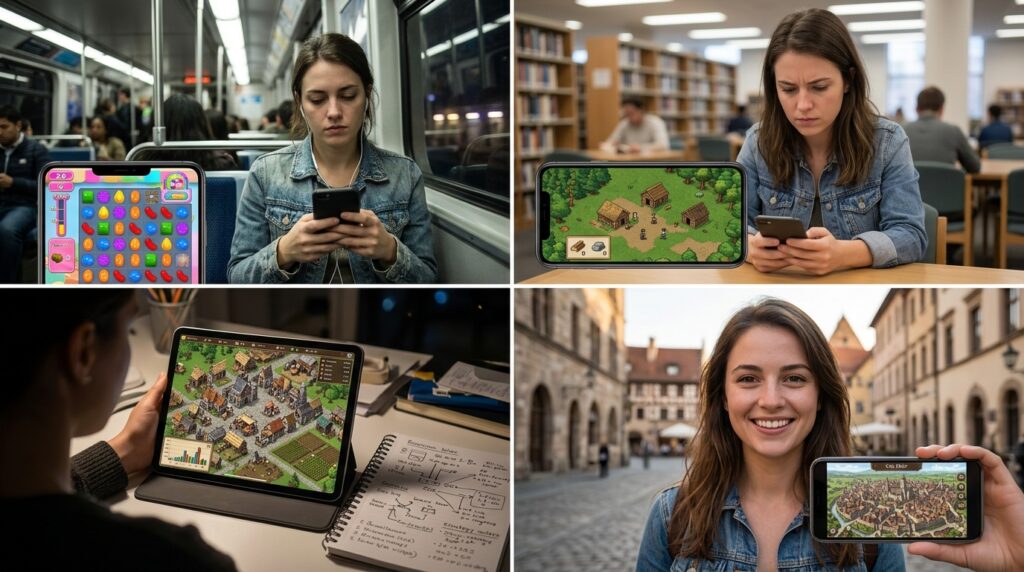
In a moment of pure weakness, I opened the app store. I navigated away from the productivity and finance sections where I usually spend my time, and I clicked on the “Games” tab. I wasn’t looking for anything meaningful. I just wanted a digital pacifier—something mindless with bright colors to make the next forty-five minutes disappear.
I downloaded a highly-rated simulation and strategy game. It was a city-builder mixed with resource management.
I expected to tap the screen a few times, collect some virtual gold coins, and delete the app as soon as I got home. Instead, what happened over the next few months completely shattered my prejudice against mobile gaming.
I didn’t just find a way to pass the time. I accidentally stumbled into one of the most rigorous, engaging, and genuinely educational experiences I have had since I left university.
The Stigma of the “Mindless” Mobile Game
When we think of mobile games, our minds naturally gravitate toward the stereotypes. We think of endless runners, matching brightly colored candies, or games designed purely to frustrate you into buying microtransactions.
For years, I viewed all mobile gaming as a net negative. I considered it a drain on cognitive energy and a waste of precious hours. I proudly told people that I didn’t have any games on my phone.
But this game was different. It didn’t treat me like a rat in a maze waiting for a pellet of dopamine. It treated me like an intelligent problem solver.
The premise was deceptively simple: you are placed in a historical era and tasked with building a functioning settlement from scratch. You start with a few villagers, some wood, and some stone.
Within the first hour, I realized this wasn’t about tapping to collect rewards. This was a complex, interlocking ecosystem of supply chains, macroeconomics, and urban planning. It was a living, breathing puzzle, and if I made a mathematical error, my virtual citizens suffered the consequences.
A Brutal Masterclass in Macro-Economics
The first major wall I hit in the game wasn’t a boss fight or a combat sequence. It was a financial collapse.
In the game, every building you construct has an upkeep cost. Every worker requires a specific amount of food and resources to remain productive. I was expanding my city far too rapidly. I was building beautiful monuments and massive residential zones because it felt like “progress.”
Then, winter arrived in the game simulation.
My food production plummeted. My workers couldn’t harvest wheat in the snow. But their consumption rates remained exactly the same. Because I had over-expanded without building a surplus, my treasury was drained trying to import emergency rations. My city went bankrupt in a matter of virtual days.
It was an incredibly harsh lesson in cash flow and emergency reserves.
I had to restart my city, but this time, I approached it like an accountant. I created a buffer. I calculated exactly how much surplus grain I needed to survive the winter cycle. I stopped building new infrastructure until I could mathematically prove that my economy could sustain the ongoing maintenance costs.
Interestingly enough, this virtual failure forced me to look at my real-world finances with a completely different perspective. I had been struggling to maintain my personal savings, and the game highlighted the exact same behavioral flaw in my real life: I was prioritizing visible “progress” (buying new things) over unseen stability (building a buffer).
The mechanics of the game mirrored the exact philosophies I had to learn when figuring out How to Budget Your Money With a Finance App. You cannot spend based on your best-case scenario; you have to budget for the inevitable winter. The game provided a safe, risk-free sandbox to learn the devastating consequences of poor financial planning.
Supply Chain Logistics and Systems Thinking
As my second city grew and stabilized, the complexity of the game deepened.
It was no longer just about gathering wood and stone. The villagers demanded more complex goods. They wanted clothing.
To provide clothing, I couldn’t just tap a button. I had to build a sheep farm to gather wool. But the sheep farm required an open pasture and a steady supply of water. Then, I had to build a weaver’s hut to turn the wool into yarn. Finally, I had to build a tailor’s shop to turn the yarn into clothes.
If my weaver’s hut was located on the opposite side of the map from the sheep farm, the transportation time destroyed my efficiency. My tailor would sit idle for days waiting for yarn, losing me money.
I had to learn how to optimize a supply chain. I had to group related industries together. I had to build roads that minimized transit time. I had to understand the concept of a “bottleneck”—finding the one slow step in the process that was holding up the entire production line, and upgrading it.
This is called “systems thinking,” and it is an incredibly valuable cognitive skill.
I found my brain actively applying this logic to my actual, physical life. I started looking at my daily chores and my work projects as supply chains.
Why was my morning routine taking so long? Because my “supply chain” was broken. My coffee maker was on one side of the kitchen, the mugs were on the other, and the beans were in a different cabinet. I was crossing the kitchen four times just to make a cup of coffee.
I started rearranging my physical environment and my digital workflows to eliminate bottlenecks. The lessons I learned managing virtual sheep translated directly into my journey of discovering How I Automated My Daily Tasks With Mobile Apps. I realized that whether you are managing a virtual 18th-century village or a modern freelance business, efficiency is always about reducing the friction between step A and step B.
The Accidental History and Geography Lesson
Beyond the math and the logistics, the game acted as a phenomenal gateway to historical curiosity.
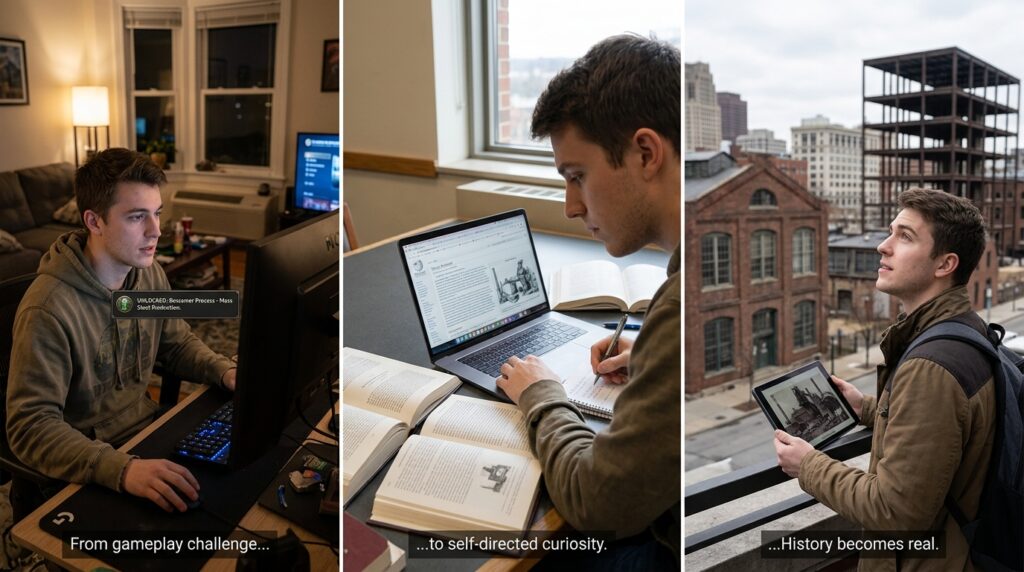
Because the game was grounded in a specific historical era (the Industrial Revolution), the technologies I was unlocking were based on real-world inventions. I found myself unlocking the “Bessemer Process” for steel production in the game, and suddenly realizing I had no idea what that actually was in real life.
Instead of just clicking past it, I paused the game. I opened my browser and read a Wikipedia article about Henry Bessemer and how the mass production of steel fundamentally altered the architecture of the 19th century.
A few days later, the game introduced a scenario based on the real-world trade routes of the Hanseatic League. Again, I found myself down a historical rabbit hole, reading about medieval merchant guilds and naval navigation.
The game wasn’t feeding me a textbook, but it was providing the context that made the textbook interesting.
It sparked a genuine, self-directed desire to learn. When you are actively engaged in a simulation, the historical facts aren’t just dry dates to memorize for a test; they are the literal rules of the universe you are trying to survive in.
This realization completely changed my view on modern education. If we want people to learn, we have to stop giving them answers to memorize and start giving them complex problems to solve. This is the exact philosophy behind many of the platforms I explored in my roundup of 10 Apps That Make Learning New Skills Easier. The most effective educational tools rarely look like classrooms; they look like engaging, interactive challenges.
The Concept of “Productive Play”
We have been conditioned by hustle culture to believe that every single second of our day must be optimized for maximum professional output. We feel guilty if we sit down to watch a movie or play a game because we feel like we “should” be working.
But the human brain desperately needs play.
Play is how mammals learn. It is how we test boundaries, experiment with cause and effect, and develop problem-solving skills in an environment where failure doesn’t result in physical harm.
Playing this complex strategy game wasn’t a waste of time. It was a high-level cognitive workout.
When I was playing the game, I was making hundreds of micro-decisions. I was weighing risk versus reward. I was predicting future outcomes based on current data. I was managing limited resources under pressure.
Compare that to the alternative. If I hadn’t downloaded that game on the bus, what would I have done? I would have opened a social media app. I would have spent forty-five minutes scrolling through a feed of perfectly curated, anxiety-inducing photos. I would have been a passive consumer of algorithmic noise.
Doomscrolling is a passive, numbing activity that drains your energy. Playing a rigorous, challenging simulation game is an active, engaging activity that stimulates your neural pathways.
Overcoming the Guilt of Screen Time
It is important to draw a hard line here between different types of mobile games.
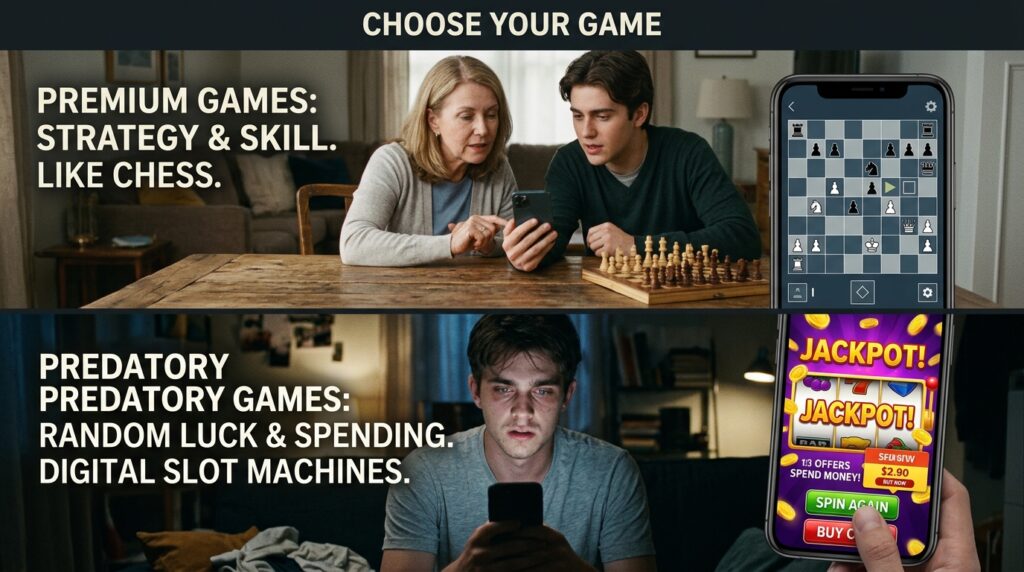
I am not advocating for downloading games that are essentially digital slot machines. If a game is designed to interrupt your gameplay with timers that can only be bypassed by spending real money, delete it. If a game requires absolutely no strategy and relies entirely on random luck and flashing lights, delete it. Those apps are predatory.
But if you can find a premium game—often one that costs a few dollars upfront to avoid the microtransaction trap—that requires actual thought, planning, and strategy, it is worth every penny.
I have stopped feeling guilty about playing this game for thirty minutes before bed. I recognize it for what it is: a puzzle that keeps my mind sharp. It is the modern equivalent of doing a crossword puzzle or playing a game of chess.
Final Thoughts on Redefining Ed-Tech
We often define “educational apps” very narrowly. We think of flashcard apps, language translation tools, or platforms that teach you how to code.
But education is not just about memorizing facts. True education is about learning how to think. It is about learning how to approach a complex system, break it down into manageable parts, identify the weaknesses, and design a solution.
This mobile game didn’t give me a certificate when I finished a level. It didn’t add a line to my resume.
But it undeniably made me a sharper thinker. It made me more mindful of my personal budget. It made me a more efficient organizer of my physical space. It reignited a dormant fascination with world history and industrial economics.
The next time you find yourself stuck on a long commute, or waiting in a doctor’s office, and you feel the urge to just mindlessly scroll through a social media feed, I challenge you to try something different.
Search for a deep, complex strategy game. Find a city-builder or a resource management simulator. Plunge yourself into a difficult virtual problem. You might be incredibly surprised to find that the very best educational tool on your phone was hiding in the games folder all along.
