
I spent four years of my life in high school sitting at a rigid wooden desk, staring at a chalkboard, desperately trying to memorize French verb conjugations.
I filled out endless worksheets. I recited the past tense of être and avoir until my voice went hoarse. I passed the written exams with flying colors. I genuinely believed that if I ever stepped off a plane at Charles de Gaulle Airport, I would be perfectly equipped to navigate the country.
A few years later, I finally made that trip to Paris. I walked into a small, bustling bakery near the Marais district, completely confident. I opened my mouth to order a simple coffee and a croissant.
Absolutely nothing came out.
My brain completely froze. The high-speed, melodic, beautiful cadence of the baker asking me what I wanted sounded absolutely nothing like the slow, sterile audio tapes my teacher used to play in the classroom. In a blind panic, I pointed at the pastry case, mumbled something incomprehensible, handed over a crumpled euro note, and practically sprinted out the door.
It was humiliating.
That moment solidified a harsh truth: the traditional, academic way we are taught languages is fundamentally broken. It prioritizes rote memorization over actual human connection. It teaches you how to pass a written test, not how to survive a spontaneous conversation with a stranger.
For a long time after that trip, I gave up on the idea of ever being bilingual. I convinced myself that I just didn’t have the “language gene.” I assumed that because I was no longer a sponge-brained toddler, the window for fluency had permanently closed.
I was completely wrong.
The problem wasn’t my adult brain; the problem was my method. Years later, sitting in my apartment in Rio de Janeiro, a sudden desire to learn Italian hit me. But this time, I refused to buy a textbook. I decided to leverage the supercomputer sitting in my pocket.
I turned to mobile applications, and what I discovered completely changed my perspective on adult education. Software developers have cracked the code on human motivation, turning the grueling process of vocabulary acquisition into an addictive, genuinely enjoyable daily game.
If you have ever felt the stinging embarrassment of a language barrier, or if you simply want to expand your cultural horizons without feeling like you are back in a boring high school classroom, put down the heavy grammar books. Here are the 5 language learning apps that completely resurrected my confidence and made the process incredibly fun.
1. Duolingo: The Gateway to Gamification
We cannot talk about digital language learning without addressing the very large, incredibly persistent green owl in the room.
Duolingo is the undisputed king of mobile language acquisition, and for a very good reason. It understands human psychology better than almost any other application on the market.
When you first start trying to learn a language, your biggest enemy isn’t the complex grammar rules; your biggest enemy is your own apathy. You need a reason to show up on day three, day fourteen, and day sixty.
Duolingo solves this through pure, unfiltered gamification. It treats learning like a mobile video game. You earn experience points (XP) for completing short, bite-sized lessons. You lose “hearts” when you make a mistake. You compete against other real users on weekly leaderboards to advance to the next “league.”
But the true genius of Duolingo is the “Streak.”
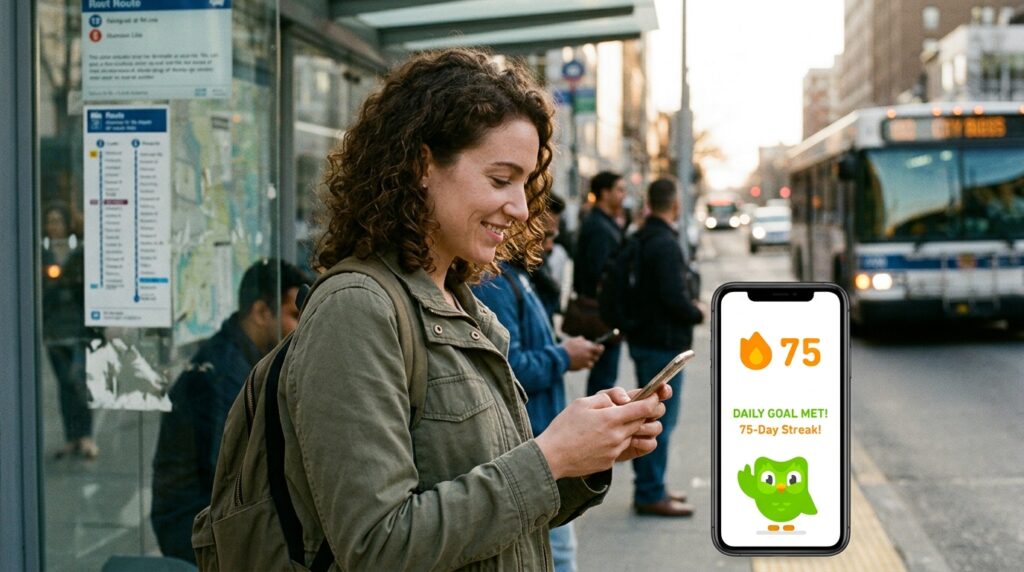
Every consecutive day you complete a lesson, your streak counter goes up. If you miss a day, the counter resets to zero. It sounds like a silly mechanic, but it is intensely powerful. Building the consistency required to keep a streak alive isn’t just about the language; it’s a core psychological mechanism. This is a concept I dive into when exploring (8 Apps That Helped Me Build Better Habits). You learn that five minutes of effort every single day is infinitely more effective than studying for three hours once a month.
Duolingo is perfect for the absolute beginner. The lessons are only three minutes long, meaning you can knock one out while waiting for a bus, sitting in the doctor’s office, or boiling water for pasta. It completely removes the “I don’t have time” excuse.
2. Babbel: The Master of Practical Conversation
While Duolingo is fantastic for building a daily habit and learning basic vocabulary, it is notorious for teaching you completely absurd sentences. (I will never forget learning how to say “The horse is eating a holy apple” in German. Not exactly useful for booking a hotel room).
When I wanted to graduate from gamified vocabulary to actual, usable dialogue, I turned to Babbel.
Babbel feels like the sophisticated, pragmatic older sibling to Duolingo. The interface is cleaner, the gamification is dialed back, and the focus is entirely on real-world utility.
Instead of teaching you isolated words, Babbel immediately throws you into practical scenarios. The very first lessons are about how to introduce yourself, how to order food in a restaurant, and how to ask for directions to the train station. It prioritizes the exact phrases you will desperately need the moment you step off an airplane in a foreign country.
What I deeply appreciate about Babbel is its integrated grammar explanations.
Instead of making you memorize a terrifying chart of verb endings, it introduces a grammar rule gently, right in the middle of a practical dialogue. It explains why the word changed its ending in a pop-up window, allowing your brain to understand the context rather than just memorizing the formula.
It is the perfect bridge app. It takes the consistency you built with gamification and applies it to structured, highly functional adult conversation.
3. Memrise: Native Speakers in Your Pocket
One of the main reasons I froze in that Parisian bakery all those years ago was because I had never actually heard real people speaking the language in a natural environment. I had only heard the slow, perfectly enunciated voices of voice actors in a recording studio.
Real life does not sound like a recording studio. Real life is fast, messy, and filled with local slang and weird pronunciations.
Memrise solves this problem brilliantly.
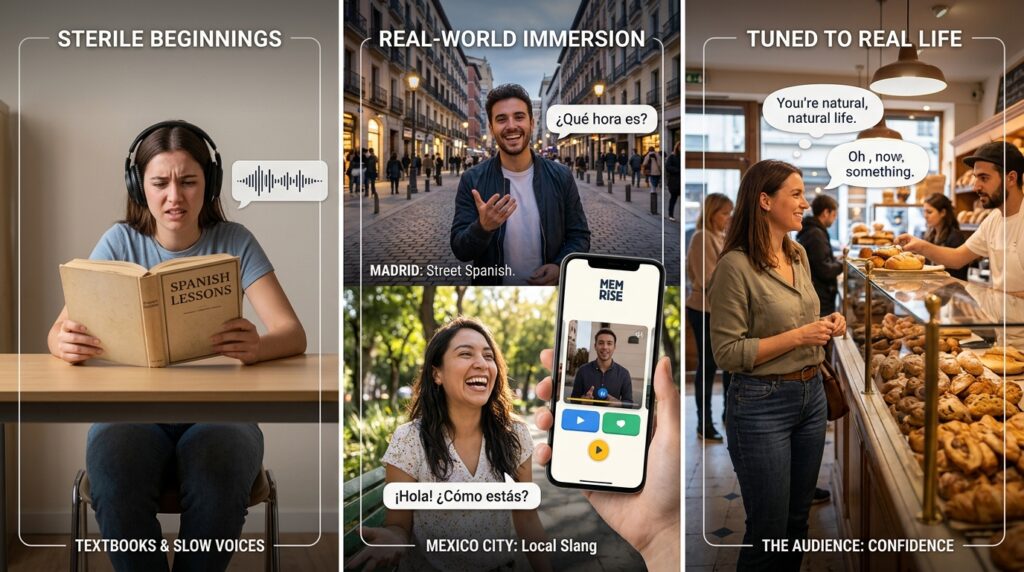
While it uses a similar flashcard-style interface to other apps, Memrise incorporates thousands of short, vertical video clips of actual native speakers on the streets of their home countries.
If you are learning Spanish, you don’t just see the phrase “What time is it?” on the screen. You watch a quick, three-second video of a guy standing on a street corner in Madrid casually asking the question. Then you watch a woman in a park in Mexico City asking it.
You get to hear the different accents. You see their facial expressions. You hear the ambient noise of the city behind them.
Incorporating native speaker videos fundamentally changes the learning experience, similar to the strategies I outlined in (How I Made Learning Fun With Educational Apps), because it removes the sterile textbook feeling. You stop viewing the language as an academic puzzle to be solved, and you start viewing it as a vibrant, living tool used by actual human beings. It tunes your ear to the authentic cadence of the streets.
4. Pimsleur: The Hands-Free Audio Method
About six months into my language journey, I hit a massive wall.
I could read the language perfectly on my phone screen. If you handed me a menu or a newspaper, I knew exactly what it said. But the moment I had to open my mouth and actually speak, my brain lagged. I was still translating the words from English in my head before speaking them out loud, making my conversational pace agonizingly slow.
I needed to train my vocal cords, not just my thumbs. That is when I discovered the digital app version of Pimsleur.
Pimsleur is based almost entirely on audio and a concept called “spaced repetition.” The app plays a 30-minute audio lesson. A narrator guides you through a conversation between two native speakers.
The magic happens when the narrator pauses and explicitly commands you to speak out loud.
“How do you say ‘I would like a glass of wine’?” the narrator asks.
There is a beat of silence. You have to physically open your mouth and say the phrase out loud before the native speaker jumps in with the correct pronunciation.
It is incredibly intimidating at first. I used to walk around my neighborhood in Rio, wearing my noise-canceling headphones, muttering Italian phrases to myself like a crazy person.
But it works. It bypasses the reading and writing centers of your brain and forces you to develop “muscle memory” in your mouth. You start speaking instinctively, rather than mathematically calculating the sentence structure. Because it is completely hands-free, it is the absolute best app to use while you are driving, doing the dishes, or folding laundry.
5. HelloTalk: The Digital Language Exchange
Eventually, you have to take off the training wheels.
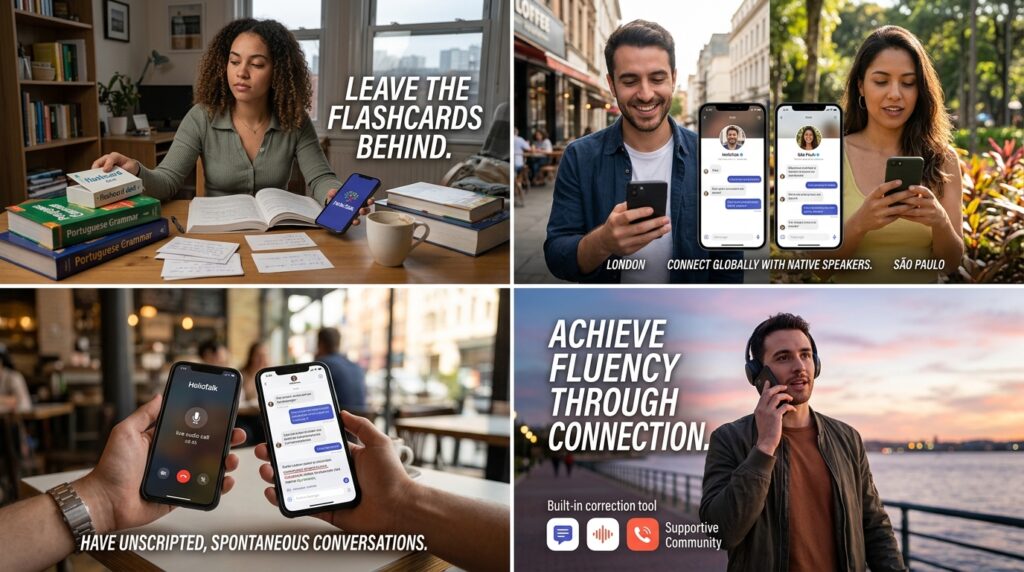
You can complete a thousand flashcards and listen to a hundred audio lessons, but you will never truly achieve fluency until you start having unscripted, spontaneous conversations with real native speakers.
The problem is, finding a native speaker to practice with is incredibly difficult if you don’t live in that specific country.
HelloTalk is a social networking app built specifically for language exchange. It connects you directly with native speakers who want to learn your language.
For example, I set my profile to say I was a native English speaker looking to practice Portuguese. Within minutes, I was connected with dozens of Brazilians who were trying to improve their English.
We struck a deal: we would chat for ten minutes in English to help them, and then ten minutes in Portuguese to help me.
The app features an incredible interface designed for this exact purpose. If I send a message in Portuguese and make a grammar mistake, my language partner can use a built-in correction tool to highlight my error and show me the natural way to say it.
You can send text messages, voice notes, or even jump on a live audio call.
I will admit, sending that first voice note to a stranger in a foreign language is absolutely terrifying. Your heart beats fast, and you feel incredibly vulnerable. If you want to accelerate your fluency using these exchange platforms without getting overwhelmed, you should definitely check out my specific (Tips for Using Language Learning Apps Faster).
But the community on HelloTalk is overwhelmingly kind and supportive. Everyone is there to learn, which means everyone understands exactly how scary it is to make a mistake. It is the final, ultimate bridge between studying a language in a vacuum and actually using it to connect with a fellow human being across the globe.
Final Thoughts on Finding Your Voice
Learning a new language as an adult is not impossible. It isn’t even inherently difficult. It is simply a matter of exposure and consistency.
The traditional education system failed many of us because it tried to force a dynamic, fluid, deeply human experience into a rigid, standardized testing format. It made us afraid to fail. It made us afraid to open our mouths and sound silly.
The apps on this list strip away that fear.
They provide a safe, private sandbox where you can make a thousand mistakes without an instructor hovering over your shoulder with a red pen. They allow you to turn idle, wasted moments—like sitting on a subway or waiting in line for coffee—into profound moments of self-improvement.
You don’t need to dedicate three hours a day to become conversational. You just need to change your digital habits.
If you have always dreamed of ordering tapas in Barcelona, chatting with a cab driver in Tokyo, or simply watching a foreign film without relying entirely on the subtitles, pick up your phone right now.
Choose one of these apps. Download it. Complete a single, three-minute lesson today. You have absolutely no idea how vast and beautiful the world becomes when you finally learn how to understand the people living in it.
