
If you had asked me a few years ago what the word “learning” meant, my brain would have immediately conjured up a deeply depressing image.
I would picture myself sitting at a cramped wooden desk in a stuffy room, aggressively highlighting paragraphs in a textbook that cost way too much money, desperately trying to keep my eyes open. I associated education with exhaustion. It was a chore, a necessary evil, and a test of sheer, agonizing willpower.
For the longest time, I assumed I just wasn’t a “curious” person. I watched documentaries where brilliant people talked passionately about history, physics, or foreign languages, and I felt a pang of jealousy. Why couldn’t I find that kind of joy in acquiring new knowledge? Why did sitting down to study feel like an absolute punishment?
The truth didn’t hit me until much later in life: I wasn’t opposed to learning; I was just traumatized by the traditional methods of teaching.
Our brains are not naturally wired to stare at black text on a white page for four uninterrupted hours. We are wired for play, for immediate feedback, for vibrant colors, and for interaction. We learn best when we are engaged, not when we are being lectured to.
My entire worldview shifted the day I stopped trying to force myself to read dry textbooks and decided to see if the supercomputer sitting in my pocket could do a better job. I started experimenting with educational mobile apps, and the results were nothing short of a personal renaissance.
I successfully rewired my brain to crave education. If you are tired of feeling like self-improvement is a grueling uphill battle, here is exactly how I completely transformed my digital environment and finally made learning fun.
1. Embracing the Gamification Hack
Let’s be brutally honest about human psychology: we are incredibly susceptible to cheap dopamine.
We love flashing lights, ascending progress bars, and the satisfying ding of unlocking a new achievement. This is exactly why mobile games are a multi-billion dollar industry. They know exactly how to push the buttons in our basal ganglia to keep us coming back for more.
For a long time, I viewed this as a negative thing. I thought gamification was just a cheap trick used to waste our time. But then I asked myself a dangerous question: What if I let them use those cheap tricks to teach me something useful?
I stopped fighting my brain’s desire for games and started actively seeking out educational apps that treated learning like an arcade.
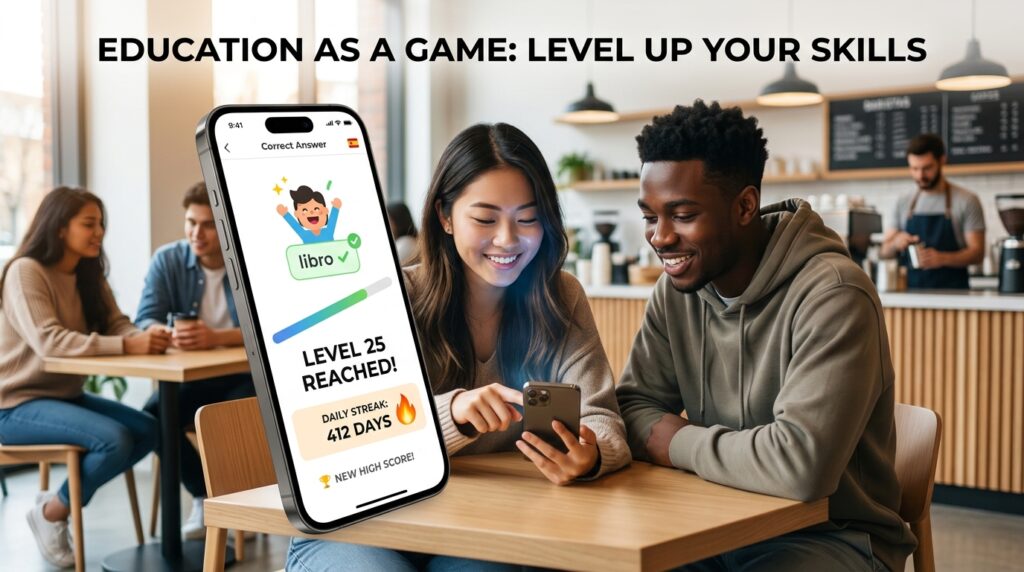
When you strip away the academic pretension, learning a new concept is essentially just leveling up your character in real life. When I first detailed my experiences in (How I Learned a New Language Using Only My Smartphone), the biggest revelation wasn’t the specific vocabulary I memorized. It was the fact that I was physically incapable of going to sleep if I hadn’t maintained my daily “streak.”
The app didn’t guilt me into studying; it dared me to keep my high score. It turned Spanish conjugations into a puzzle game. If I got an answer wrong, I lost a “heart.” If I got it right, I earned a gem. Suddenly, the friction of studying vanished. I was no longer opening a textbook; I was logging on to beat my previous record.
2. The Magic of Micro-Learning
The traditional academic model demands massive blocks of time. “Sit down and study for two hours,” they say. As a busy adult with a full-time job and a life to manage, finding two uninterrupted hours feels impossible. When we can’t find the time, we simply don’t do it.
Educational apps introduced me to the concept of “micro-learning,” which completely saved my sanity.
Instead of demanding hours, modern learning apps only ask for five minutes. They break complex, intimidating subjects down into bite-sized, incredibly digestible chunks.
I started hunting for the “dead time” in my day. We all have it. It’s the ten minutes you spend waiting for the bus. It’s the fifteen minutes you sit in the doctor’s waiting room. It’s the time you spend boiling water for pasta.
In the past, I would fill this dead time by mindlessly scrolling through social media, absorbing absolutely nothing of value. I made a strict new rule: before I was allowed to open a social media app, I had to complete one five-minute micro-lesson.
I used apps like Drops to learn a few words of vocabulary while standing in line at the grocery store. I used Blinkist to listen to the summary of an entire non-fiction book during my fifteen-minute commute.
This specific strategy is the absolute bedrock of my philosophy, which I outlined step-by-step in (How to Turn Your Smartphone Into a Learning Tool). By sneaking education into the tiny margins of my day, I was learning rapidly without ever feeling like I was sacrificing my free time. It felt like I was cheating the system.
3. Interactive vs. Passive Consumption
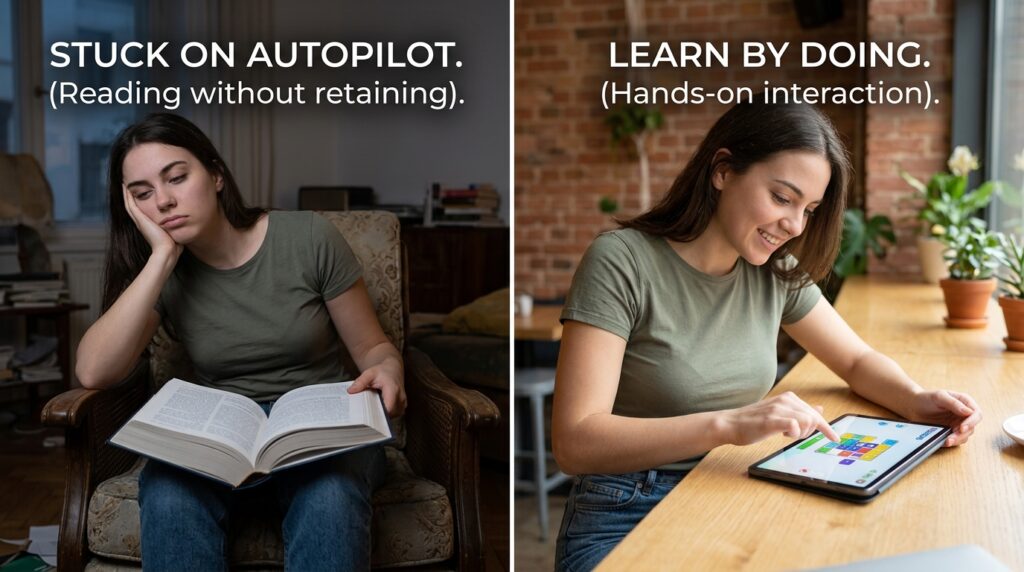
Have you ever read three pages of a book, gotten to the bottom of the page, and realized you have absolutely no idea what you just read? Your eyes were scanning the words, but your brain was thinking about what you were going to have for dinner.
That is the danger of passive consumption. It is incredibly boring, and it puts your brain on autopilot.
To make learning fun, it has to be interactive. You have to physically engage with the material.
I wanted to improve my understanding of math and logic, subjects that historically made me want to pull my hair out. Instead of buying a math workbook, I downloaded an app called Brilliant.
Brilliant doesn’t make you read a block of text about the laws of physics. Instead, it drops an interactive puzzle on your screen. It asks you to literally drag and drop the trajectory of a pendulum to see how gravity affects it in real-time. It forces you to build visual algorithms to guide a robot out of a maze.
You aren’t just absorbing information; you are manipulating it. When you make a mistake, the app doesn’t grade you with a big red ‘X’. It gently shows you the visual consequence of your logic and encourages you to try tweaking the variables.
It feels like playing in a sandbox. It taps into the innate, childlike curiosity that traditional schooling usually beats out of us. When learning becomes a hands-on experiment rather than a memorization test, the boredom completely evaporates.
4. Structuring the Digital Chaos
As I started devouring all this new information across different apps, I ran into a new problem: digital overload.
I was learning fascinating things about history, picking up coding terminology, and listening to brilliant audiobook summaries, but my brain couldn’t hold it all. I was forgetting things as quickly as I learned them, which started to bring the frustration back.
If learning is going to remain fun, you have to feel like you are actually making tangible progress. You need a place to store your victories.
I realized I needed a “Second Brain”—a digital filing cabinet to hold all the cool facts, quotes, and lessons I was picking up on my mobile adventures. I began testing various software solutions to capture these fleeting thoughts, a process I ultimately perfected and shared in my guide on (10 Note-Taking Apps That Actually Help You Stay Organized).
Whenever I learned a mind-blowing concept in an app, I would quickly toggle over to my note-taking app and write a two-sentence summary. I created digital folders for “Interesting Tech Facts,” “Spanish Grammar Rules,” and “Psychology Quotes.”
This did two things. First, the act of writing it down cemented the knowledge in my memory. Second, it created a beautiful, personalized encyclopedia of my own curiosity. On days when I felt unmotivated, I could open my notes app and scroll through hundreds of fascinating things I had voluntarily learned over the past year. It provided massive validation that my brain was, in fact, growing.
5. The Power of Friendly Competition
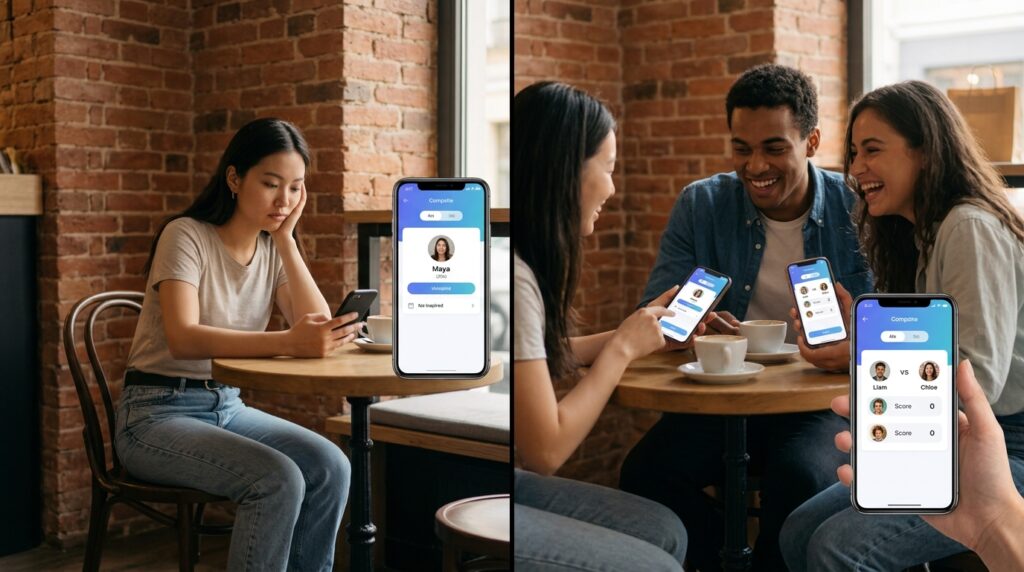
Learning in isolation can sometimes feel lonely. Humans are deeply social creatures, and we are heavily motivated by peer pressure, community, and a little bit of healthy rivalry.
The smartest educational apps understand this implicitly. They don’t just connect you to the material; they connect you to other people.
I started convincing a few of my friends to download the same educational apps I was using. We created private leaderboards. Suddenly, learning wasn’t just a personal journey; it was a sport.
If I saw that my best friend had overtaken my score on a Sunday afternoon, my competitive instincts would kick into overdrive. I would sit on the couch and knock out three extra lessons just to secure my spot at the top of the podium before the weekly reset.
Even if you don’t have friends using the app, you can join global leagues. Many platforms group you with fifty strangers from around the world who are at a similar skill level. You fight to advance to the “Diamond League” by the end of the week.
Is it silly? Yes, absolutely. Does it work? Better than any harsh discipline or strict schedule ever could. By turning education into a multiplayer game, the apps completely masked the effort required to learn.
Final Thoughts: Reclaiming Your Curiosity
The greatest tragedy of our modern world is that we walk around with the cumulative knowledge of all human history in our pockets, yet we mostly use it to argue with strangers on the internet and look at pictures of people’s lunches.
Your smartphone is a portal. It can be a portal to endless anxiety and distraction, or it can be a portal to a richer, more fascinating life.
You do not have to settle for the belief that you aren’t “smart enough” or “disciplined enough” to learn new skills. You are just using the wrong tools. You are trying to use 19th-century study methods in a 21st-century world.
Stop punishing yourself with heavy books and long, boring lectures if they don’t work for you. Lean into the gamification. Let the flashing lights and the digital rewards hack your dopamine loop for good. Steal back those five-minute windows of dead time in your day.
Download an educational app tonight. Don’t look at it as a commitment to study. Look at it as a new game to play. Let your natural curiosity take over, and watch as the entire concept of learning transforms from a heavy burden into the highlight of your day.
