
I was standing at a small, bustling café in Buenos Aires, feeling a cold drop of sweat roll down my back as the barista waited impatiently for my order.
I had been practicing my Spanish on a popular language learning app every single day for over a year. I had a 400-day streak. I was in the “Diamond League.” I had earned hundreds of meaningless digital gems and leveled up my virtual avatar. I felt incredibly confident walking into that café.
But when the barista looked at me and fired off a rapid, colloquial question about whether I wanted to drink my coffee there or take it to go, my brain completely short-circuited. I froze. I stared at him blankly, mumbled something unintelligible, and eventually just pointed at the menu like a terrified tourist.
As I walked out with my coffee, the harsh reality washed over me: I hadn’t spent the last year learning Spanish. I had spent the last year learning how to play a mobile game.
Language apps are brilliant pieces of technology. They have democratized education and made building a daily habit incredibly easy. But the way they are designed—relying heavily on multiple-choice questions, matching games, and immediate rewards—can trick your brain into feeling a false sense of fluency. You become incredibly fast at recognizing words on a screen, but completely incapable of recalling them in a real-world conversation.
I realized I didn’t need to quit using the apps; I needed to completely change how I interacted with them. I had to stop being a passive player and start being an active student.
If you feel like you are spending hours swiping on your phone but still can’t string a basic sentence together, you are not alone. You just need to hack the system. Here are the practical, aggressive tips for using language learning apps faster to bridge the gap between digital tapping and real-world fluency.
1. The “Cover and Speak” Technique (Forcing Active Recall)
The biggest flaw in almost every major language app is that they rely on passive recognition.
When an app shows you the phrase “La manzana es roja” and gives you four English options to choose from, you aren’t actually translating. Your brain is just scanning for the word “apple” and “red.” You can guess the right answer without truly understanding the grammar.
To learn faster, you have to force “active recall.”
When a new prompt appears on my screen, I immediately cover the bottom half of my phone with my hand so I cannot see the multiple-choice options or the word bank. I force myself to translate the sentence out loud, speaking to the empty room. Only after I have formed the sentence in my own mouth do I move my hand and tap the correct bubbles.
It makes the app incredibly frustrating at first. You will realize how heavily you were relying on the word bank as a crutch. But this tiny moment of intense mental struggle is exactly when the neural pathways in your brain actually grow. You are training your brain to generate the language from scratch, which is exactly what you have to do when talking to a barista in real life.

2. Ditch the Translation Mindset Immediately
Most of us learn a new language by tethering it to our native language. We see “Gato” and we instantly translate it to “Cat” in our heads.
This translation step is a massive bottleneck. If you have to translate every single word you hear back into English, process it, translate your response back into Spanish, and then speak, you will never be able to hold a conversation at a normal speed. You have to cut the English middleman out entirely.
When I started diving into different platforms, a journey I documented in The Language Learning App That Actually Works for Me, I actively looked for apps that allowed me to turn off the English translations entirely.
If your app doesn’t allow this, you have to do it mentally. When the app teaches you the word “Gato,” do not think of the English letters C-A-T. Close your eyes and visualize a physical, furry animal sitting on your couch. Associate the foreign word with the physical object or the raw emotion, not with an English translation. This builds a direct cognitive bridge, allowing you to eventually think directly in your target language.
3. Exploit the Audio: The Shadowing Method
Language apps provide thousands of hours of native-speaker audio, but most people treat it like background noise while they focus on reading the text. This is why people can read French beautifully but sound completely incomprehensible when they try to speak it.
You must turn the app into a pronunciation simulator using a technique called “Shadowing.”
When the app plays a sentence, I don’t just read it and move on. I listen to it, and then I try to mimic the audio exactly. I am not just mimicking the words; I am mimicking the melody, the intonation, the rhythm, and the emotional tone of the speaker. I repeat the audio three or four times, shadowing the voice until my mouth physically feels comfortable producing those unfamiliar sounds.
Your mouth is full of muscles, and speaking a new language requires moving those muscles in ways they have never moved before. It is physical training. You cannot learn to play the guitar just by reading sheet music, and you cannot learn an accent just by reading text. You have to aggressively shadow the audio to build the muscle memory.
4. Break the “Streak” Illusion and Timebox Your Learning
The gamification of language apps is a double-edged sword. The app desperately wants you to keep your “streak” alive because that keeps you opening the app every day.
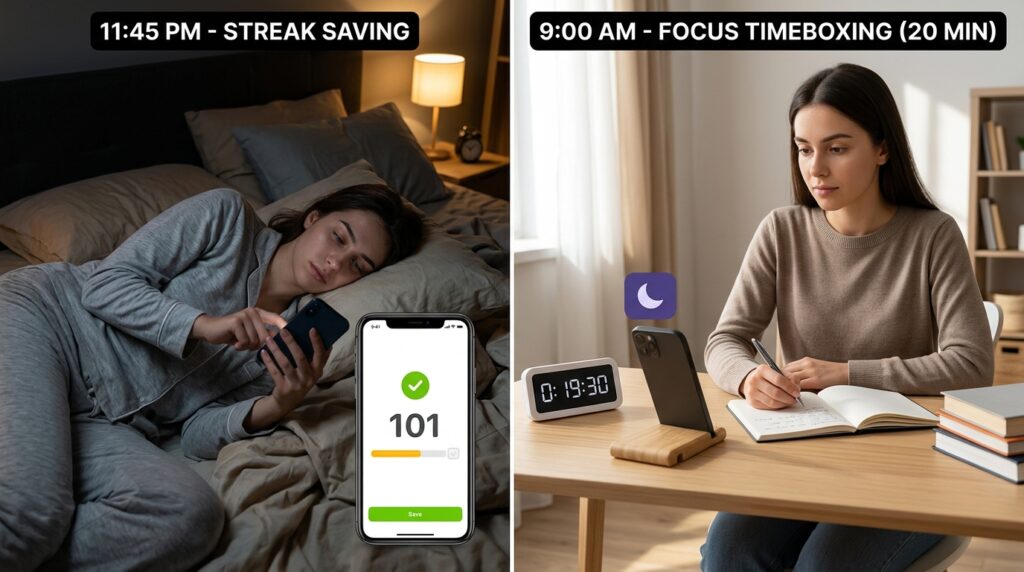
But what happens when it is 11:45 PM, you are exhausted in bed, and you realize you haven’t done your lesson yet? You open the app, do the easiest, fastest review lesson available, mindlessly tap the screen for three minutes, and go to sleep feeling like you accomplished something.
You didn’t accomplish anything. You saved a digital streak, but you learned zero language.
I realized that casual, distracted swiping was actively harming my progress. I had to create a focused environment. I adopted strict digital boundaries, an approach I outlined completely in Apps That Help Me Focus When Working From My Phone.
I stopped caring about my streak and started caring about “Timeboxing.” I set aside twenty minutes of uninterrupted, highly focused time. I put my phone on Do Not Disturb, sit at a desk, and treat the app like a serious textbook. Twenty minutes of intense, deliberate study will advance your fluency ten times faster than an entire week of mindless three-minute streak-savers while riding the bus.
5. Harvest Your Mistakes into a Spaced Repetition System
When you get a question wrong in a standard language app, the screen turns red, it shows you the correct answer, and you move on. Maybe the app will show you that question again at the end of the lesson, but by next week, that specific mistake is gone from the algorithm.
If you want to accelerate your learning, you have to manually harvest your mistakes.
I keep a separate app open alongside my language app—specifically, a Spaced Repetition System (SRS) app like Anki.
Anki is a digital flashcard app powered by a highly aggressive memory algorithm. Whenever I make a mistake in my main language app, or whenever I encounter a phrase that feels particularly difficult to pronounce, I pause. I copy that exact sentence and paste it into my custom Anki deck.
I don’t just copy the word; I copy the entire sentence, so I have context. Every morning, before I even open my main language app, I review my Anki deck. The algorithm tests me on my personal weaknesses, ensuring that the exact concepts I struggled with yesterday are cemented in my memory today. It is the ultimate hack for plugging the leaks in your memory.
6. Escape the App Ecosystem (The 50/50 Rule)
The most dangerous trap of language learning apps is the belief that the app alone is enough. You start to view the app as the entire universe of the language.
But an app is just a sterilized, perfectly structured sandbox. Real language is messy. It is full of slang, people talking over each other, background noise, and thick regional accents. If you only ever interact with the robotic, perfectly enunciated voices inside your app, the real world will crush you.
To use the app faster, you have to use it less. You must adopt the 50/50 rule.
If I dedicate forty minutes a day to learning a language, twenty minutes are spent inside the app learning grammar rules and vocabulary. The remaining twenty minutes must be spent outside the app, consuming native content.
This ecosystem approach is vital, and it is exactly how I structured my entire learning environment, as I detailed in How I Learned a New Language Using Only My Smartphone. I go to YouTube and watch vloggers from Colombia or Spain. I listen to Spanish podcasts designed for native speakers, even if I only understand 30% of what they are saying.
When you hear a word in a fast-paced YouTube video that you just learned in your app yesterday, your brain lights up. The word suddenly stops being a digital puzzle piece and becomes a living, breathing tool for communication. That moment of cross-platform recognition cements the vocabulary permanently in your mind.
7. Change the Language of Your Digital Life
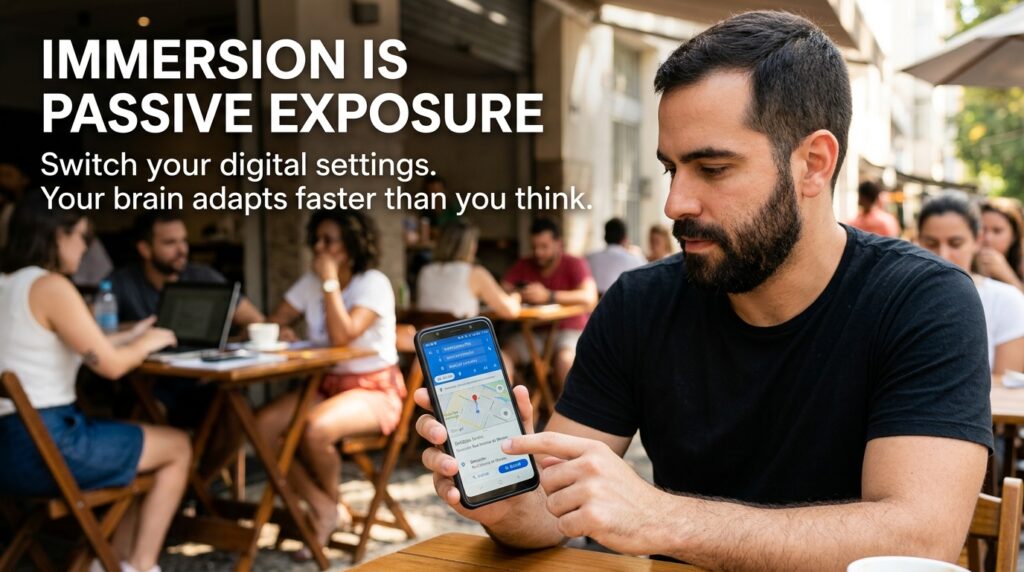
If you truly want to accelerate your learning, you have to dramatically increase your passive exposure. You can’t just study for twenty minutes a day and then revert to your native language for the other twenty-three hours and forty minutes.
You need to manufacture immersion. Because I live in Rio de Janeiro but wanted to learn Spanish, I couldn’t rely on my physical environment for immersion. I had to change my digital environment.
I went into my smartphone’s core settings and changed the operating system language entirely to Spanish.
Suddenly, my alarm clock, my calendar app, my weather widget, and my Google Maps navigation were all operating in my target language. It was incredibly disorienting for the first three days. I accidentally deleted an email because I clicked the wrong button.
But your brain adapts astonishingly fast to survival situations. Because I desperately needed to know how to navigate my phone, I absorbed the vocabulary instantly. I didn’t need flashcards to learn the words for “Settings,” “Share,” “Delete,” or “Search.” I learned them through pure, unadulterated daily context.
By forcing your primary digital tool into your target language, you create thousands of micro-interactions every single day. You turn mindless scrolling into a passive language lesson.
Final Thoughts: You Are the Teacher
The greatest marketing trick ever pulled by the tech industry was convincing us that we could learn a complex, nuanced human language just by playing a colorful game on our phones for five minutes a day.
The app is not your teacher. The app is a textbook. It is a tool.
A hammer cannot build a house by itself; it requires a carpenter with a blueprint and a strong swing. If you use your language app passively—just tapping the screen to make the red notification dot go away—you are just holding the hammer.
To actually build fluency, you have to swing. You have to cover the screen and force your brain to struggle. You have to speak out loud until your jaw is tired. You have to export your mistakes, dive into messy native content, and completely surround yourself with the language.
The next time you open your language app, don’t just play the game. Challenge the software. Engage with the material aggressively. When you stop relying on the algorithm to save you and start taking responsibility for your own active recall, you won’t just keep your digital streak alive—you will finally be able to order that coffee with confidence.
