
Let me paint a painfully embarrassing picture for you. About two years ago, I was sitting in a bustling, beautiful little café in the heart of Buenos Aires. The air smelled intensely of dark roasted espresso and warm, sugary medialunas. The atmosphere was electric, filled with the rapid, melodic hum of locals chatting over their morning coffee.
I had been “studying” Spanish for exactly one hundred and twenty days straight.
I knew this because my phone sent me a brightly colored notification every single morning congratulating me on my impressive streak. I had unlocked digital badges. I had earned virtual currency. I was in the top percentage of users in the “Diamond League” on a very popular, highly gamified language application. I felt incredibly confident.
The waiter, a kind-looking older gentleman with a white apron, approached my table. He smiled and said something very fast, very politely, in Spanish.
My brain completely froze. The confident, bilingual version of myself that existed inside my phone instantly evaporated.
I sat there, staring at him blankly. My mind desperately searched its database for the appropriate response. I knew how to say “The horse eats an apple.” I knew how to translate “The boy is drinking milk.” But I had absolutely no idea how to say, “I would like a flat white and a pastry, please.”
After a few agonizing seconds of silence, my face flushed bright red. I pointed at the menu, held up one finger, and mumbled “Por favor.”
I walked out of that café feeling utterly defeated. I had spent hours staring at a screen, swiping words, and matching pictures, but I hadn’t actually learned how to communicate. I had learned how to pass a multiple-choice test.
I realized right then and there that my approach was fundamentally broken.
The Gamification Trap
When I returned home to Brazil, I took a hard look at the tools I was using.
The app I had relied on for months wasn’t designed to make me fluent; it was designed to keep me on the app. It was a masterpiece of behavioral psychology. The chiming sounds, the progress bars, the fear of losing my daily streak—it all triggered the exact same dopamine receptors as a social media feed.
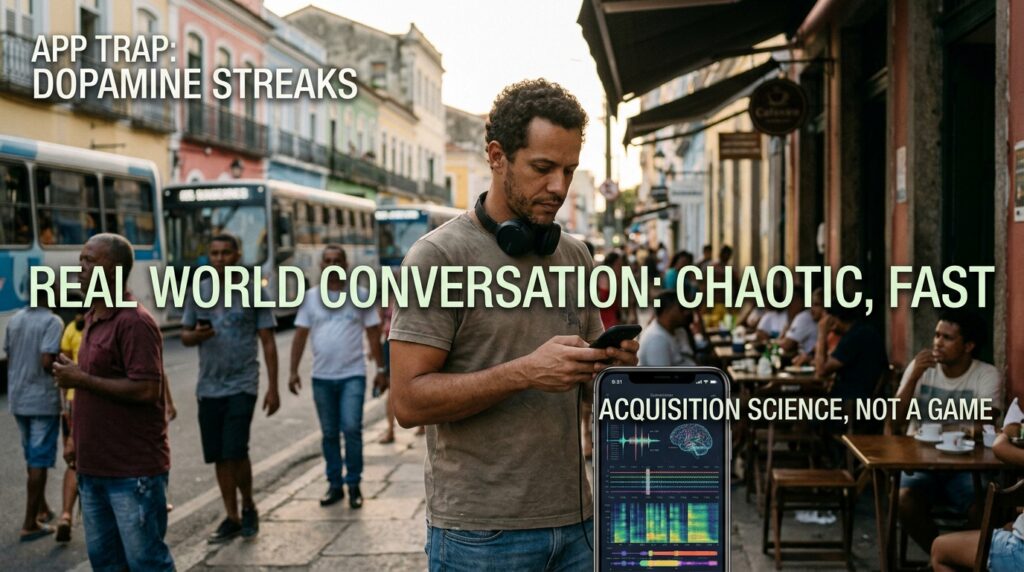
But matching the word “gato” to a cartoon picture of a cat does not prepare your brain for the chaotic, fast-paced reality of human conversation.
I had fallen into the trap of passive learning. I was reading and translating, which uses a completely different part of the brain than listening and speaking. In the real world, you don’t have five seconds to look at four written options and choose the correct verb conjugation. In the real world, language happens in real-time.
I was ready to give up entirely. I thought perhaps I was just too old to learn a new language. I told myself that the window of neuroplasticity had closed and I was doomed to be a monolingual tourist forever.
But before I threw in the towel, I decided to do some serious research into the science of linguistics. I wanted to understand how the human brain actually acquires a new tongue, and whether technology could actually facilitate that process rather than just turning it into a video game. I documented a lot of this early exploration in my piece on How I Learned a New Language Using Only My Smartphone, but the core revelation came down to finding an entirely different kind of software.
Discovering the Audio-First Approach
My research led me away from the bright, cartoonish apps and toward a platform that looked much more serious. It didn’t have leagues, it didn’t have animated mascots, and it didn’t have multiple-choice translation exercises.
Instead, it was built entirely around an audio-first, immersion-based philosophy. (Think of the methodology used by platforms like Pimsleur or Paul Noble).
When I started my first lesson on this new app, I was immediately thrown off guard. There was no text on the screen. There was nothing to swipe.
A narrator simply spoke to me in English, setting a scene. “Imagine you are sitting next to a stranger on a bus in Madrid. You want to ask them if they speak English. Listen to this conversation.”
Then, two native speakers engaged in a rapid, natural-sounding dialogue. It sounded incredibly intimidating. But then, the narrator broke it down. He didn’t explain the grammar rules. He didn’t tell me what a past participle was. He simply asked me to repeat a single syllable. Then two syllables. Then a word.
Within thirty minutes, I was speaking full, complex sentences out loud in my living room. I was pacing back and forth, actively participating in a simulated conversation.
It was exhausting. My brain physically hurt after the first lesson. But for the first time in my life, I felt like I was actually speaking, not just translating.
Context Over Grammar Rules
The most profound shift this app introduced was its complete abandonment of traditional grammar lessons.
If you took a foreign language in high school, you probably remember the trauma of memorizing conjugation charts. I am, you are, he is, they are. You stare at the grid on the whiteboard until your eyes cross.
This app never once showed me a chart. It taught grammar the same way a toddler learns their native language: through pure context and repetition.
When you hear a native speaker say “I would like a coffee” ten different times in ten different simulated scenarios, your brain naturally absorbs the pattern. You don’t need to know the linguistic name for the verb tense; you just know what it sounds like when it’s correct.
If you are struggling with traditional studying methods, I highly recommend looking into strategies that bypass rote memorization. I’ve compiled several of these in my guide on Tips for Using Language Learning Apps Faster, but the foundational rule is always context. When you learn a word in the context of a story or a conversation, your brain creates a sticky memory. When you learn a word on a flashcard, it evaporates the moment you close the app.
The Algorithm of Memory: Spaced Repetition
The secret engine running beneath the surface of this app—and the reason it actually worked for me—is a concept called Spaced Repetition System (SRS).
The human brain is incredibly efficient at forgetting things it doesn’t think are important. If you learn a new Spanish word on Monday and never hear it again, your brain deletes it by Thursday to make room for more relevant information.
Spaced repetition uses an algorithm to hack this forgetting curve.
When I learn a new phrase in the app, the software waits until the exact moment my brain is about to forget it—maybe two days later—and prompts me to use it again. If I remember it correctly, the algorithm waits a little longer next time—maybe five days. If I get it wrong, it brings it back tomorrow.
This constant, targeted review process forced the vocabulary to move from my fragile short-term memory into my permanent long-term memory. It felt like magic, but it was just applied neuroscience.
I didn’t have to worry about what to review or when to study. I just opened the app, trusted the algorithm, and answered the prompts. The software did all the heavy lifting of managing my curriculum.

Embracing the Friction and the Embarrassment
One of the biggest hurdles in language acquisition is what linguists call the “affective filter.” It is essentially the wall of anxiety and self-consciousness that blocks your brain from absorbing new information.
When I was in Buenos Aires, my affective filter was completely maxed out. I was so terrified of sounding stupid that my brain completely shut down.
Because this new app required me to speak out loud, continuously, it forced me to confront that embarrassment in the safety of my own home.
The app uses voice recognition software to evaluate your pronunciation. During the first few weeks, it constantly corrected me. I would say a phrase, and the app would politely buzz, indicating I had butchered the accent. I would have to repeat it five, six, sometimes ten times before the software accepted it.
It was frustrating. But that friction was the crucible where actual learning was taking place.
I was training the muscles in my mouth and tongue to make sounds they had never made before. I was getting comfortable with the feeling of sounding foolish. By the time I had completed two months of the program, I was no longer afraid of making a mistake. I had made thousands of mistakes in my living room, and I had survived every single one of them.
Building a Bulletproof Routine
Of course, the most scientifically advanced app in the world is completely useless if you don’t actually open it.
With my previous, gamified app, finding time wasn’t an issue. I could mindlessly tap through a lesson while waiting in line at the grocery store or while half-watching television.
Because this audio-first app demanded my full vocal attention, I had to deliberately carve out time for it. I couldn’t do it on the subway without looking like a crazy person talking to myself.
I decided to attach the habit to an existing routine: my daily morning walk.
Every morning at 7:00 AM, I put on my noise-canceling headphones, open the app, and walk around my neighborhood for thirty minutes. For that entire half hour, I am fully immersed. I am listening to Spanish dialogues, answering prompts out loud, and conversing with a digital tutor while I get my steps in.
This routine became sacred. I wasn’t relying on willpower or digital confetti to keep me going. I was relying on a rock-solid daily schedule. Maintaining this kind of discipline is exactly why I rely on structural systems, which I detail further in my article about How I Track My Progress and Stay Motivated Every Day.
By combining physical movement with the audio lessons, I actually looked forward to the study sessions. My morning walks became a portal to another culture.
The Breakthrough Moment
The true test of this entire experiment came about eight months after I started using the new app.
I was invited to a dinner party by a friend here in Rio. When I arrived, I realized that half the guests were visiting from Colombia and spoke very little Portuguese or English.
The familiar wave of panic hit my chest. My mind immediately flashed back to that café in Buenos Aires. I almost turned around and went home.
But then, one of the guests approached me, smiled, and asked a question in Spanish.
And something incredible happened.
I didn’t translate his words into English in my head. I didn’t frantically search my memory for a conjugation chart. I just understood the intention behind the sounds.
Before my conscious brain even realized what was happening, my mouth opened and a completely coherent, grammatically correct Spanish sentence came out.
The guest smiled, replied, and suddenly, we were having a conversation.
It wasn’t perfect. I definitely made mistakes. I stumbled over a few complex verb tenses, and I had to ask him to slow down once or twice. But I was communicating. We talked about the weather, we talked about the food, and we laughed at a joke.
I was actually doing it.

Why the Right Tools Matter
We live in an incredible era where the collective knowledge of humanity is available in our pockets. But not all tools are created equal.
For a long time, I blamed my own intelligence for my failure to learn a language. I thought I just didn’t have the “gene” for it.
What I now understand is that I was simply using the wrong tool for the job. I was trying to build a house using a plastic toy hammer. Gamified apps are fantastic for learning a few vocabulary words before a two-day vacation, or for entertaining yourself on a bus ride. But they are not designed to build genuine fluency.
Fluency requires friction. It requires listening to native speakers speak at their normal, terrifying speed. It requires feeling the physical awkwardness of forming new sounds with your mouth. It requires making mistakes over and over again until the patterns finally sink into your subconscious.
Finding an app that embraced this friction—an app that prioritized audio immersion and spaced repetition over colorful animations—completely changed my life.
It didn’t just teach me a new language; it gave me the confidence to step out of my comfort zone and connect with people I never would have been able to speak to otherwise.
If you are feeling stuck in your language journey, if you have a massive streak on a popular app but still freeze up when a native speaker says hello, I urge you to rethink your strategy. Step away from the screen, put your headphones in, and start listening. Stop translating, and start speaking. It will feel uncomfortable at first, but that discomfort is the exact feeling of your brain growing. Embrace it, and the world will open up to you in ways you never imagined.
