
For the better part of a decade, I carried around a heavy, embarrassing secret: I was a chronic language-learning quitter.
If you were to search my apartment a few years ago, you would have found the physical evidence of my failed ambitions. I had a stack of expensive Spanish textbooks gathering dust on a bottom shelf. I had thick workbooks filled with exactly three pages of aggressively neat handwriting before turning completely blank. I even had a set of audio CDs that I listened to in my car exactly twice before switching back to my favorite podcasts.
I loved the idea of speaking another language. I daydreamed about traveling to Madrid, ordering coffee like a local, and navigating the city without acting like a lost tourist.
But the reality of traditional studying always crushed me. I would get home from a long day at work, look at the heavy textbook sitting on my desk, and feel a wave of sheer exhaustion. Finding an uninterrupted hour to sit down with a notebook and study grammar felt impossible. So, I would tell myself, “I’ll do it tomorrow when I have more energy.”
Tomorrow, of course, never came.
My breakthrough didn’t come from finding more willpower or enrolling in an expensive evening class. It came from a sudden, jarring realization about my daily screen time.
I checked my phone’s digital wellness stats one evening and realized I had spent over two hours aimlessly scrolling through social media, reading comments on videos I didn’t even care about. I didn’t have a “time” problem. I had an “attention” problem. I was already spending hours every single day staring at a supercomputer in the palm of my hand. What if I stopped fighting my smartphone and started using it as a portable language laboratory?
I decided to completely ditch the heavy textbooks. I was going to see if I could achieve fluency using nothing but mobile apps. This is the exact, step-by-step digital ecosystem I built to learn a new language, right from my pocket.
Phase 1: The Gamified Hook
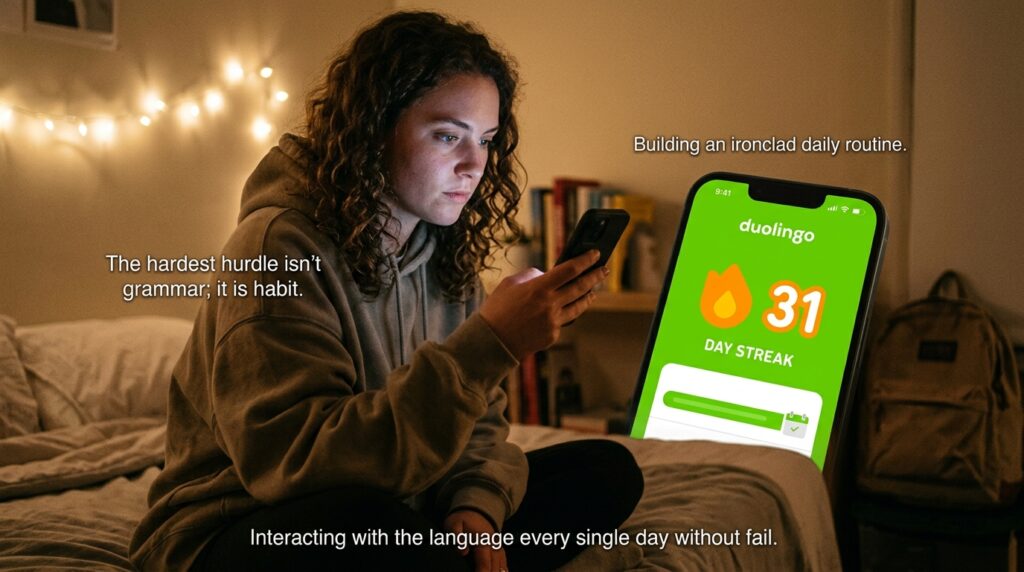
When you first start learning a language, the biggest hurdle isn’t the grammar; it is the habit. You have to convince your brain to show up every single day.
I knew that if I downloaded a dry, academic app, I would quit within a week. I needed something that hijacked my brain’s love for cheap dopamine. I needed a game.
I started with Duolingo. I know serious polyglots often criticize it for being too simplistic, but for a beginner, it is an absolute masterpiece of behavioral psychology. The app doesn’t ask you to study for an hour. It asks you to play a colorful matching game for five minutes.
Every time I finished a lesson, I earned experience points. I climbed imaginary leaderboards. But most importantly, I started building a “streak.” After two weeks of logging in every day, the thought of losing my streak physically pained me. I would literally be in bed at 11:45 PM, realize I hadn’t done my Spanish, and frantically open the app just to keep the flame icon alive.
It wasn’t making me fluent yet, but it was doing something much more important: it was building an ironclad daily routine. I was interacting with the language every single day without fail. Finding an application that actually resonated with my learning style was a massive part of this early phase, a journey I detailed extensively when I wrote about (The Language Learning App That Actually Works for Me). Once the habit is locked in, you can start doing the heavy lifting.
Phase 2: Active Recall and the Forgetting Curve
After about three months of gamified learning, I hit a wall. I was great at recognizing words when they were presented in a multiple-choice format, but if someone asked me how to say “newspaper” in Spanish, my mind would go completely blank.
I was experiencing the “App Illusion.” I felt productive, but I wasn’t actually retaining the vocabulary in my long-term memory.
I needed to switch from passive recognition to active recall. I downloaded an app called Anki (AnkiDroid for Android, AnkiMobile for iOS).
Anki is a digital flashcard app that uses Spaced Repetition Software (SRS). It is incredibly ugly, entirely utilitarian, and arguably the most powerful learning tool ever created.
Unlike physical flashcards where you review everything equally, Anki uses an algorithm to track exactly what you know and what you are about to forget. When I flipped a digital card, the app asked me to rate how difficult it was to remember. If I instantly knew the word, Anki wouldn’t show me that card again for a month. If I struggled, it would show it to me again in ten minutes.
It forced me to spend my time studying only the specific words I was weak at. I started building my own custom decks, adding words I encountered in my daily life. Reviewing my Anki deck while waiting in line for coffee became my ultimate productivity hack.
Phase 3: The Digital Immersion Strategy
You cannot learn a language purely by memorizing individual words. You have to see how those words dance together in the real world. You need input—massive amounts of reading and listening.
In the past, this meant ordering expensive foreign novels or buying specialized CDs. With a smartphone, immersion is free and instantaneous.
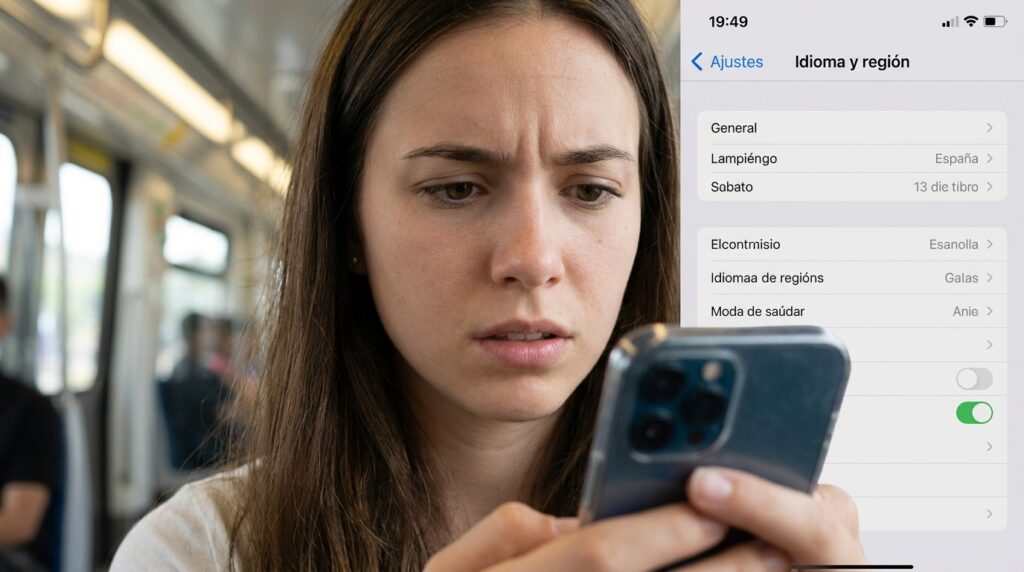
I completely changed my digital environment. First, I went into my smartphone’s settings and changed the entire operating system language to Spanish.
This was terrifying for the first three days. Navigating my camera settings or trying to set an alarm became a puzzle. But very quickly, my brain adapted. I passively learned dozens of technology-related words just by trying to use my phone normally.
Next, I tackled my content consumption. Instead of listening to my usual true-crime podcasts on my commute, I downloaded podcasts designed specifically for intermediate language learners. Apps like Spotify and Apple Podcasts are absolute goldmines. I started listening to Radio Ambulante and Coffee Break Spanish.
For reading, I used an app called LingQ. LingQ allows you to import articles, YouTube videos, or news stories in your target language. As you read the text on your screen, any word you don’t know can be tapped for an instant translation. The app then highlights that word in yellow, saving it to your vocabulary database.
I stopped reading the morning news in English. I would open LingQ and read the news in Spanish. If I didn’t understand a sentence, my phone provided the translation in real-time. I was absorbing the language in context, surrounded by native grammar structures.
Phase 4: Finding Real Humans on a Glass Screen
Reading and listening are safe. You can do them silently on a train. But eventually, if you want to speak a language, you actually have to open your mouth.
This was my biggest fear. I didn’t have any native Spanish-speaking friends in my city, and the idea of walking up to a stranger and butchering their language gave me massive social anxiety.
My smartphone provided a safe, accessible bridge. I downloaded language exchange apps, primarily HelloTalk and Tandem.
These apps act like social networks, but they match you with native speakers of your target language who are trying to learn your native language. It is a mutually beneficial trade. I matched with a guy named Carlos in Bogotá who was trying to improve his English.
We started by just texting. It was incredibly low-pressure. If I didn’t know how to conjugate a verb, I had time to look it up before I hit send. The app even has built-in correction tools, allowing Carlos to seamlessly correct my grammatical errors without stopping the flow of the conversation.
After a few weeks of texting, we upgraded to voice notes. Voice notes are the ultimate stepping stone to real conversations. You get to practice speaking out loud, but without the terrifying, real-time pressure of a phone call. I would record myself speaking Spanish, listen to it, cringe, delete it, record it again, and finally send it.
Eventually, we moved to live video calls directly through the app. The first call was incredibly awkward, filled with nervous laughter and long pauses. But by the fifth call, I realized something profound: I was having a real, unscripted conversation in a foreign language. The digital training wheels were coming off.
Phase 5: Systematizing the Journey
The hardest part of this entire process was not the grammar, the vocabulary, or the speaking anxiety. The hardest part was simply staying consistent over the course of an entire year. Motivation fades, and life gets busy.
I had to build systems that protected my learning time. I knew that relying on willpower alone was a recipe for failure, a philosophy I leaned into heavily when discovering (8 Apps That Helped Me Build Better Habits).
I used habit tracking apps to keep myself accountable, visually charting my daily progress so I could see my momentum. But more importantly, I had to protect my phone from itself.
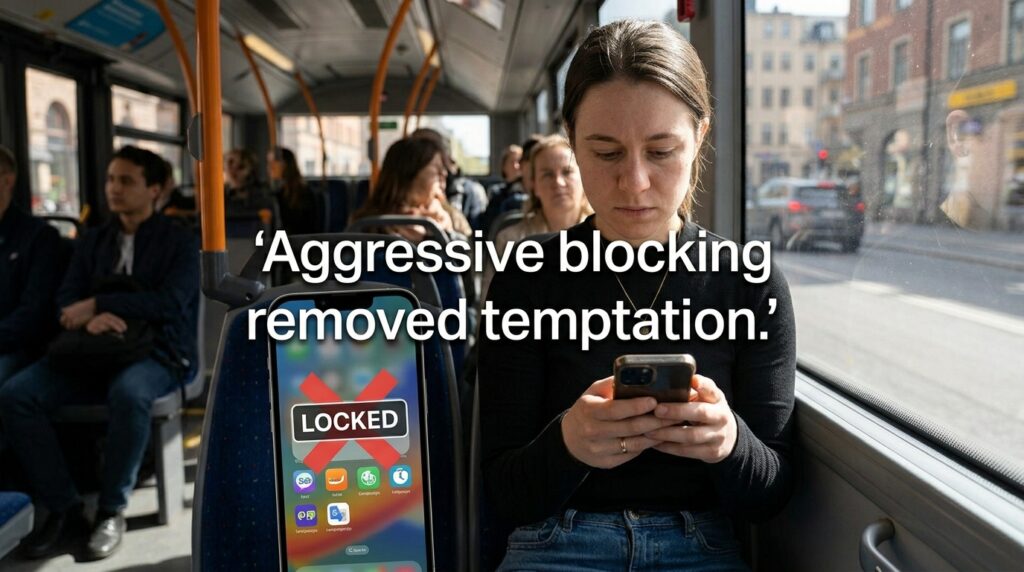
A smartphone is an incredible learning tool, but it is also the greatest distraction machine ever invented. It is incredibly easy to open your phone with the intention of doing flashcards, see an Instagram notification, and lose thirty minutes.
To combat this, I had to get ruthless with my screen time. I employed aggressive software blockers, a strategy I outlined step-by-step in my guide on (How I Reduce Distractions Using Mobile Apps). During my designated study blocks, I used apps that physically locked me out of my social media feeds. If I opened my phone during my commute, the only applications I was legally allowed to access were my language tools. I removed the temptation entirely.
Final Thoughts on the Portable Classroom
About a year and a half after I started this digital experiment, I finally took that trip to Madrid.
I vividly remember walking into a crowded, noisy café near the Plaza Mayor. The waiter approached my table, speaking at what felt like a hundred miles an hour.
I didn’t freeze. I didn’t reach for Google Translate. I smiled, ordered my café con leche and a pastry, and asked him for directions to a nearby museum—all entirely in Spanish. He didn’t switch to English. He just treated me like any other customer.
As I sat there sipping my coffee, I pulled my smartphone out of my pocket and set it on the table.
This little glass rectangle didn’t just distract me anymore. It wasn’t just a toy for scrolling through pictures or reading angry political debates. By intentionally curating the software I used, and by stealing back fifteen minutes of dead time here and there throughout my day, I had turned my phone into a key.
You don’t need to move to a foreign country to immerse yourself in a language. You don’t need to spend thousands of dollars on university classes, and you don’t need to haul heavy textbooks around in your backpack.
The most powerful classroom in the world is already sitting in your pocket. You just have to decide to open the right apps. Delete the games that are wasting your time, download a flashcard deck, change your phone’s language settings today, and start building your own digital immersion. The world is waiting to talk to you.
