
For a very long time, my relationship with fitness was built entirely on guesswork and guilt.
I would walk into a crowded gym on a Monday evening, look around at the sea of metal and sweat, and realize I had absolutely no plan. I would wander over to the dumbbell rack, pick up a weight that felt reasonably heavy, do a few biceps curls until it burned, and then move on to a cardio machine.
If you had asked me what my bench press was, or how many miles I ran the previous month, I wouldn’t have been able to give you a straight answer. I was just showing up, hoping that the sheer act of being inside a building that smelled like rubber and protein powder would somehow transform my body.
It didn’t. I was working incredibly hard, but I was spinning my wheels. I would get frustrated by the lack of visible progress, assume I just didn’t have the “genetics” for fitness, and quit for three months.
The turning point happened when a personal trainer friend of mine looked at my chaotic, plan-less gym routine and told me something that completely shifted my paradigm: “You cannot manage what you do not measure.”
If you don’t know exactly what you lifted last week, how can you possibly know what you are supposed to lift today? If you don’t know how far you ran on Tuesday, how do you know if you are actually getting faster by Friday?
I tried using a physical notebook, but it got soaked in sweat, the pages tore, and trying to do the math to calculate my volume while out of breath was a nightmare. That is when I realized I was carrying a supercomputer in my pocket. I just needed to stop using it to scroll through social media between sets and start using it as my dedicated fitness dashboard.
During my early days, I bounced between dozens of platforms, an exhausting process I documented in (I Tried 5 Fitness Apps — Only One Kept Me Motivated), before realizing that simplicity is the ultimate feature. You don’t need an app that promises to do everything poorly; you need a few apps that do one thing perfectly.
If you are tired of working hard without seeing results, here is exactly how to track your fitness goals using mobile apps that actually work.
Phase 1: Tracking the Iron (Strength and Hypertrophy)
The core principle of building muscle and getting stronger is called “progressive overload.” This simply means that your body adapts to stress. If you lift 100 pounds for 10 reps every single week for a year, your body has absolutely no reason to grow stronger. You have to constantly force it to do just a little bit more—whether that is adding five pounds to the bar or squeezing out one extra repetition.
Trying to track progressive overload in your head is a fool’s errand. You will forget.
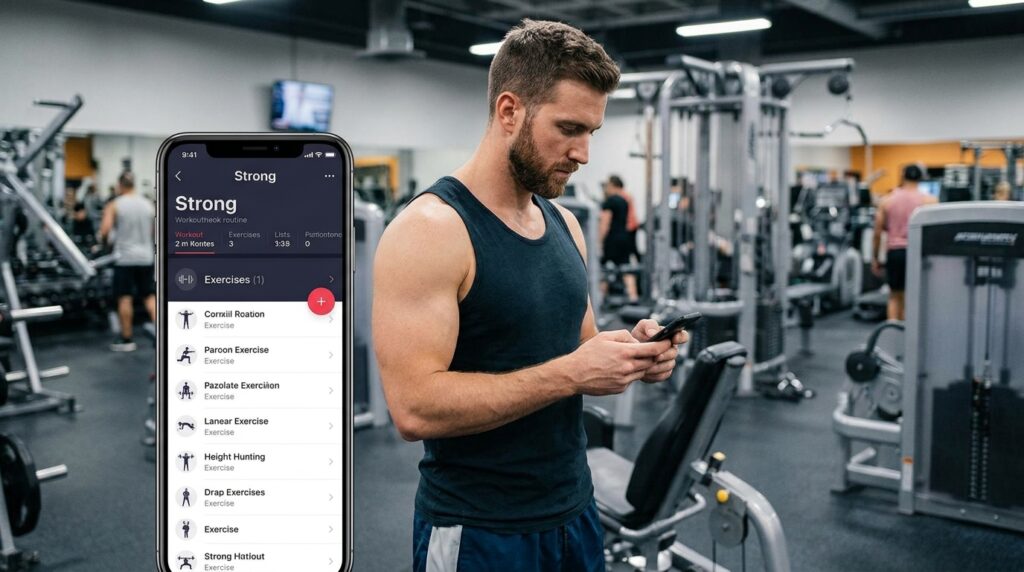
For the weight room, the only app I use is Strong (though Hevy is a phenomenal, slightly more social alternative).
The beauty of Strong is its clean, data-driven interface. When I walk into the gym, I open the app and select my “Pull Day” routine. The app tells me exactly what exercise is up first: Deadlifts. But more importantly, right below the name of the exercise, it shows me a tiny line of gray text: Last time: 225 lbs x 8 reps.
That tiny line of text completely dictates my workout. I know, with mathematical certainty, that if I want to progress today, I either need to lift 230 pounds, or I need to lift 225 pounds for 9 reps. The app removes all the emotion and guesswork from the equation.
Furthermore, the moment I log my set and check the little circle on the screen, Strong automatically triggers a rest timer. It buzzes my wrist two minutes later, telling me it is time to lift again. It stops me from getting distracted, sitting on a bench for ten minutes, and losing my pump.
Phase 2: Tracking the Engine (Cardio and Endurance)
Tracking cardiovascular fitness requires an entirely different set of metrics. You aren’t tracking weight; you are tracking distance, pace, elevation, and heart rate.
For this, Strava is the undisputed heavyweight champion.
Strava uses your phone’s GPS (or syncs seamlessly with your Apple Watch or Garmin) to map exactly where you ran, cycled, or swam. It gives you a beautiful, colorful map of your route and breaks down your pace minute by minute.
But the real reason Strava works is the psychological leverage of its community. Strava is essentially a social media network specifically for people who like to sweat. When you finish a grueling 5K run and upload it, your friends can give you “Kudos” (the Strava equivalent of a “Like”).
This might sound trivial, but on a cold Tuesday morning when my alarm goes off at 6:00 AM and I am desperately trying to justify skipping my run, the thought of having a blank spot on my Strava feed—and knowing my running group will notice I stayed in bed—is often the exact push I need to lace up my shoes. It gamifies the suffering of cardio.
Phase 3: Tracking the Fuel (Nutrition and Macros)
Here is a harsh reality that took me years to accept: you cannot out-train a bad diet. You can spend two hours in the gym every single day, but if your nutrition is entirely disconnected from your goals, your body composition will not change.
However, tracking food is a psychological minefield. A lot of legacy apps use aggressive, red-colored warnings when you go over your calorie goal, creating a cycle of guilt and shame around eating.
If you find yourself obsessing over every single calorie to the point of anxiety, you need to step back. I wrote a comprehensive guide on (Tips for Tracking Your Fitness Without Feeling Overwhelmed) that tackles the mental side of data tracking. You have to view food as data, not as a moral failing.
To achieve this neutral, data-driven approach, I switched to an app called MacroFactor.
MacroFactor was built by scientists and bodybuilders, and it operates entirely differently from other food trackers. It does not judge you. If you eat a whole pizza on a Friday night, the screen doesn’t turn red. It just accepts the data.
What makes MacroFactor incredible is its dynamic algorithm. You log your food, and you log your morning body weight. The app constantly analyzes the relationship between those two numbers. After a week or two, it calculates your precise, personalized resting metabolic rate. It doesn’t use a generic online calculator; it learns how your specific body processes energy.
If your goal is to lose fat, it will automatically adjust your daily calorie and protein targets every week based on what your metabolism is actually doing. It acts as an unbiased digital nutritionist in your pocket, constantly steering the ship toward your goal.

Phase 4: Tracking the Battery (Recovery and Sleep)
This was my biggest blind spot. In my quest to get fit, I glorified the “hustle.” I thought that more volume, more sweat, and more days in the gym automatically equaled more results.
I ended up with chronic joint pain, a plateau in my strength, and a deep, lingering sense of fatigue.
Muscle is not built while you are lifting weights. When you lift, you are physically tearing the muscle fibers down. The muscle is built while you are asleep in your bed, recovering. If you only track your output and completely ignore your recovery, you are driving a car with the pedal to the metal while the oil light is flashing.
I started taking my recovery as seriously as my workouts. I use AutoSleep (paired with my Apple Watch) to track what happens when my eyes are closed.
AutoSleep doesn’t just tell me how many hours I was in bed; it tracks the quality of those hours. It measures my Heart Rate Variability (HRV) and the time I spend in Deep and REM sleep stages.
When I wake up, the app gives me a “Readiness Score.” If my score is a 95%, I know my central nervous system is fully recovered, and I can push hard in the gym. But if I wake up and my score is a 40% because I had a late dinner and slept poorly, the data is telling me to back off. On those days, I skip the heavy deadlifts and do a light yoga session instead. Tracking my recovery completely eradicated my chronic injuries because I finally started listening to the biological data my body was transmitting.
Phase 5: Tracking the Mind (Consistency and Habits)
You can have the best strength tracker, the most accurate GPS, and the smartest nutrition algorithm on the planet, but none of it matters if you only open the apps once a month.
Fitness is not about the heroic intensity of a single workout. It is about the quiet, boring consistency of doing the right things, day after day, week after week, even when you aren’t motivated.
Your body is entirely unique, which is why I highly recommend checking out my framework for (How to Use Fitness Apps to Build a Personalized Routine) so you aren’t just blindly following a generic template built for someone else’s lifestyle. But once that routine is built, you have to protect the habit itself.
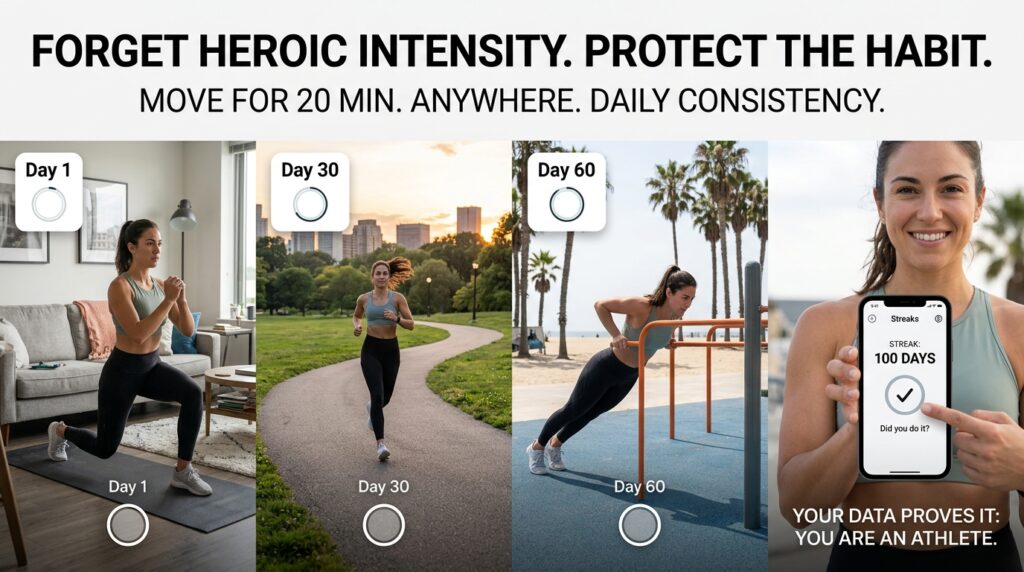
For this, I use a shockingly simple app called Streaks.
Streaks isn’t for tracking sets or reps; it is purely for tracking binary actions. Did you do the thing, or did you not?
I have a daily goal in Streaks simply labeled “Move for 20 Minutes.” It doesn’t matter if that is a grueling weightlifting session, a run, or just a brisk walk around the neighborhood while listening to a podcast. As long as I intentionally move my body for twenty minutes, I get to tap the circle and watch my streak grow.
When my streak hits 50, 60, or 100 days, it creates a powerful psychological anchor. I no longer identify as “someone who is trying to get in shape.” I identify as an athlete, because an athlete is simply someone who moves every single day. The data proves my identity.
Final Thoughts on Becoming a Scientist of Your Own Body
Before I started tracking, my body felt like a confusing, unpredictable machine. I would gain weight and not understand why. I would feel weak in the gym and blame myself for being lazy.
When you download these apps and start religiously logging the data, the mystery completely disappears.
Fitness is not magic. It is biology and mathematics. If you eat in a caloric surplus with adequate protein and apply progressive mechanical tension to your muscles, you will grow. If you eat in a caloric deficit and move your body, you will lose fat.
The apps on your phone are not there to do the work for you. You still have to sweat, you still have to breathe hard, and you still have to say no to the second slice of cake. But the apps act as your navigation system.
They show you the exact coordinates of where you are starting, they map the most efficient route to your destination, and they warn you when you are drifting off course.
Stop guessing. Take your smartphone into the gym tomorrow. Log your very first set. Track your first run. Record your first meal. Once you see the hard data appearing on your screen, the anxiety fades, the clarity sets in, and the actual, tangible progress finally begins.
