
The human body has a very strange, often frustrating way of keeping score.
A few years ago, I started noticing a bizarre physical phenomenon happening to me every single evening. I would wrap up my workday, shut my laptop, and sit down on the couch. By all external measures, the stressful part of my day was over. I was in my own home, the lights were dimmed, and I was safe.
But my jaw would be locked so tightly it ached. My shoulders were practically touching my earlobes. My breathing was shallow, trapped somewhere in the top two inches of my chest.
My brain knew I was off the clock, but nobody had informed my nervous system. I was carrying the residual, vibrating energy of eight hours of back-to-back video calls, urgent emails, and the general chaotic hum of navigating city traffic here in Rio.
I tried all the standard advice to “unwind.” I poured a glass of wine, but that just made me groggy. I turned on the television, but the flashing lights and loud dialogue only overstimulated me further. I tried reading, but my eyes would scan the same paragraph four times without absorbing a single word because my mind was still replaying a tense conversation I had with a client at noon.
I needed an intervention. I needed something that could actively guide my brain out of its fight-or-flight loop and land it safely back in the present moment.
Turning to my smartphone to find peace felt incredibly counterintuitive at first. After all, wasn’t the phone the source of half my daily anxiety? However, once I learned to curate my digital space—a process I documented when exploring (How I Reduce Distractions Using Mobile Apps)—I realized that the device itself is neutral. It is the software that dictates the experience.
I decided to run an experiment. I turned off all my notifications, put on my noise-canceling headphones, and started testing the waters of digital mindfulness.
It wasn’t an overnight fix, and I had to kiss a lot of digital frogs to find the right fit. Some apps were too mystical for my pragmatic brain, while others were too clinical and cold. But eventually, I curated a rotation of tools that fundamentally shifted how I decompress.
If you are struggling to leave your work stress at the door, here are the 6 meditation apps that actually helped me relax when my mind simply wouldn’t shut off.
1. Headspace: The Friendly Introduction to Stillness
When I first decided to try meditation, I was incredibly intimidated. I had this preconceived notion that I needed to sit in a perfect lotus position for an hour and completely empty my mind of all thoughts. Since my brain is basically a browser with eighty tabs open at all times, I assumed I was simply incapable of meditating.
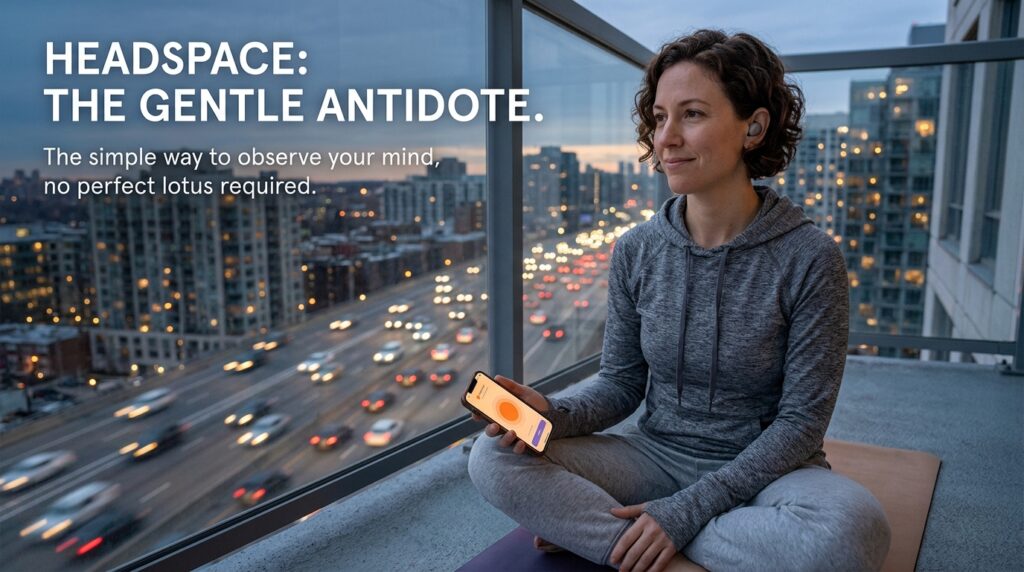
Headspace was the perfect antidote to that intimidation.
The app doesn’t take itself too seriously. It is filled with quirky, charming animations that explain the complex neuroscience of the brain using simple metaphors, like watching cars drive by on a busy highway instead of running out into traffic to stop them.
The co-founder, Andy Puddicombe, is a former Buddhist monk with a voice that sounds like a warm, comforting cup of tea. His guided sessions start at just three minutes long. He constantly reassures you that it is perfectly normal for your mind to wander. When I was first learning to build this habit, I relied heavily on this gentle approach, an experience I expanded upon when writing about (How to Use Mindfulness Apps to Reduce Stress).
Headspace taught me the absolute basics without making me feel like a failure. It gave me the foundational tools of body scanning and breath focus that I still use every single day. If you are a complete beginner who is highly skeptical of the whole “mindfulness” industry, this is the safest, most welcoming place to start.
2. Calm: The Ultimate Sleep Savior
While Headspace was fantastic for my daytime anxiety, my evenings presented a completely different challenge.
There were nights when I felt physically exhausted, but the moment my head hit the pillow, my brain would suddenly decide it was the perfect time to review every awkward thing I had said since 2014. Insomnia fueled by stress is a brutal, isolating experience.
I downloaded Calm specifically for their “Sleep Stories,” and it completely changed my nocturnal routine.
Sleep Stories are exactly what they sound like: bedtime stories for adults. But they aren’t thrilling mysteries or gripping dramas. They are beautifully written, incredibly descriptive, deliberately slow narratives designed to gently distract your conscious mind until you drift off.
You can listen to the actor Matthew McConaughey describe the slow, meandering path of a river, or hear Stephen Fry talk about the lavender fields of Provence. The audio engineering is phenomenal, mixing soothing voice work with high-fidelity nature sounds.
Because the stories give my anxious brain something safe and mundane to focus on, it stops spinning out of control. I have listened to dozens of Sleep Stories on the Calm app, and to this day, I have absolutely no idea how any of them end because I am always asleep within fifteen minutes.
3. Insight Timer: The Global Community Sandbox
After I had grasped the basics of guided meditation, I started feeling a little restricted by the structured courses of the premium apps. I wanted to explore different styles, different teachers, and different philosophies without paying a massive subscription fee.
That is when I stumbled into Insight Timer.
If Headspace is a structured classroom, Insight Timer is a massive, sprawling digital sandbox. It boasts a library of over 100,000 free guided meditations, sound baths, ambient music tracks, and philosophical talks from teachers all over the globe.
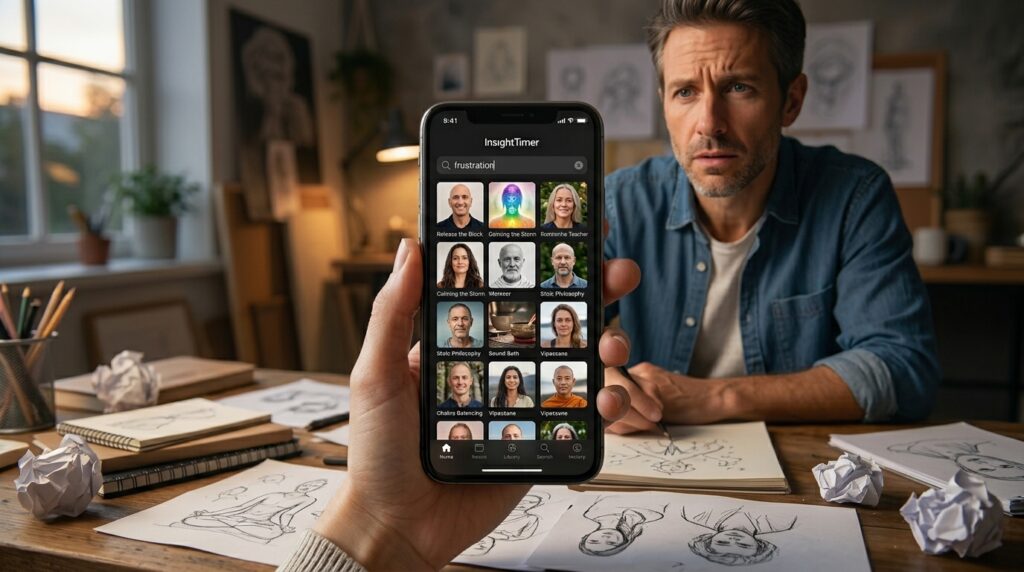
What I love most about this app is its sheer variety. If I come home feeling a specific type of stress—let’s say, frustration after a creative block—I can literally type “frustration” into the search bar and find fifty different tracks specifically designed to address that exact emotion.
It also features a highly customizable, unguided timer. On the days when I don’t want to hear a human voice, I just set the timer for ten minutes, choose a deep, resonant Tibetan singing bowl sound as my interval bell, and sit in silence.
There is also a fascinating community aspect. When you finish a session, the app shows you a map of the thousands of other people around the world who were meditating at the exact same time as you. Seeing that visual representation of global stillness is oddly comforting on a lonely, stressful evening.
4. Ten Percent Happier: The Pragmatist’s Lifeline
There is a very specific type of stress that comes from corporate burnout. It is a cynical, exhausted flavor of stress. When I was in the thick of a terrible quarter at work, the last thing I wanted to hear was someone telling me to “open my heart chakra” or “send love into the universe.” I was angry, and that language just irritated me.
Ten Percent Happier is the meditation app built specifically for skeptics.
It was created by Dan Harris, a news anchor who famously had a panic attack live on national television and subsequently turned to meditation to save his career. The app completely strips away the mystical, esoteric language of mindfulness and replaces it with cold, hard neuroscience and practical application.
The teachers on this app speak to you like normal human beings. They acknowledge that life is hard, that jobs are stressful, and that sitting still is genuinely annoying sometimes.
The app features incredible video courses that interview leading scientists about exactly what meditation physically does to the gray matter of your brain. Knowing the biological “why” behind the practice made it infinitely easier for my logical brain to accept. It didn’t ask me to change my entire personality; it just promised to make me about ten percent happier, which was exactly the realistic margin I was looking for.
5. Waking Up: The Philosophical Deep Dive
Once I had been meditating for about a year, the practice shifted from a simple relaxation tool to something much more profound. I started asking deeper questions about why my thoughts had so much power over me in the first place.
I downloaded Waking Up, created by neuroscientist and philosopher Sam Harris, and it completely blew the doors off my understanding of consciousness.
This app is not for the faint of heart. It doesn’t just want to help you relax after a tough day; it wants to fundamentally deconstruct your sense of self.
The daily guided meditations are rigorous. Harris challenges you to look closely at the physical sensation of anxiety. Where is it located in the body? What is it actually made of? He teaches you to observe your thoughts not as facts, but as temporary weather patterns passing through the sky of your mind.
Beyond the meditations, the app contains hours of fascinating audio courses on stoicism, time management, and cognitive behavioral therapy. It completely shifted how I view my daily routine, a transformation I explored deeply in my essay about (A Lifestyle App That Made Me Rethink My Daily Routine).
When I use Waking Up after a stressful day, I don’t just feel calm; I feel a deep, structural sense of perspective. It reminds me that the urgent email that ruined my afternoon is ultimately just a tiny, meaningless blip in the grand scheme of human experience.
6. Aura: The Algorithm of Immediate Relief
Sometimes, you don’t have twenty minutes to sit on a cushion. Sometimes, you are hiding in a bathroom stall at a crowded restaurant, or sitting in your parked car before walking into a difficult family gathering, and you are on the verge of a full-blown panic attack.
For those moments of acute, overwhelming stress, Aura is my absolute go-to.
Aura operates on a sophisticated personalization algorithm. When you open the app, it immediately asks you a simple question: “How are you feeling right now?”
You tap an emotion—Anxious, Sad, Stressed, Unmotivated, or Restless.
Based on your answer, the app uses machine learning to instantly generate a micro-meditation, usually lasting exactly three minutes. You don’t have to scroll through libraries or make any decisions. The app just hands you the exact piece of audio you need at that exact second.
These three-minute interventions act like a circuit breaker for my nervous system. I can put my AirPods in, close my eyes in the passenger seat of an Uber, and do a rapid, intense breathing exercise that pulls me out of a downward spiral. It is the digital equivalent of a stress-relief emergency kit.

Final Thoughts on Finding Your Digital Sanctuary
The modern world is incredibly loud. We are subjected to a relentless barrage of news, demands, and notifications from the moment we wake up until the moment we fall asleep.
It is entirely unreasonable to expect your brain to simply turn off like a light switch at the end of the day. You cannot go from moving at a hundred miles an hour to a dead stop without experiencing some serious whiplash.
You have to actively build an off-ramp for your mind.
For a long time, I resisted using my phone as part of my wellness routine because I blamed the screen for my stress. But the truth is, these devices are just empty vessels. They can be a portal to infinite anxiety, or they can be a sanctuary of profound peace. You are the one who gets to choose what you download.
If your evenings are currently defined by a tight chest, a racing mind, and a locked jaw, I urge you to stop trying to force yourself to relax.
Pick one of the apps from this list. It doesn’t matter if you choose the friendly animations of Headspace, the deep philosophy of Waking Up, or the community vibe of Insight Timer.
Just download one. Commit to three minutes of sitting still before you turn on the television or pour a drink. Allow a guided voice to remind your nervous system that you are safe, that the workday is over, and that you are allowed to put the burden down.
It might feel a little awkward the first few times you try it. But stick with it. The moment you finally feel your shoulders drop away from your ears and your breathing return to its natural rhythm, you will realize that a little bit of digital stillness is the ultimate luxury in a chaotic world.
