
If you were to walk into my bedroom a few months ago, you would have immediately noticed the towering, precarious stack of books sitting on my nightstand.
It was an impressive collection. There were massive, 600-page historical biographies, a few trendy self-help paperbacks with bright yellow covers, and some classic literary fiction that I felt I should have read in college but never actually did.
To a casual observer, I looked like a voracious intellectual. I looked like someone who spent their evenings sipping chamomile tea and diving into deep, complex narratives.
But that stack of books was a complete lie.
It wasn’t a reading pile; it was a museum of good intentions. It was a physical manifestation of the person I desperately wanted to be, rather than the person I actually was.
The sad, undeniable truth was that those books were collecting dust. Every night, I would get into bed, look at the beautiful, crisp spine of a new novel, tell myself “I’m just too tired tonight,” and then proceed to spend the next ninety minutes mindlessly scrolling through short-form videos on my phone until my eyes burned.
The Loss of the “Deep Reading” Brain
When the end of the year rolled around, social media was flooded with people posting their reading challenges. Friends were sharing graphics boasting that they had conquered fifty, sixty, or even a hundred books in twelve months.
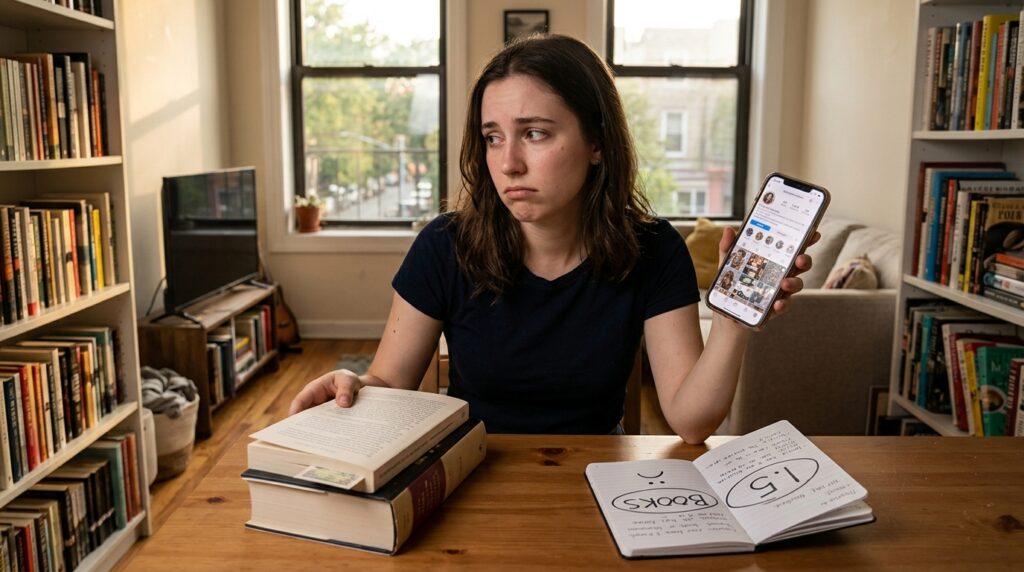
I sat down and honestly tried to tally up my own list.
I had read exactly one and a half books.
It hit me like a punch to the stomach. I used to be a reader. When I was younger, I could disappear into a paperback for an entire Saturday afternoon. But somewhere along the line, my brain had fundamentally changed. My attention span felt fractured. My dopamine receptors were completely fried by the instant gratification of notifications and endless feeds.
If a paragraph was longer than a tweet, my eyes would glaze over. I felt a profound sense of intellectual decay. I wasn’t just losing out on good stories; I felt like I was losing my ability to think deeply and focus quietly.
I knew I needed a radical intervention.
The Failed “Analog” Approach
My first attempt to fix the problem was rooted in pure, aggressive willpower.
I decided I was going to ban my phone from the bedroom. I bought an old-school, analog alarm clock. I declared that from 9:00 PM onwards, I was living in the 19th century. No screens, no internet, just me and the printed word.
It was a miserable disaster.
The silence of the room was deafening. My brain, addicted to the fast-paced stimulation of the internet, fought back viciously. I would read the same page of a novel four times and realize I hadn’t comprehended a single word because my mind was racing, wondering what emails I was missing or what the current news cycle was doing.
I was treating reading like a punishment. I was forcing it.
I realized then that relying on sheer willpower to completely overhaul a deeply ingrained digital habit is a losing game. I had already learned this lesson in other areas of my life, which I detailed heavily when I wrote about The Productivity App That Changed How I Work Every Day. You cannot fight friction with force; you have to redesign the system.
If You Can’t Beat the Screen, Use the Screen
I sat down and analyzed my actual behavior.
Why was I picking up my phone instead of a book? It wasn’t because the content on my phone was better. It was because the phone was frictionless. It was always in my pocket. It didn’t require two hands to hold open. It didn’t require an external light source. It was effortless.
I realized that if I wanted to read more, I had to stop fighting the screen and start hijacking it. I needed to put my books exactly where my bad habits lived.
That is when I abandoned the romantic idea of physical paperbacks and downloaded a dedicated, high-powered digital reading app.
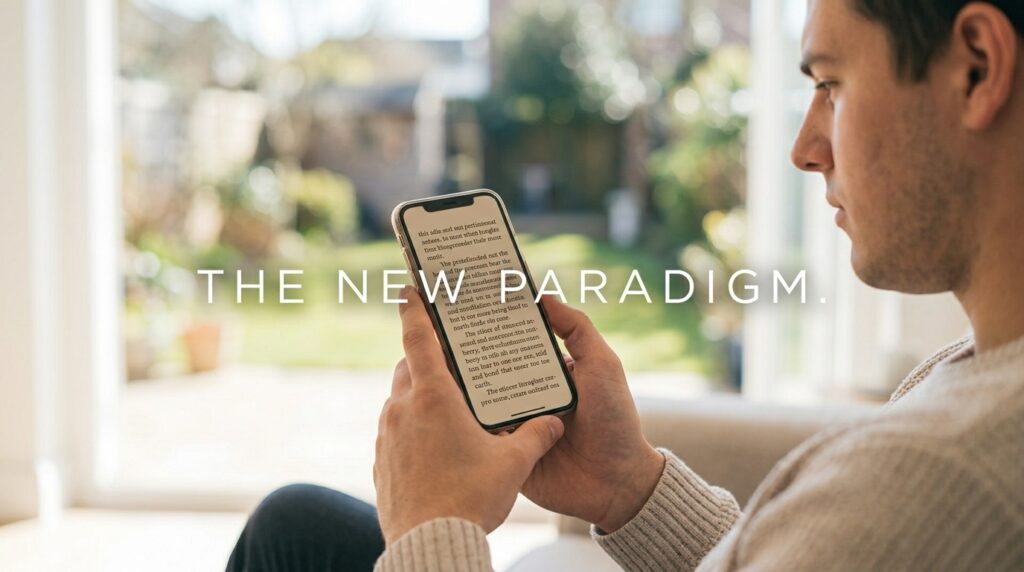
I know what you are thinking. “Reading on a phone is terrible. The blue light! The notifications!” I had all the same prejudices. But this specific app completely changed my entire paradigm.
Connecting to the Public Library Ecosystem
The first massive barrier the app removed was the financial friction.
Buying new books is expensive. If I bought a $25 hardcover and realized by chapter two that I hated the author’s writing style, I felt obligated to finish it because I had spent the money. This “sunk cost fallacy” would paralyze me. I would stop reading entirely rather than abandon a book I paid for.
The app I downloaded acts as a digital bridge to my local public library.
I plugged in my library card number, and suddenly, I had an entire universe of high-quality, commercially published ebooks and audiobooks available to me for exactly zero dollars.
This completely changed how I experimented with genres. If a book didn’t grab my attention within the first twenty pages, I simply returned it with a swipe of my thumb and downloaded something else. There was no guilt. There was no financial loss. I became ruthless with my attention, which paradoxically made me much more excited to dive into the next title.
The Magic of the “Five-Minute Pocket”
Perhaps the biggest lie we tell ourselves about reading is the myth of the “perfect environment.”
We convince ourselves that in order to read, we need an hour of uninterrupted time, a comfortable armchair, a blanket, and a cup of artisan coffee. Because that perfect scenario rarely happens in our chaotic adult lives, we never read.
The mobile app taught me how to read in the cracks of my day.
I call these “Five-Minute Pockets.”
A few weeks ago, I was standing in line at the grocery store. The person in front of me was arguing over a coupon, and the line was completely stalled. In the past, this was a trigger to pull out my phone and open Instagram.
Instead, I opened my reading app.
I read exactly four pages of a thrilling science fiction novel while waiting for the cashier. It wasn’t a deep, immersive, hour-long session. But it was four pages.
Later that day, I was sitting in my car waiting for my partner to finish an appointment. I read ten more pages. While waiting for a pot of water to boil for pasta that evening, I read three more.
By the end of the day, I had read thirty pages without ever officially “sitting down to read.” It is the exact same compounding philosophy I use to keep my daily chores from piling up, which is why How a Simple To-Do App Made My Life Less Stressful remains one of my core operational beliefs. Small, consistent actions taken in the margins of your life add up to massive, undeniable results.
The Audio-Visual Synchronization
One of the absolute killer features of this digital transition was discovering the seamless ecosystem between audio and text.
I used to consider audiobooks “cheating.” I have since abandoned that incredibly pretentious notion. Reading with your ears is still reading. It still stimulates the imagination and expands your vocabulary.
The beauty of the app is how it handles the handoff.
I can be doing the dishes, wearing my wireless headphones, listening to the narrator deliver a gripping chapter of a mystery novel. When the dishes are done and I sit down on the couch, I can open the app on my screen. The software knows exactly what sentence the audio narrator just finished.
With a single tap, the audio stops, and I seamlessly transition to reading the text with my eyes right where the voice left off.
This adaptability means I am never away from the story. I don’t have to choose between doing my chores and enjoying a book. I can weave the narrative directly into the mundane activities of my daily existence.
Customizing the Visual Experience
Let’s address the elephant in the room: reading on a harsh, bright smartphone screen can be awful for your eyes.
But a truly premium reading app isn’t just a PDF viewer; it is a highly customizable interface designed to reduce visual fatigue.
I spent ten minutes tinkering with the typography settings, and it made a world of difference. I changed the background from a harsh white to a soft, warm sepia tone. I increased the font size significantly, meaning my eyes didn’t have to strain to focus on tiny text. I increased the line spacing, allowing the words room to breathe.
I even experimented with a specialized font designed specifically for readers with dyslexia. Even though I don’t have dyslexia, the heavier weighting at the bottom of the letters anchors the text and prevents my eyes from skipping lines.
By taking the time to optimize the visual interface, the screen melted away. I was no longer staring at a glowing phone; I was just absorbing a story.
Gamification That Doesn’t Feel Cheap
I am usually incredibly skeptical of apps that try to gamify my behavior with badges and digital confetti. But the subtle tracking features in this reading app struck the perfect balance.
Just like I learned when I was intensely studying Spanish and documenting The Language Learning App That Actually Works for Me, having a visual representation of your consistency is a powerful psychological motivator.
The app doesn’t shame you for not reading for an hour. It simply tracks your “days read” streak.
There were nights when I was genuinely exhausted and wanted to just go to sleep. But then I would look at the app and see that I had a 14-day reading streak going. I didn’t want to break the chain. So, I would open the book, read just two paragraphs to satisfy the algorithm, and log my day.
More often than not, those two paragraphs would hook me, and I would end up reading a whole chapter. The tracker got me through the door, but the story kept me in the room.
The Knowledge Vault
The final piece of the puzzle that made me fall completely in love with digital reading was the highlighting ecosystem.
When I used to read physical books, I hated taking a pen to the pages. It felt like vandalizing a piece of art. If I read a profound quote that I wanted to remember, I would try to just commit it to memory, which meant I forgot it three days later.
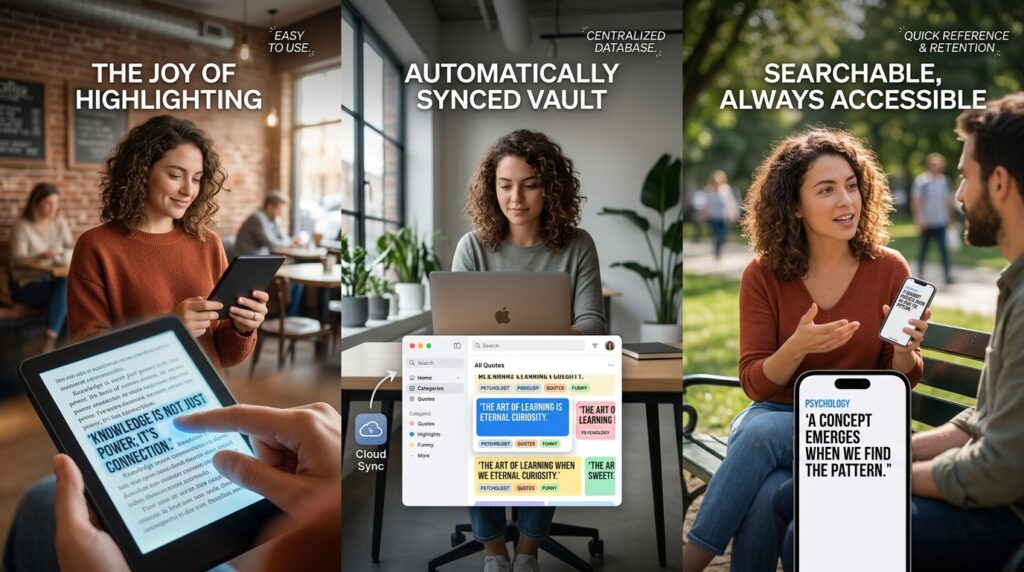
With the app, highlighting is an absolute joy. I simply drag my finger across a beautiful sentence, and it glows on the screen.
But it doesn’t just stay trapped in the book. The app automatically extracts every single highlight I make and syncs it to a centralized digital vault.
Now, I have a searchable, ever-growing database of every smart, funny, or moving thing I have ever read. If I am having a conversation with a friend and want to reference a specific psychological concept I read about months ago, I just open my vault, type a keyword, and the exact quote appears instantly. It makes me feel like I am actually retaining the knowledge I am consuming, rather than just letting it wash over me and disappear.
The Thirty-Day Tally
After one month of committing exclusively to this app, I sat down to review my progress.
I hadn’t locked my phone away. I hadn’t forced myself to wake up an hour earlier. I hadn’t fundamentally changed my schedule at all. I had simply replaced the friction of physical paper with the frictionless ease of a digital library, and swapped out my social media scrolling for “five-minute pockets” of reading.
In that single month, I read six entire books.
I read a memoir by a famous musician, a dense book on behavioral economics, three fast-paced thrillers, and a beautiful collection of essays.
I read more in those thirty days than I had in the previous fourteen months combined.
Final Thoughts
The narrative that technology is destroying our attention spans is only half true. Unintentional, algorithmic technology is absolutely destroying our attention spans.
But technology can also be the ultimate cure, provided you use it as a deliberate tool rather than a passive pacifier.
My brain isn’t broken. I hadn’t lost my ability to focus. My environment was simply stacked against my best intentions. By bringing my books into the exact device where my attention was already directed, I successfully hijacked my own bad habits.
If you are staring at a dusty stack of unread novels on your nightstand, feeling guilty every time you walk past them, give yourself permission to let them go. The medium doesn’t matter. The stories do. Download a great app, get a digital library card, and start reading in the cracks of your day. You might just rediscover the reader you used to be.
