
Have you ever woken up at 3:00 AM with your heart pounding because you suddenly remembered you forgot to pay the water bill?
Your eyes snap open in the pitch dark. The house is completely quiet, but your brain is suddenly screaming. You grab your phone from the nightstand, squinting against the harsh blue light, just to write a frantic note to yourself so you don’t forget it again in the morning. Then, you spend the next two hours tossing and turning, your mind racing through an endless, unorganized list of chores, emails, and obligations.
That used to be my reality almost every single night.
I was walking around carrying what I now call an “invisible backpack” filled with mental clutter. On the outside, I looked like a functioning, relatively successful adult. But on the inside, my brain was operating like a web browser with seventy-five tabs open, and music was playing from one of them, but I couldn’t figure out which one.
I relied almost entirely on my own memory to run my life. If a colleague asked me to send them a file by Friday, I just nodded and told myself to remember it. If we were running out of olive oil at home, I made a mental note. If my mom’s birthday was coming up, I trusted my brain to remind me to buy a card in time.
The problem is, the human brain is an incredible machine for processing complex emotions, solving creative problems, and dreaming up new ideas. It is an absolutely terrible machine for storing random data points.
The Breaking Point of Mental Gymnastics
My reliance on my own memory worked decently well in my early twenties when my responsibilities were minimal. But as I got older, my life became infinitely more complex.
The breaking point happened on a random Thursday afternoon. It wasn’t a massive catastrophe that brought my system crashing down; it was a domino effect of tiny failures. I had forgotten to pick up a specific medication my partner needed from the pharmacy on my way home from work. When I walked through the front door empty-handed, the look of quiet disappointment on their face crushed me.
To make matters worse, as I turned around to head back out to the pharmacy, my phone buzzed. It was an email from a very irritated client. I had completely missed a mid-day deadline for a project deliverable because I had been too focused on putting out a different fire that morning.
I sat in my car in the driveway and just cried. I wasn’t just dropping the ball; I was dropping all the balls, all the time. The constant, low-grade anxiety of feeling like I was always forgetting something important was slowly eating away at my happiness. It was causing tension in my relationship, making me look unprofessional at work, and robbing me of any ability to just sit on the couch and relax without feeling guilty.
I realized that if I didn’t find a way to outsource my memory, I was going to burn out completely.

The Trap of Overcomplicated Systems
My first instinct was to go to the extreme opposite end of the spectrum. I decided I needed a massive, complex project management system to fix my broken life.
I spent an entire weekend watching tutorial videos on how to build elaborate relational databases. I signed up for software that required me to categorize tasks by priority matrixes, assign color-coded tags, and link them to macro-level life goals. For a few days, I felt incredibly productive just setting up the system.
But by Wednesday, the entire thing had collapsed.
The system was simply too heavy. When you are standing in line at the grocery store and you suddenly remember you need to call the dentist, you don’t have five minutes to open a complex database, navigate through three folders, assign a priority tag, and link it to your “Healthcare” milestone. You need to get the thought out of your head in exactly three seconds.
Because the complex software had too much friction, I stopped using it. The unwritten tasks started piling up in my brain again, and the anxiety immediately returned. I was back to square one.
Discovering the Power of Frictionless Capture
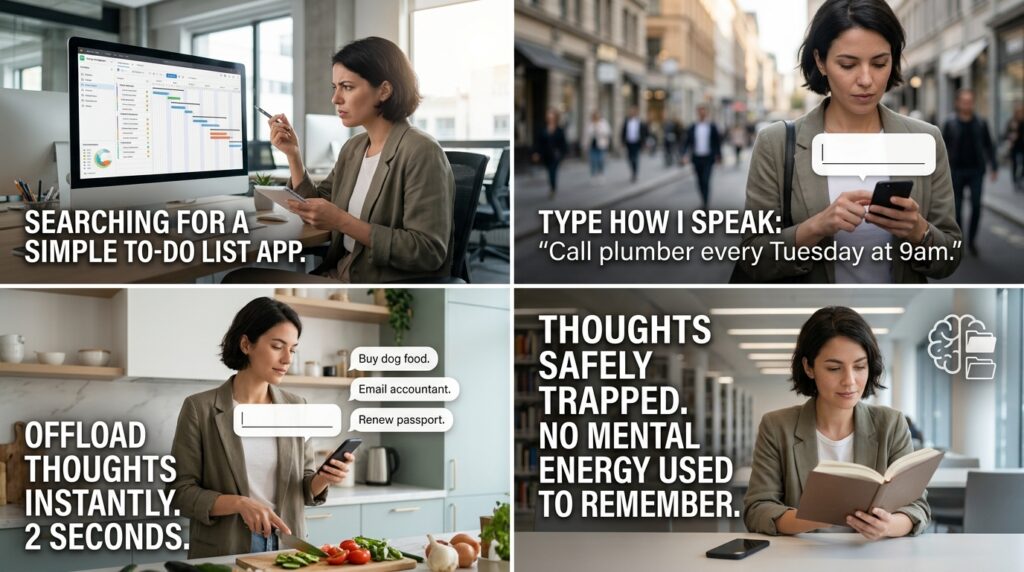
What I actually needed wasn’t a project management suite. I needed a digital piece of scratch paper that was always in my pocket, but smart enough to remind me when it mattered. I started searching for a simple to-do list app, completely paring down my requirements.
When you are trying to figure out How I Stay Organized While Managing Multiple Projects, the most crucial element you must prioritize is the speed of capture. The tool you use must be faster than a pen and paper.
I finally found an app that featured natural language processing, and it completely changed my life.
Instead of dealing with drop-down menus and calendar pickers, I could simply open the app and type the way I speak. I could type: “Call the plumber every Tuesday at 9am until they fix the sink.” The app’s algorithm would instantly understand my text, create the task, and automatically schedule a recurring reminder for every Tuesday at 9:00 AM.
That one feature—frictionless capture—was the magic key.
Suddenly, my phone wasn’t just a device for scrolling social media; it became an external hard drive for my brain. I put a massive widget for the app right on my home screen. The moment a thought popped into my head—”buy dog food,” “email the accountant,” “renew passport”—I typed it into the widget and hit enter.
It took two seconds. And more importantly, once I hit enter, the thought was safely trapped in the system. I didn’t have to use mental energy to remember it anymore.
The Nightly Brain Dump Ritual
Capturing tasks on the fly was a game-changer, but the true stress relief came when I instituted a daily ritual that completely cured my 3:00 AM anxiety wake-ups.
I call it the “Nightly Brain Dump.”
Every evening, about thirty minutes before I go to sleep, I open my to-do app. I look at my generic “Inbox” list—which is just a chaotic dumping ground of all the random thoughts I captured throughout the day.
I take five minutes to organize them. I assign a specific date to the things that actually need to get done. I move the random ideas into a “Someday/Maybe” folder. And I ruthlessly delete the things that sounded important at 2:00 PM but are actually completely irrelevant now.
Then, I look at my list for tomorrow. I ensure it is realistic. If there are twenty things on tomorrow’s list, I know I will just feel overwhelmed and paralyzed. So, I reschedule fifteen of them to later in the week, leaving only the absolute essentials.
This simple habit is profound. Because I have actively reviewed my upcoming responsibilities and trusted my system to hold them, my brain receives a psychological signal that it is “off duty.”
There is a psychological concept called the Zeigarnik effect, which states that people remember uncompleted or interrupted tasks better than completed tasks. Our brains hold onto unfinished business, creating a loop of background stress. Writing the tasks down and scheduling them closes that mental loop. The brain says, “Okay, we have a plan for that. We can stop worrying about it.”
Finding this rhythm didn’t happen overnight. I had to experiment with different scheduling philosophies, actively exploring various Tools That Help Me Plan My Week Without Stress before settling on this nightly review. But once it clicked, the insomnia vanished. I started sleeping through the night for the first time in years.
Contextual Lists: Organizing the Chaos
Once I got the hang of capturing tasks, I realized I needed a way to view them without feeling overwhelmed.
If you open your app and see “Finish quarterly tax report” right next to “Buy peanut butter,” your brain short-circuits. You are mixing highly stressful, high-energy cognitive tasks with low-energy errands.
The beauty of a digital to-do app is the ability to create contextual lists. I created a very simple folder structure:
-
Work: Strictly for professional obligations.
-
Home/Errands: For groceries, chores, and phone calls.
-
Personal/Creative: For books I want to read, movies to watch, and hobby ideas.
During my workday, I only click on the “Work” list. The app hides everything else. I am not distracted by the fact that I need to buy a birthday present for my nephew while I am trying to draft a contract.
Conversely, when Saturday morning rolls around, I don’t look at the Work list at all. I open the “Home/Errands” list. This compartmentalization allows me to be entirely present in whatever environment I am currently occupying.
The ultimate goal of this compartmentalization is mobility. I needed my lists to be accessible whether I was sitting at my desk or standing in the aisle of a hardware store. That is why I spent time mastering How I Organize My Tasks Using Only Mobile Apps. Because the app syncs instantly between my phone, my laptop, and my smartwatch, I am never disconnected from my “external brain.” If I remember something while out on a jog, I can just dictate it to my wrist, and it will be waiting for me on my computer when I get home.
The Dopamine of the Done List
We cannot talk about the stress-relieving power of a to-do app without talking about the physical, chemical reaction of checking an item off.
When you swipe a task and hear that little ding sound, your brain releases a tiny hit of dopamine. It is the exact same chemical pathway that social media apps use to keep you addicted to scrolling, but redirected toward your own personal growth and productivity.
On days when my stress levels are incredibly high, and I feel like I am drowning in work, I will literally write down ridiculously easy tasks just so I can check them off and build momentum.
I will write down:
-
Make coffee.
-
Drink one glass of water.
-
Open laptop.
Check. Check. Check.
Seeing that visual representation of progress instantly lowers my cortisol levels. It proves to my anxious brain that I am moving forward, even if the steps are tiny.
At the end of a long week, my favorite feature to look at is the “Completed” log. When you are in the thick of a stressful period, it is very easy to feel like you haven’t accomplished anything at all. You feel like you are just spinning your wheels. Looking back at a digital log showing eighty-five completed tasks over the last five days is incredibly validating. It provides concrete, undeniable proof that you are handling your business.

Reclaiming My Mental Real Estate
It has been over two years since I fully committed to offloading my memory into a simple to-do app. The transformation in my quality of life is difficult to put into words without sounding dramatic, but it is entirely true.
I am a significantly less stressed human being.
My partner no longer has to constantly remind me to do things, which has completely eliminated that specific strain of nagging tension from our household. My colleagues trust me deeply, knowing that if I say I will do something, it is instantly captured in my system and will absolutely get done.
But the most profound change has happened internally.
Because I am no longer using my brain’s precious processing power to remember to buy toothpaste or reply to an email, a massive amount of mental real estate has suddenly been freed up. I have more patience. I have more creative ideas. I can sit on my patio with a cup of coffee on a Sunday morning and actually just watch the birds, without a ticker-tape of chores running across the bottom of my vision.
Technology is often blamed for increasing our stress levels, keeping us hyper-connected and constantly bombarded with information. But when wielded correctly, it can act as an incredible shield.
A simple to-do app isn’t just a list of chores. It is a boundary. It is a vault where you can safely lock away your anxieties, obligations, and deadlines, allowing you to walk away and actually enjoy the life you are working so hard to manage. If you are feeling overwhelmed, stop trying to remember everything. Your brain deserves a break. Let the app do the heavy lifting.
