
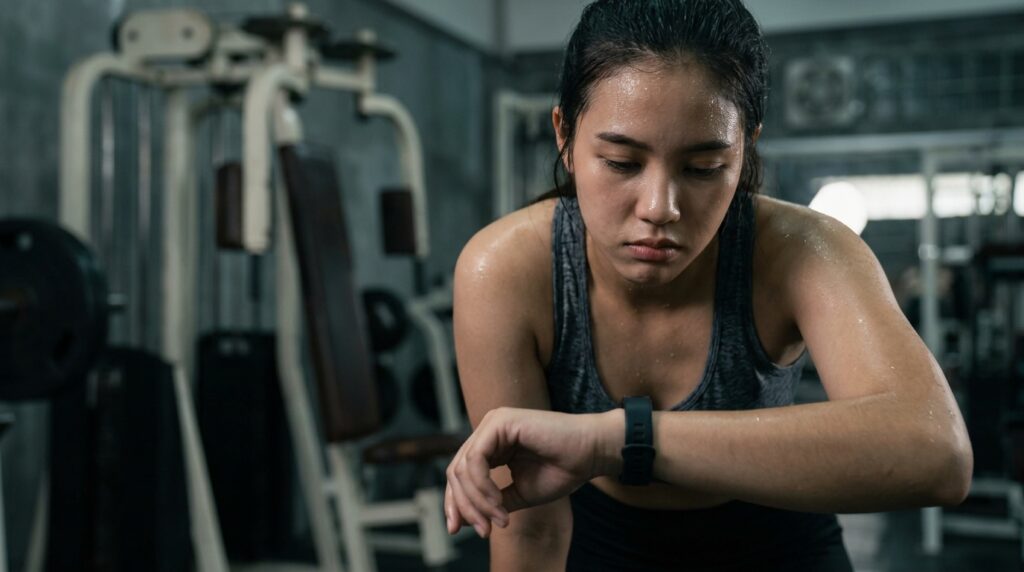
I can pinpoint the exact moment my relationship with fitness technology completely shattered. It was a crisp, early Tuesday morning about a year ago. I was halfway through a grueling 5K run on the pavement near my apartment. My legs felt like they were made of concrete, my lungs were burning, and I had a dull, throbbing headache that had started the moment I woke up.
I should not have been running. My body was practically screaming at me to stop, go back inside, and sleep for another three hours.
But I looked down at my wrist. The bright, colorful digital rings on my smartwatch were taunting me. I was on a 42-day “streak.” If I didn’t finish this run, the streak would die, and my digital watch would send me a passive-aggressive notification about missing my goals.
So, I pushed harder. And about two miles in, I felt a sharp, unmistakable pop in my right calf.
I had to limp two miles back to my apartment, defeated, in pain, and incredibly frustrated. As I sat on my couch with an ice pack strapped to my leg, I glared at my phone. The fitness app was completely oblivious to my injury. In fact, it was congratulating me on burning 300 calories.
It was a profound wake-up call. I realized that my fitness tracker wasn’t actually tracking my fitness; it was only tracking my movement. It didn’t care if I was exhausted, fighting off a cold, or on the verge of a muscle tear. It just wanted me to hit an arbitrary number of steps every single day, regardless of the biological cost.
I took the watch off and deleted the app. I needed a system that actually listened to my body instead of just barking orders at me. That search led me to an entirely different class of fitness tracking, and a specific app that has become so deeply embedded in my daily life that I check it before I even get out of bed.
The Tyranny of the Static Goal
To understand why this new app was such a revelation, we have to talk about why traditional fitness trackers are fundamentally flawed.
Most wearable tech operates on static goals. You set a goal of 10,000 steps, or 500 active calories, or 30 minutes of exercise. But human biology is not static. You are not a machine.
If you spent the entire weekend moving furniture, slept terribly on Sunday night, and woke up on Monday morning with a scratchy throat, your biological capacity for exercise is severely diminished. Expecting your body to hit the exact same 10,000-step goal on that Monday as it did on a perfectly rested Saturday is not just illogical; it is a recipe for chronic fatigue and injury.
Traditional apps treat rest like a failure. If you take a day off to recover, you lose your streak. You get a blank spot on your calendar. You are subtly punished for doing exactly what your muscles need to rebuild.
I desperately wanted to figure out How to Track Your Fitness Goals With Apps That Work, but I wanted a tool that understood that recovery is fifty percent of the fitness equation. I didn’t need a digital drill sergeant; I needed a digital physical therapist.
Enter the “Readiness” Paradigm
The app I eventually transitioned to (which pairs with a minimalist, screen-free wearable band) completely flipped the script. It operates on a philosophy of “Readiness.”
When I first opened the app, I was shocked to see that it didn’t even have a step counter. It doesn’t care how many steps I take. Instead, it measures the physiological stress on my body and tells me how prepared I am to take on more stress.
Every morning, the app gives me a Readiness Score from 1 to 100.
This score is not a guess. It is calculated using a complex algorithm that measures my resting heart rate (RHR), my respiratory rate, and most importantly, my Heart Rate Variability (HRV) while I sleep.
For those who don’t know, HRV is essentially the variation in time between your heartbeats. It is an incredible indicator of your nervous system’s balance. When your body is fully recovered and relaxed, your HRV is high. When your body is fighting off an illness, overtrained, or highly stressed, your HRV plummets.
This metric changed everything for me.
Now, when I wake up, I open the app. If my Readiness Score is a glowing green 92%, the app actively encourages me to go hard. It gives me a high “Strain” target for the day, telling me my body is primed to crush a heavy weightlifting session or a long run.
But if I wake up and my Readiness Score is a red 31%, the app’s interface changes. It tells me that my central nervous system is highly fatigued. It explicitly instructs me to prioritize rest, hydration, and light stretching.
The psychological relief of having a piece of software give me permission to rest was staggering. It removed all the guilt from taking a day off. I was no longer breaking a streak; I was actively following the data.
The Sleep Architecture Obsession
Before using this app, my understanding of sleep was incredibly basic. I thought that if I got into bed at 11:00 PM and my alarm went off at 7:00 AM, I got eight hours of sleep.
The tracking app showed me how incredibly wrong I was.
The sleep dashboard on this app is mesmerizing. It breaks down my night into exact stages: Awake, Light Sleep, REM (Rapid Eye Movement) sleep, and Deep Sleep.
I quickly realized that spending eight hours in bed did not equal eight hours of restorative sleep. During my first week of tracking, the app showed me that I was waking up twelve to fifteen times a night without even realizing it. More alarmingly, I was barely getting any Deep Sleep, which is the physical restoration phase where your body releases human growth hormone to repair muscle tissue.
No wonder my hamstring had popped during that 5K. I was working out constantly, but I wasn’t actually repairing any of the damage at night.
Armed with this data, I began treating my sleep with the same intensity that I used to treat my workouts. I started running self-experiments. If I wanted to optimize my life, I had to optimize my nights, a strategy that heavily influenced How I Built a Productive Daily Routine Using Apps. I used the tracker to see exactly how my lifestyle choices impacted my biological recovery.
The Brutal Truth About Alcohol and Late Meals
The most humbling part of using an advanced fitness tracking app is that you can no longer lie to yourself. The data is ruthlessly honest.
I used to love having a glass of red wine with dinner, or sometimes a late-night snack right before bed. I didn’t think it was a big deal.
Then I looked at the app.
On the nights I drank even a single glass of wine, my resting heart rate would stay elevated by an extra eight beats per minute for the entire night. My body was working overtime to process the alcohol instead of resting. My Deep Sleep would plummet by fifty percent, and my Readiness Score the next morning would invariably be in the yellow or red zone.
The same thing happened when I ate a heavy meal within two hours of going to sleep. My core body temperature would stay too high, destroying my sleep architecture.
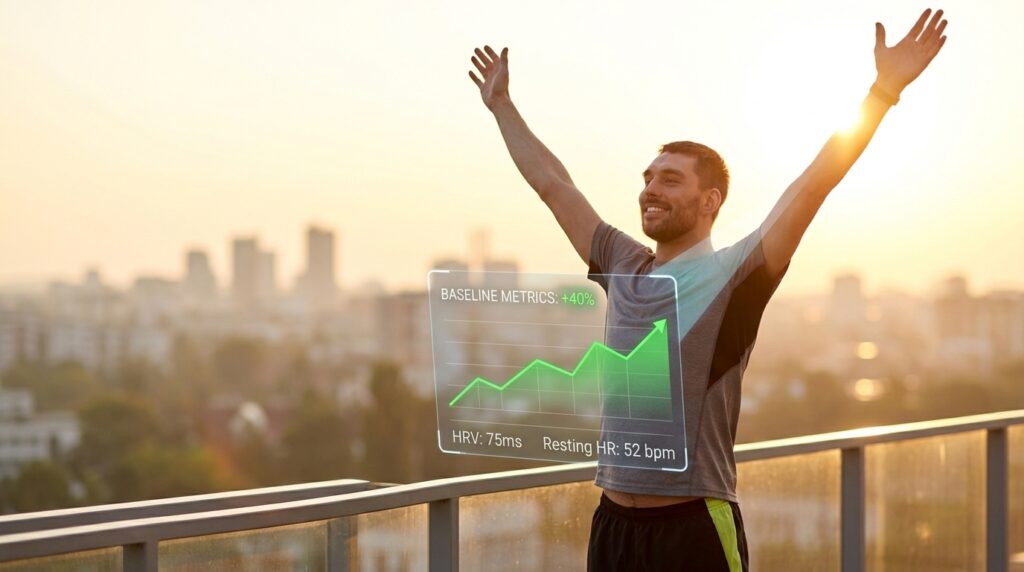
Seeing the undeniable, mathematical damage that these habits were causing my body completely changed my behavior. I didn’t need willpower to stop eating late at night; I just needed to see the data. I started finishing my dinners by 7:00 PM, and I reserved alcohol only for truly special occasions. Within a month, my baseline metrics skyrocketed. My resting heart rate dropped, my HRV climbed, and I started waking up with a level of natural energy I hadn’t felt since I was a teenager.
The Daily Journal: Connecting Behaviors to Outcomes
What makes this app truly sticky—the reason I haven’t abandoned it like the dozens of other trackers in my digital graveyard—is the daily journal feature.
Every morning, immediately after showing me my Readiness Score, the app prompts me to fill out a highly customized journal. It asks me simple yes or no questions about my behavior the day before.
-
Did you read before bed?
-
Did you consume caffeine after 2:00 PM?
-
Did you share your bed with a pet?
-
Did you view screens in bed?
-
Did you engage in a mindfulness practice?
I spend exactly thirty seconds checking off the boxes.
At the end of every month, the app’s algorithmic engine crunches all of this journal data against my biological recovery metrics and generates a Monthly Performance Assessment.
This report is pure gold. It explicitly tells me which behaviors are helping me and which are hurting me. For example, my report last month told me that on the days I reported “viewing screens in bed,” my REM sleep decreased by an average of 14 minutes. On the days I reported “reading a physical book,” my Deep Sleep increased by 11%.
It turns abstract health advice into personalized, actionable data. You always hear that looking at your phone before bed is bad, but when an app proves to you that your specific phone usage is robbing you of muscle recovery, you actually put the phone away.
This level of granular tracking is essential for anyone serious about self-improvement. It aligns perfectly with How I Use My Phone to Track Goals and Productivity. You can’t manage what you don’t measure, and this app measures the invisible variables of human health better than anything else on the market.
Shifting from “More” to “Optimal”
Perhaps the greatest gift this app has given me is a complete paradigm shift regarding what it means to be “fit.”
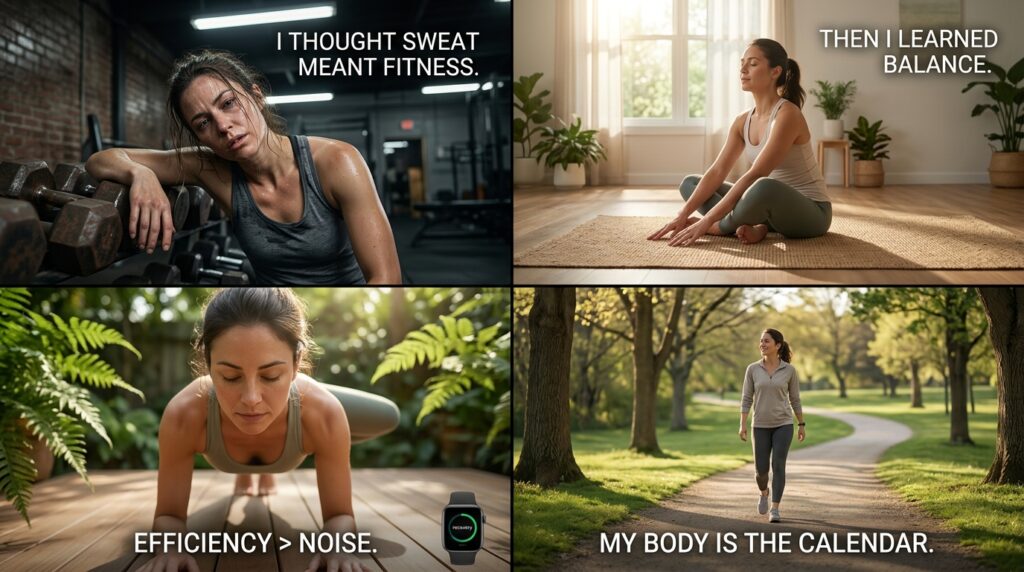
For the first thirty years of my life, I thought fitness was about sheer volume. I thought the person who sweated the most, ran the furthest, and lifted the heaviest was the healthiest. I wore my exhaustion like a badge of honor.
This app taught me that true fitness is about efficiency and balance.
It showed me that a 20-minute, highly focused yoga session on a day when my nervous system is fried is actually better for my long-term health than forcing myself through a miserable 45-minute HIIT workout. It taught me that recovery is not the absence of work; recovery is the period where the actual growth happens.
I no longer structure my week around an arbitrary workout calendar. I structure my week around my biology. If I plan to do heavy deadlifts on a Wednesday, but I wake up in the red zone, I don’t feel guilty about pivoting to a light walk instead. I know that pushing through the red zone will only lead to diminishing returns and potential injury.
Final Thoughts on Quantified Wellness
We live in an age where we track our finances down to the penny, we track our packages across the globe, and we track the exact engagement metrics of our social media posts. Yet, for so long, most of us have operated our own bodies entirely in the dark, guessing at our energy levels and hoping for the best.
Using an advanced fitness and recovery tracker is like finally turning the dashboard lights on in your car.
It is incredibly empowering to know exactly how your engine is running. It removes the guesswork from wellness. You stop following generic influencer advice and start following the specific, undeniable data generated by your own heart and lungs.
If you are stuck in a cycle of overtraining, chronic fatigue, and minor injuries, I highly recommend stepping away from the apps that yell at you to close your rings. Look for a tool that measures your strain against your recovery.
Start tracking your sleep architecture. Start tagging your daily behaviors. Give the algorithm a month to learn your baseline, and I promise you, the insights will absolutely blow your mind. You will stop fighting your body and start collaborating with it, and that is when the real, sustainable transformations happen.
