
I will never forget the sheer, unfiltered panic of standing in the middle of a crowded train station in Tokyo at 11:30 PM, completely lost, with a dead physical map in my hand and zero bars of cell service on my phone.
I was exhausted from a fourteen-hour flight, my luggage felt like it was filled with bricks, and all the signs around me were in a beautiful but completely incomprehensible script. I had the address of my capsule hotel written on a scrap of paper, but the local taxi drivers were waving me away because my destination was down a pedestrian-only alleyway.
That night, I spent three hours wandering in circles, dragging my suitcase over cobblestones, before a kind local finally took pity on me and pointed me in the right direction.
When I finally collapsed onto my narrow mattress, I made a solemn vow to myself. I was never going to travel blind again.
Traveling is heavily romanticized on social media. We see the perfectly framed photos of sunsets in Santorini and pasta in Rome. What we don’t see are the frantic searches for a public restroom, the mental math exhaustion of trying to calculate currency conversions in a bustling market, or the absolute dread of missing a connecting flight because the gate changed at the last minute.
A smartphone can be a source of distraction, but on the road, it is your ultimate survival tool. Over the years, I have ruthlessly tested, deleted, and refined my digital travel toolkit. I don’t want apps that promise the world and deliver clunky interfaces. I need tools that work offline, act instantly, and solve immediate physical problems.
If you are packing your bags for a trip, these are the 8 indispensable mobile apps that I absolutely never board a plane without.
1. The Offline Map Savior (Maps.me)
We have all grown entirely dependent on Google Maps. But relying on live, streaming map data when you are in a foreign country is a massive gamble.
Even if you have an international data plan, there will inevitably be dead zones. You will take the subway underground, or you will hike into a mountain valley, and your blue dot will freeze.
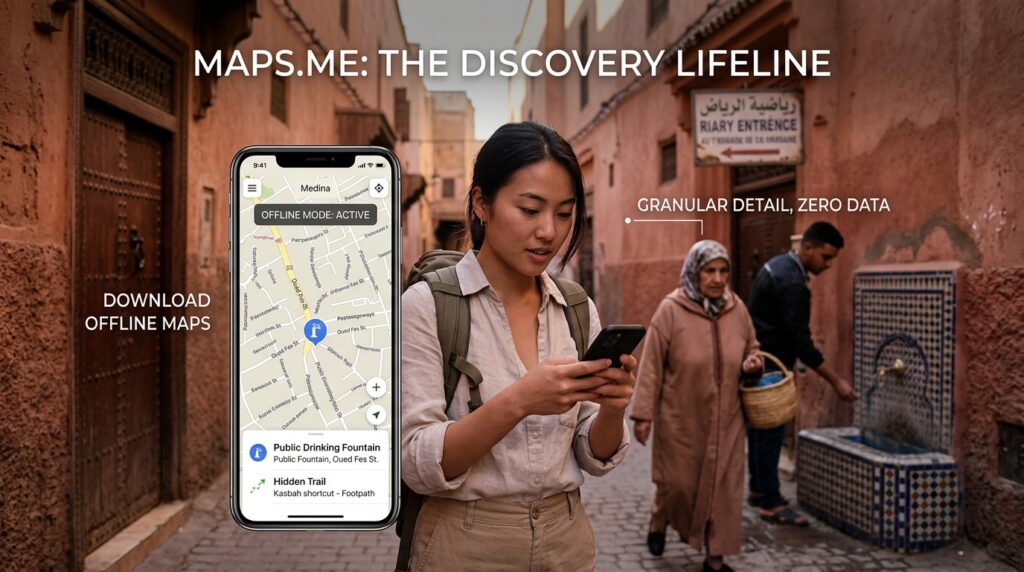
That is why my number one travel rule is to download offline maps before I ever leave my house. While Google Maps has an offline feature, I find the dedicated offline app Maps.me to be infinitely superior for deep travel.
The compression is fantastic, meaning you can download the map data for an entire country without eating up all the storage space on your phone. But its true superpower is the level of granular detail. Because it relies on open-source data, it shows tiny, obscure hiking trails, hidden alleyways, and public drinking fountains that standard maps completely ignore. When I am navigating the labyrinthine streets of Venice or the Medina in Marrakech without a drop of cellular data, this app is my undisputed lifeline.
2. The Real-Time Translator (Google Translate)
Language barriers are beautiful because they remind us of how vast the world is, but they can also be incredibly intimidating when you are trying to buy allergy medication at a rural pharmacy.
I actually dedicated a significant amount of time to language acquisition recently, which I detailed in my article about (How I Learned a New Language Using Only My Smartphone). But learning a language takes months, and sometimes you just need to know what kind of meat is inside the dumpling right now.
The Google Translate app is mandatory. I don’t use it for typing; I use it for the camera feature.
You open the app, tap the camera icon, and hold your phone up to a foreign menu, a train schedule, or a street sign. The app uses augmented reality to instantly overlay the English translation directly onto the live image on your screen. It feels like science fiction.
Furthermore, the “Conversation” mode acts as an active interpreter. You place your phone on the table between you and a local, hit the microphone, and speak. The app listens, translates your words aloud in their language, and then automatically listens for their response to translate back to you. It has allowed me to have deep, meaningful conversations with taxi drivers and shop owners with whom I share exactly zero common words.
3. The Digital Itinerary Hub (TripIt)
If your travel planning consists of starring emails in your Gmail inbox and hoping you can find your booking reference numbers when you get to the rental car counter, you are causing yourself unnecessary stress.
I used to be a victim of this exact chaos, which led me to write extensively about (How a Travel App Helped Me Plan My Last Trip in Hours).
TripIt is the ultimate aggregator. The moment you book a flight, a hotel, a museum ticket, or a dinner reservation, you simply forward the confirmation email to the app’s designated address.
The software automatically parses the data and builds a beautiful, chronological master itinerary. When I land at the airport, I don’t have to frantically search my inbox for my hotel address. I just open TripIt, and there is my hotel, complete with the check-in time, the confirmation code, and a map showing me how to get there. It takes the fragmented mess of travel bookings and turns it into a unified, stress-free timeline that is accessible entirely offline.
4. The Frictionless Expense Splitter (Splitwise)
Traveling with friends is incredible, but it is also the fastest way to ruin a friendship if you don’t handle the finances properly.
Nothing kills the vibe of a beautiful tapas dinner in Barcelona faster than four people passing a single receipt around, trying to calculate who had the extra glass of sangria and who owes tip money. It is awkward and exhausting.
Splitwise eliminates the financial friction of group travel.
Whenever anyone pays for anything—a taxi, a round of drinks, a shared Airbnb—they just open the app and input the total amount. You select who was involved, and the app does the math. It keeps a running, objective ledger in the background for the entire trip.
At the end of the vacation, you don’t have to exchange money fifty times. The app simplifies the debts and tells you exactly who needs to send money to whom. It completely preserves the peace and allows you to actually focus on enjoying the company of your friends.

5. The Financial Anchor (XE Currency)
When you are dealing with a foreign currency, especially one with a dramatically different exchange rate (like the Vietnamese Dong or the Colombian Peso), you lose your financial anchor.
When a street vendor tells you a scarf costs 450,000 currency units, your brain short-circuits. You don’t know if that is five dollars or fifty dollars. In the panic of the moment, it is incredibly easy to overpay or get scammed.
XE Currency is a simple, lightweight app that provides live, mid-market exchange rates.
Before I step out of my hotel for the day, I open the app on Wi-Fi so it updates the latest rates. For the rest of the day, it works offline. Whenever I am at a market, I just type the local price into the calculator, and it instantly shows me the exact equivalent in my home currency. It removes the mental math fatigue from haggling and ensures I stay strictly within my daily budget.
6. The Granular Transit Guide (Citymapper)
Google Maps is great for driving, but when it comes to navigating complex, subterranean public transit systems in mega-cities like London, Paris, or Tokyo, it often falls short.
Citymapper is explicitly designed for public transportation, and its level of granular detail is astounding.
It doesn’t just tell you to take the blue line. It tells you exactly which exit of the subway station to walk out of (which can save you ten minutes of walking in the wrong direction). It tells you what part of the train to board (front, middle, or back) to be perfectly positioned for your transfer at the next station.
It also actively monitors delays and strikes, automatically rerouting you if a specific bus line shuts down. When you are trying to navigate a sprawling metropolis during rush hour, this app transforms you from a confused tourist into an efficient, hardened local.
7. The Proactive Travel Agent (FlightAware)
Airport anxiety is a very specific, terrible emotion. You sit at the gate, staring at the departure board, wondering why your plane hasn’t arrived yet, while the gate agents tell you everything is “on time.”
The airlines will always lie to you until the absolute last possible second. They don’t want a panic at the gate.
FlightAware tracks the actual physical airplanes via radar. If I am sitting in Miami waiting for a flight to New York, I don’t look at the departure board. I look at FlightAware to see where my actual, physical aircraft is currently located.
If my app shows that the plane designated for my route is currently circling in a holding pattern over Atlanta due to thunderstorms, I know my flight is going to be delayed by at least two hours, regardless of what the screen at the gate says.
Having this information before the general public allows me to pivot. I can grab a table at a quiet restaurant or head to a lounge before the rest of the passengers realize they are stuck. If you want to master the art of smooth transit, checking out (How I Optimized My Travel Apps to Save Time and Money) is a great next step, because proactive information is the ultimate travel currency.
8. The Connectivity Hack (Airalo)
For a long time, arriving in a new country meant dealing with the absolute nightmare of SIM cards.
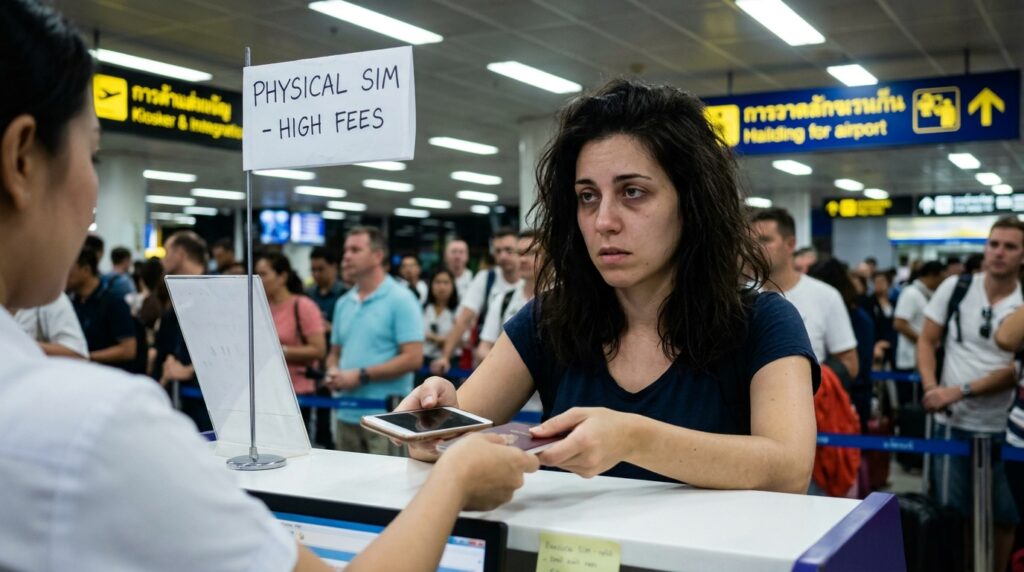
You would land exhausted, wait in a long line at a sketchy airport kiosk, hand over your physical phone to a stranger, and pay an exorbitant markup for a tiny piece of plastic, just so you could call an Uber. Or worse, you would accidentally leave your home carrier’s roaming turned on and come back to a $400 phone bill.
The invention of the eSIM completely eradicated this problem, and Airalo is the best platform I have found for managing it.
An eSIM is entirely digital. A day before I fly to a new country, I open the Airalo app while sitting on my couch at home. I purchase a digital data plan for my destination—usually for about $10 or $15.
The moment my airplane’s tires touch the runway in the new country, I go into my phone’s settings, toggle the digital eSIM on, and I instantly have high-speed 5G local data before I even unbuckle my seatbelt. I can text my family that I landed, order a ride, and load my maps before I even reach the customs line. It is the single most liberating technological advancement for international travel in the last decade.
Final Thoughts on Traveling Smart
There is a movement in the travel community that glorifies the idea of “disconnecting.” They argue that you should leave your phone in the hotel safe and just get lost in the city.
While I appreciate the sentiment of being present, getting genuinely lost without a safety net is rarely a romantic adventure; it is usually just a miserable, stressful waste of time.
Technology is not inherently a distraction. It only becomes a distraction when you use it to mindlessly scroll through social media instead of looking at the Colosseum in front of you.
When used correctly, your smartphone is the ultimate friction-reducer. It handles the translations, the navigation, the math, and the scheduling. By offloading all of that administrative stress into these eight specific applications, you free up massive amounts of mental bandwidth.
You don’t travel to be stressed about logistics. You travel to experience the world. Load your digital toolbelt before you leave the house, trust your systems, and allow yourself the profound luxury of simply enjoying the journey.
