
I can still vividly remember the exact smell of my freshman dorm room. It was a highly specific, slightly overwhelming combination of cheap industrial cleaning supplies, stale instant ramen, and sheer, unfiltered panic.
When you first arrive at college, everyone tells you about the fun parts. They tell you about the campus events, the late-night pizza runs, and the lifelong friends you are going to make.
What they completely fail to adequately prepare you for is the terrifying reality of the “Syllabus Drop.”
During the first week of classes, you sit in huge lecture halls, and every single professor hands you a stapled packet of paper. That packet outlines every reading assignment, every mid-term, every group project, and every massive essay you are expected to complete over the next four months.
I remember laying all five of my syllabi out on my twin-sized dorm bed on a Tuesday night. I looked at the sheer volume of work required, and my brain completely short-circuited.
In high school, my day was structured for me. I went to class from 8:00 AM to 3:00 PM, a teacher reminded me when homework was due, and my parents made sure I was awake in the morning.
College is the exact opposite. You might only be in a physical classroom for twelve hours a week. The illusion of “free time” is the deadliest trap on campus. Nobody is going to hold your hand, nobody is going to remind you to read chapter four, and nobody is going to stop you from playing video games until 4:00 AM.
I almost drowned during my first semester. I tried to keep all my deadlines in my head. I took notes in physical spiral notebooks that I inevitably lost. I spent hours “studying” in the library, which actually consisted of me scrolling through social media while a textbook sat open on my desk.
By midterms, I was exhausted, anxious, and dangerously close to failing a core class.
I realized that working harder wasn’t going to save me. I had to work smarter. I needed to build a digital safety net. I began treating my phone and my laptop not just as entertainment devices, but as survival tools.
Over the next few years, through trial, error, and many late nights, I curated a specific suite of mobile and desktop applications that entirely saved my academic career. If you are heading off to college, or if you are currently drowning in coursework, here are the 7 apps you absolutely need to survive.
1. The Master Calendar (Time-Blocking Your Life)
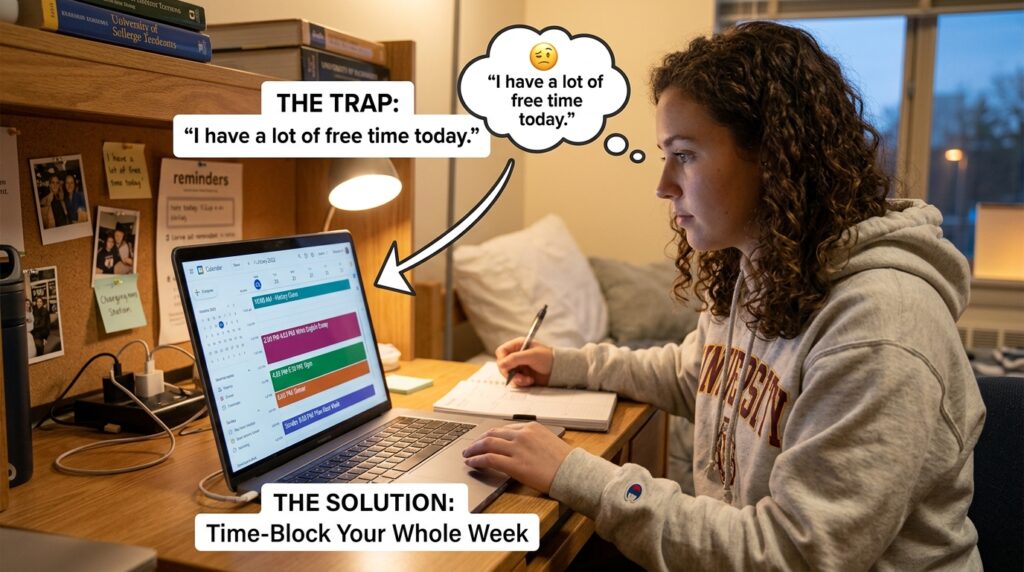
The biggest lie college students tell themselves is: “I have a lot of free time today.”
When you look at your schedule and see that you only have one class at 10:00 AM and nothing else for the rest of the day, your brain translates that into a vacation. You end up watching a movie, taking a nap, and suddenly it’s 8:00 PM, and you haven’t written a single word of your English paper.
You don’t need a basic to-do list; you need a digital calendar app that allows you to “time-block.” (Think Google Calendar, Apple Calendar, or specialized apps like Tiimo).
Here is the habit that saved my GPA: Every Sunday evening, I sat down and mapped out my entire 168-hour week.
I didn’t just schedule my classes. I scheduled my study time. I created a two-hour block on Tuesday afternoon specifically labeled “Read History Chapter 5.” I scheduled my laundry time. I scheduled my meals. I even scheduled my social time.
When you assign a specific task to a specific block of time on a visual calendar, it ceases to be a vague intention and becomes a concrete commitment. It forces you to realize exactly how little time you actually have, which instantly cures your urge to procrastinate. Your calendar becomes your boss, telling you exactly where you need to be and what you need to be doing.
2. The Ultimate Note-Taking Ecosystem
During my freshman year, my backpack weighed roughly forty pounds. I had a different colored spiral notebook for every subject, massive textbooks, and a chaotic folder full of loose, unorganized handouts.
When it came time to study for finals, I spent more time trying to find my notes than I did actually reading them.
You must transition to a centralized digital note-taking system. I cannot stress this enough. If you are curious about the mechanics of setting up a reliable digital brain, you should absolutely read my breakdown of 10 Note-Taking Apps That Actually Help You Stay Organized.
Whether you choose Notion, Evernote, or GoodNotes, the key feature you are looking for is searchability.
When a professor mentions a highly specific term during week two, and then asks a question about it on the final exam in week fourteen, you cannot flip through hundreds of paper pages hoping to spot it.
With a digital ecosystem, I could just type the keyword into the search bar, and the app would instantly pull up the exact lecture note, the date I took it, and the accompanying slides. It turned studying from an archeological dig into a streamlined, highly efficient process. Furthermore, because my notes synced to the cloud, I could study on my phone while riding the bus, without lugging my laptop around.
3. The Unbreakable Distraction Shield
The university library is a fascinating sociological experiment. It is a building filled with thousands of stressed young adults, all desperately trying to focus, and almost all of them utterly failing.
I used to go to the quiet floor of the library, open my laptop, and swear I was going to write my essay. Then, my phone would buzz. A friend would send a funny video. I would watch it, and then “just quickly” check Instagram. An hour later, I would emerge from an algorithmic trance, my essay completely untouched.
Willpower is not enough to combat modern technology. Silicon Valley engineers are paid millions of dollars to keep your eyeballs glued to their platforms. You need software to fight software.
You need a focus app. I relied heavily on apps like Forest, or heavy-duty site blockers like Freedom. These tools are the digital equivalent of locking your phone in a safe. In fact, optimizing this exact habit became so vital to my success that I compiled a specific list of the Apps That Help Me Focus When Working From My Phone.
When I sat down to write a paper, I would activate the focus app for 45 minutes. It would aggressively block every social media site, every messaging app, and every distracting website on my devices. If I reflexively tried to open Twitter, the app would literally block the screen with a message telling me to get back to work.
It was frustrating at first, but it completely broke my twitch-reaction habit of checking my phone every three minutes. It allowed me to finally achieve deep, uninterrupted focus.
4. The Brutal Financial Reality Check
There is a running joke about college students surviving on ramen noodles because they are broke. It is funny until it actually happens to you.
When I got my first taste of financial independence, I was a disaster. I didn’t understand the cumulative power of small purchases. A three-dollar coffee here, a late-night pizza delivery there, a few energy drinks before a study session. It didn’t feel like I was spending a lot of money.
Then, halfway through the semester, I checked my bank account and saw a terrifyingly low number. I had to call my parents and awkwardly beg for a loan to buy a textbook. It was humiliating.
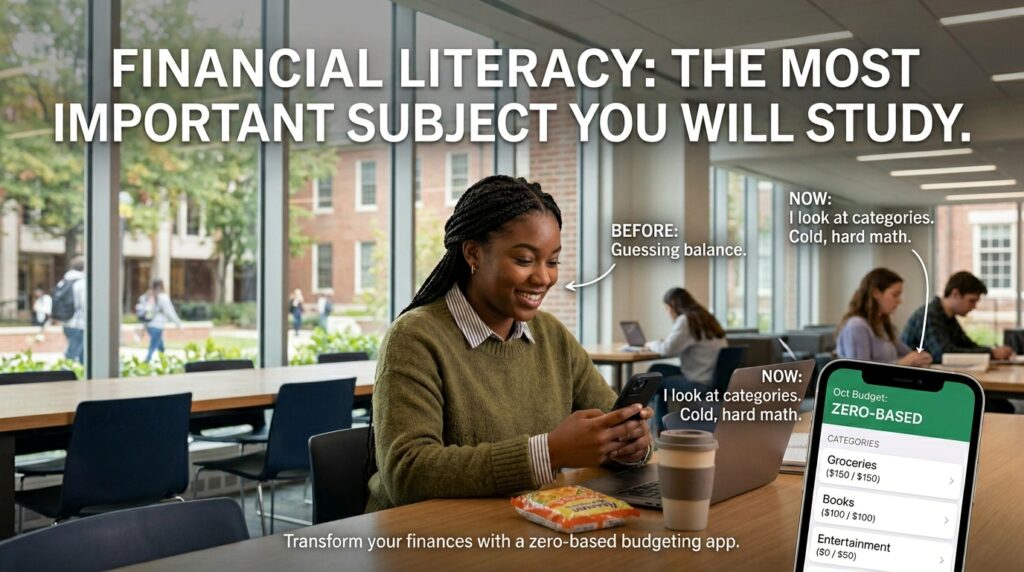
You cannot survive college without a zero-based budgeting app. (Think YNAB or EveryDollar).
I stopped checking my bank balance and started checking my budget categories. I had to learn how to assign every single dollar a job before the month even started. If you want to see exactly how this paradigm shift works, I highly recommend checking out the 11 Finance Apps That Helped Me Save Money This Year.
When I wanted to go out with my friends on a Friday night, I didn’t look at my checking account to see if I had $50. I looked at my “Entertainment” category. If that category was empty, I didn’t go, or I suggested a free activity. The app removed the emotion from my spending and replaced it with cold, hard math. It taught me financial literacy, which is arguably the most important subject you will ever study.
5. The Bibliography and Citation Savior
If you have not yet experienced the unique agony of formatting an academic bibliography at 3:00 AM, consider yourself incredibly lucky.
You spend weeks researching a topic, reading dense academic journals, and writing a stellar ten-page paper. You finally finish the conclusion. You are exhausted. All you want to do is go to sleep.
And then you remember you have to format twenty different citations in perfect APA or MLA style. One missing comma, one italicized word in the wrong place, and your professor docks your grade.
Do not do this manually. It is an archaic waste of your time.
You need a dedicated citation manager like Zotero, Mendeley, or EasyBib. These apps are absolute lifesavers.
As I conducted my research, I installed a browser extension tied to my citation app. Whenever I found a scholarly article or a book I wanted to use, I clicked one button. The app automatically pulled the author, the publication date, the journal title, and the volume number, saving it to a neat digital library.
When it was time to write my paper, the app integrated directly with my word processor. With two clicks, it generated a perfectly formatted, flawless bibliography in whatever style my professor demanded. It saved me dozens of hours of tedious, mind-numbing administrative work over my four years.
6. The Roommate Peacekeeper
Living with roommates is a core part of the college experience. It can be incredibly fun, but it is also a breeding ground for petty, friendship-destroying resentments.
The fastest way to ruin a living situation is arguing over money and shared household items.
“I bought the toilet paper last time.” “Well, I bought the dish soap and the trash bags.” “Who hasn’t paid their share of the electric bill yet?”
These conversations are awkward, uncomfortable, and exhausting. You need to remove the human element of debt collection and hand it over to an app.
Apps like Splitwise are essential for anyone living in a shared apartment or dorm.
We had a strict rule in my apartment: If you buy a shared item for the house, you immediately input the receipt into the app. The app automatically does the math and splits the cost evenly among everyone living there. It keeps a running, objective tally of exactly who owes who.
At the end of the month, we just hit the “Settle Up” button. Nobody had to play the role of the nagging debt collector. Nobody felt like they were secretly subsidizing the household. It preserved our sanity and kept our friendships completely intact.
7. The Cloud Storage Lifesaver
Let me leave you with a horror story.
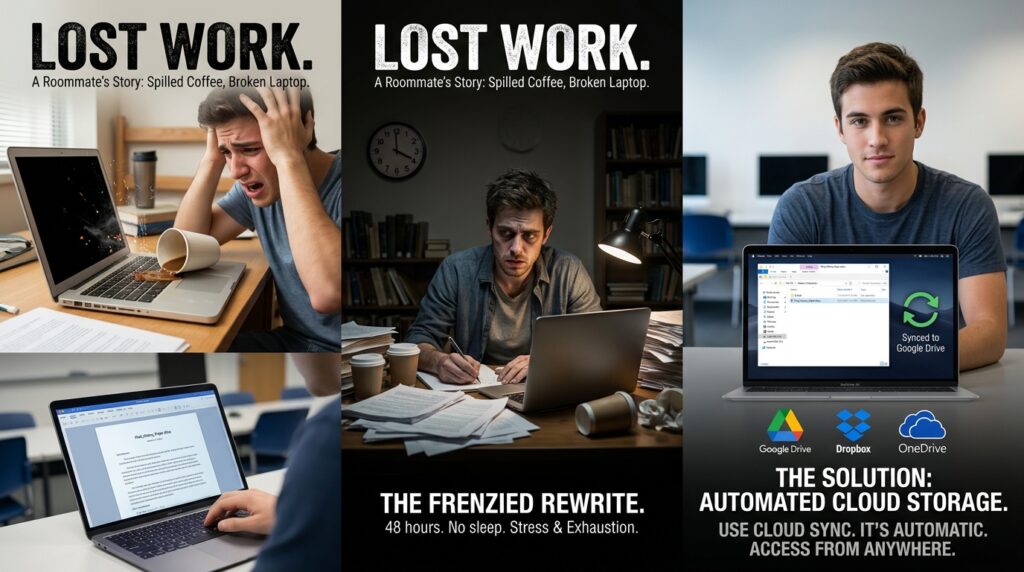
During my sophomore year, my roommate was writing his final term paper for a massive history class. It was worth forty percent of his grade. He had been working on it for three weeks. He saved the Microsoft Word document directly to the desktop of his incredibly cheap, ancient laptop.
Two days before the paper was due, he spilled half a cup of coffee directly onto his keyboard. The laptop sizzled, went black, and never turned on again.
He lost everything. He had to beg the professor for an extension and rewrite three weeks of research in forty-eight hours. He didn’t sleep for two days, and the stress completely broke him.
Do not be my roommate. Hardware fails. Laptops get stolen in the library. Coffee gets spilled.
You must have an automated cloud storage application running silently in the background of your computer at all times. (Google Drive, Dropbox, or OneDrive).
I configured my laptop so that every single document I ever created was automatically saved and synced to the cloud the moment I hit “Save.” If my laptop were to be thrown out of a moving vehicle, it wouldn’t matter. I could walk into the campus computer lab, log into my cloud account, and my essay would be sitting right there, exactly as I left it.
Final Thoughts on Your Digital Toolkit
College is meant to be a challenging experience. It is designed to test your limits, push you out of your intellectual comfort zone, and prepare you for the realities of the adult world.
But there is a massive difference between a productive intellectual challenge and unnecessary administrative suffering.
You don’t get extra points for memorizing your schedule when a calendar can do it for you. You don’t get a higher grade for manually typing out a bibliography when software can automate it. You don’t prove your discipline by staring at a blank wall in the library when a focus app can block your distractions.
Treat your time and your mental energy as the finite, incredibly valuable resources they are. Build your digital toolkit early, stick to your systems, and let the software handle the heavy lifting. When your logistics are automated, your brain is finally free to actually learn, explore, and enjoy the best four years of your life.
