
There is a very specific, quiet danger that creeps into long-term relationships. It doesn’t usually announce itself with a massive argument or a dramatic slamming of doors. Instead, it sneaks in during the mundane moments.
A couple of years ago, my partner and I were sitting in our living room on a Tuesday night. The television was playing softly in the background. We were both sitting on the same couch, physically less than two feet away from each other. Yet, we were millions of miles apart.
We were both staring down at our phones, silently scrolling through our respective social media feeds.
When we did speak, the conversations had devolved into purely logistical, administrative updates. “Did you remember to buy paper towels?” “What time is your meeting tomorrow?” “Whose turn is it to walk the dog?”
We hadn’t stopped loving each other, but we had accidentally slipped into the dreaded “roommate phase.” We were co-managing a household, but we had entirely stopped communicating as partners. Our emotional connection was slowly starving to death because we were relying on the assumption that just being in the same room was enough.
It wasn’t.
I realized that our smartphones were acting as digital walls, keeping us isolated in our own little algorithmic bubbles. But then I had a counterintuitive thought: What if, instead of trying to banish our phones entirely, we used them to bridge the gap?
Technology is just a tool. It can distract you, but if you download the right software, it can also force you to connect. I started searching for digital solutions to our very human problem. What I found was a fascinating category of software designed specifically to hack romantic communication.
If you feel like you and your partner are speaking different languages, or if you just want to inject a little bit of fun back into your daily routine, here are 6 relationship apps that completely transformed the way we talk to each other.
1. Paired: The Daily Spark
When you have been with someone for years, you falsely assume that you already know absolutely everything about them. You stop asking questions because you think you already know the answers. This is a fatal flaw in communication.
Paired completely shatters this assumption.
The premise of the app is beautifully simple. Every single day, the app sends both you and your partner a prompt or a question. These range from lighthearted and funny (“What is a movie you secretly love but pretend to hate?”) to deeply profound (“What is a boundary you feel we need to establish with our extended family?”).
Here is the brilliant catch: You cannot see your partner’s answer until you type in your own.
This completely eliminates the pressure of agreeing with the other person just to keep the peace. It forces you to actually think about your own stance. Once you both hit submit, the answers are revealed.
Suddenly, sitting on the couch on a Tuesday night wasn’t silent anymore. We would read each other’s answers and burst out laughing, or we would launch into a fascinating, hour-long debate about a topic we never would have organically brought up. The app acts as an impartial conversation starter. I was so blown away by this specific dynamic that I actually wrote an entire dedicated piece on how (This Relationship App Actually Helped My Partner and Me Communicate). It takes the heavy lifting out of vulnerability.

2. TimeTree: The Logistical Peacemaker
I know what you are thinking. A shared calendar app doesn’t sound very romantic. But let me be painfully honest with you: mismanaged logistics are the silent killers of romance.
Nothing ruins a date night faster than a furious argument that starts with, “I told you last week I had a late shift today!” or “I thought you were picking up the groceries!”
When your logistical communication fails, it breeds resentment. You start feeling like you are carrying the entire mental load of the household, and your partner feels like they are constantly being nagged.
TimeTree is a shared digital calendar that completely neutralizes this battleground.
We stopped relying on verbal passing comments to manage our schedules. If an event, a deadline, or a chore isn’t in TimeTree, it doesn’t exist. The app allows us to color-code our individual schedules and our shared obligations. If I want to plan a surprise dinner, I don’t have to ask my partner if they are free and ruin the surprise; I just check the app.
Having a unified visual dashboard of our lives drastically reduced our daily friction. It is a philosophy I rely on heavily, which you can read more about in my guide detailing (How I Use Apps to Keep My Family Organized). When you remove the stress of miscommunication over schedules, you leave so much more mental energy for actual, meaningful affection.
3. Agapé: The Gratitude Engine
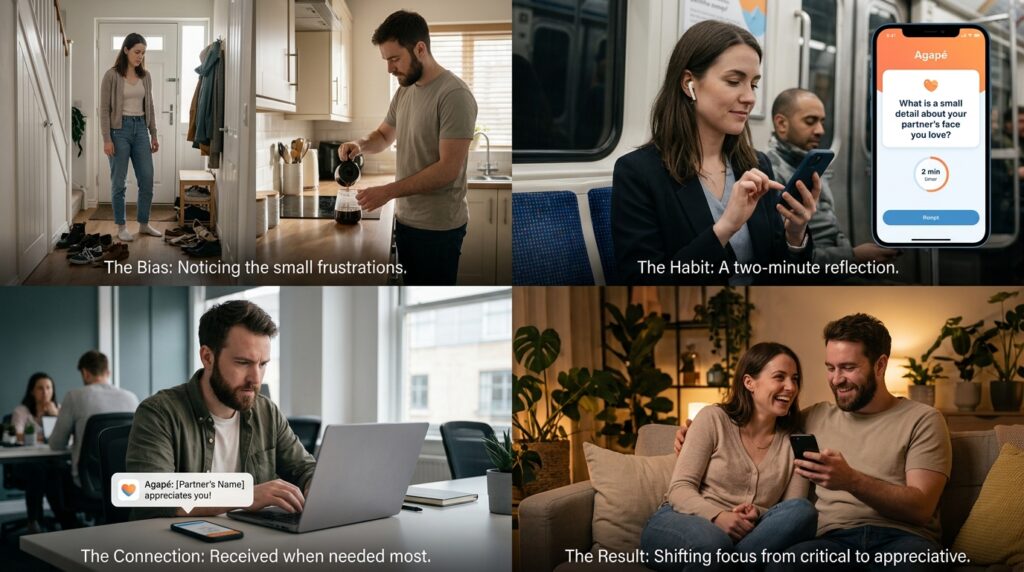
Human brains have a very frustrating evolutionary flaw called the “negativity bias.” We are biologically hardwired to notice and remember the negative things much more strongly than the positive things.
In a relationship, this means you are ten times more likely to notice that your partner left their shoes in the hallway than you are to notice that they quietly made the coffee exactly the way you like it.
Agapé is an app designed to aggressively counteract this bias.
It is rooted in positive psychology and focuses almost entirely on gratitude. Every day, the app prompts you to reflect on something you appreciate about your partner. It might ask, “What is a small detail about your partner’s face that you love?” or “What is something your partner did this week that made you feel safe?”
Typing out a thoughtful response takes exactly two minutes. But when my partner receives that notification in the middle of a stressful workday, it acts as a massive emotional anchor. It reminds us both that we are seen, appreciated, and valued. By actively forcing us to look for the good in each other, the app completely rewired our default communication style from critical to appreciative.
4. Honeydue: Removing the Emotion from Finances
If we are talking about communication, we absolutely have to talk about money. Financial stress is consistently ranked as one of the top causes of divorce globally.
Talking about money is terrifying. It is tied up in our egos, our childhood traumas, and our deepest insecurities. When couples try to discuss budgets, the conversation almost always devolves into defensive arguments about spending habits.
Honeydue is a financial app built specifically for couples, and it acts as an objective, emotionless mediator.
You both connect your bank accounts and credit cards to the app. You can choose exactly how much information to share—you can share everything, or you can keep individual accounts private and only share a joint checking account.
The app tracks your shared spending, reminds you when shared bills are due, and allows you to comment directly on specific transactions. Instead of a vague, accusatory argument like “You spend too much money on takeout,” we can look at the objective data together. It shifted our communication from “Me versus You” to “Us versus the Budget.”
We learned to manage our financial resources as a team. If you struggle with the balancing act of career income and household output, finding the right digital structure is crucial, a concept I outlined in (Tools That Help Me Organize Work and Personal Life Together). Honeydue takes the sting out of the money talk and replaces it with collaborative strategy.
5. Lasting: The Pocket Counselor
There are times when a daily prompt or a shared calendar isn’t enough to bridge a communication gap. Sometimes, you hit a wall. You find yourselves having the exact same argument over and over again, like a broken record, and neither of you knows how to break the cycle.
Therapy is incredible, but it is also expensive, and finding a time when both partners are available to sit on a therapist’s couch can be a logistical nightmare.
Lasting bridges the gap. It is essentially a science-based marriage counseling program condensed into a mobile app.
The app guides you through comprehensive, structured sessions on highly complex topics like attachment styles, conflict resolution, sexual intimacy, and family boundaries. You both read through the educational materials and answer deep, multiple-choice, and open-ended questions.
The app then compares your answers and highlights the exact areas where your communication is breaking down. It doesn’t just tell you that you are arguing; it explains the psychological why behind the argument. It gave us a shared vocabulary to discuss our emotional triggers without getting defensive. When we realized that my “avoidant” communication style was triggering their “anxious” attachment style, it felt like someone had handed us the instruction manual to our own relationship.
6. Love Nudge: The Habit Tracker for Affection
Dr. Gary Chapman’s concept of the “5 Love Languages” is incredibly famous for a reason. The core idea is that we all give and receive love in different ways: Words of Affirmation, Acts of Service, Receiving Gifts, Quality Time, and Physical Touch.
If your partner’s love language is Acts of Service, you can tell them “I love you” a hundred times a day, but they won’t truly feel it until you actually get up and do the dishes for them.
The problem is that even if we know our partner’s love language, the busyness of daily life causes us to forget to actually speak it.
Love Nudge is the official app for the 5 Love Languages, and it essentially acts as a habit tracker for affection. You both take a quiz to determine your primary languages. Then, the app allows you to set specific, actionable goals to fill up your partner’s “Love Tank.”
If my partner’s language is Quality Time, the app will gently nudge me on a Thursday afternoon: “Hey, you haven’t planned a screen-free dinner this week. Want to set a goal to do that tonight?”
It removes the guesswork from romance. It ensures that the effort I am putting into the relationship is actually translating into the emotional currency my partner needs to feel valued. It turns abstract feelings of love into concrete, communicative actions.

Final Thoughts on Digital Intimacy
We spend an enormous amount of time curating our digital lives. We use apps to track our sleep, optimize our workouts, manage our diets, and schedule our workdays. We treat our own bodies and careers as serious projects that deserve premium software.
Yet, when it comes to the most important metric of human happiness—the quality of our closest relationships—we often just cross our fingers and hope for the best. We expect communication to just magically happen, and we get frustrated when it breaks down.
Your relationship requires infrastructure.
You don’t need to download all six of these apps today. That would be overwhelming and counterproductive. But I urge you to look honestly at where your communication is currently failing.
Are you stuck in a rut of boring conversations? Download Paired. Are you arguing about who bought the groceries? Install TimeTree. Are you feeling unappreciated? Try Agapé.
A mobile app cannot fix a toxic relationship, and it cannot manufacture love where none exists. But if you have a solid foundation that is just slightly buried under the exhaustion of modern life, these digital tools can act as a shovel. They can clear away the logistical debris, lower your defensive walls, and give you the structural support you need to finally look across the living room and truly see your partner again.
