
There was a specific evening last winter that I now look back on as the absolute lowest point of our communication.
We were sitting on our comfortable sofa in our living room. The TV was playing some generic streaming series in the background, mostly just to fill the silence. My partner was scrolling endlessly through social media on their phone, and I was on my tablet, checking emails I had already checked three times that day.
We were physically less than two feet apart, but we might as well have been on different planets.
Suddenly, I looked over and realized something terrifying: I had absolutely no idea what was going on in the mind of the person I loved most in the world. We had become incredibly efficient life partners, but we had slowly stopped being romantic partners.
We had mastered the art of the “logistics conversation.” We were experts at coordinating who was going to buy the groceries, whose turn it was to take the car to the mechanic, and what time we needed to leave for my mother’s birthday dinner. But if you asked me what my partner’s biggest fear was that week, or what they were most excited about for the upcoming year, I would have drawn a complete blank.
We hadn’t had a fight. There was no explosive argument or dramatic betrayal. We had just quietly, slowly drifted into the numb comfort of routine.
The Resistance to “Digitizing” Romance
When I first thought about looking for a solution, my mind naturally went to therapy. But the logistics of scheduling couples counseling, finding someone we both liked, and fitting it into our already exhausted schedules felt like climbing a mountain.
Then, a close friend mentioned that they were using a relationship app.
I actually laughed out loud. The idea felt completely dystopian to me. We were already spending too much time staring at glowing rectangles; how was staring at another one going to save our relationship?
I am someone who relies heavily on technology to manage my professional life. I have complex systems for everything, which I’ve previously outlined in my article about (How I Stay Organized While Managing Multiple Projects). But applying that same software-driven logic to love felt clinical and cold. Romance is supposed to be spontaneous, right? It’s supposed to be candlelight and deep, unprompted conversations under the stars.
But sitting on that silent couch, I realized that waiting for spontaneous romance wasn’t working. The “organic” approach had resulted in us becoming excellent, highly efficient roommates.
We needed an intervention, even if it came from the App Store. So, feeling incredibly skeptical, I downloaded the app, sent my partner an invite code, and asked them to humor me for just one week.

The Genius of the “Blind Reveal”
The concept of the app we chose is remarkably simple, but the execution is built on brilliant psychological principles.
Every single day, the app sends both partners a single question. It ranges from incredibly lighthearted and silly to profoundly deep and vulnerable.
But here is the absolute genius mechanic that makes the whole system work: You cannot see your partner’s answer until you have submitted your own.
This single feature completely changed the dynamic of how we communicate.
In a normal, face-to-face conversation, there is always an element of mirroring and reactivity. If I ask my partner a deep question, I am watching their body language. I might soften my own response based on their reaction. I might hold back my true feelings because I don’t want to start a disagreement right before bed. Face-to-face communication, while vital, carries a lot of immediate pressure.
Typing your answer into your phone while sitting on the train on your way to work, completely independent of your partner’s immediate reaction, creates a strange and wonderful psychological safety net.
You are forced to be honest with yourself first. You can’t just agree with whatever your partner said to keep the peace. You have to put your own thoughts down in black and white.
The First Breakthrough Conversation
I will never forget the very first question we answered. It was a Tuesday morning. The app notification popped up: “What is a small, everyday thing your partner does that makes you feel incredibly loved?”
I sat at my desk, holding my coffee, and really thought about it. In the hustle of our daily lives, I rarely stopped to consider this.
I typed out my answer: “When you wake up before me and quietly close the bedroom door so the noise from the kitchen doesn’t wake me up. It makes me feel protected and cared for in a very quiet way.”
I hit submit. Instantly, a notification popped up saying my partner had also answered, and the app revealed their text.
My partner had written: “When you remember to buy that specific brand of sparkling water I like, even when it’s not on the main grocery list. It shows me you are paying attention to the little details of my day.”
I teared up reading it. We had both been silently appreciating these tiny gestures for years, but we had never actually voiced them. That evening, when we both got home from work, the energy in the apartment was entirely different. We weren’t just roommates anymore; we were two people who felt seen and appreciated. That single, simple prompt sparked a two-hour conversation over dinner that evening.

Gamifying Empathy
As the weeks went on, the app began to feel less like a chore and more like a game we were playing together.
Not every question was a heavy, emotional tearjerker. Some days, the prompt would be completely ridiculous. “In a zombie apocalypse, which one of our friends would you sacrifice first and why?”
Those lighthearted questions were just as important as the deep ones. They brought back a sense of playfulness and humor that we had lost somewhere between paying mortgages and managing careers. We found ourselves laughing out loud from different rooms in the house when the answers were revealed.
The app also included couples’ quizzes. It would ask a question like, “What does your partner consider their best physical feature?” You would answer for yourself, and then guess what your partner would say about themselves.
These quizzes were eye-opening. They revealed how incredibly poor my assumptions were. Sometimes, I assumed my partner was stressed about work, but the app revealed they were actually feeling insecure about an upcoming family event. It forced me to stop guessing what was in their head and actually read the raw data.
Overcoming the “Screen Time” Guilt
One of my initial fears was that using a relationship app would just lead to more isolation. I was actively trying to figure out (How I Reduce Distractions Using Mobile Apps), and bringing my smartphone into my romantic life felt contradictory.
However, I quickly realized that the medium is not the message.
Yes, we were using our phones, but we were using them intentionally. We weren’t mindlessly scrolling through the curated lives of strangers; we were actively investing focused attention into each other.
The app actually became a bridge back to the physical world. The digital prompts almost always led to real-world, face-to-face discussions. The app broke the ice, doing the heavy lifting of initiating the tough topics, leaving us to simply enjoy the resulting conversation.
If a prompt asked about our long-term financial goals, we didn’t just leave our answers in the app. The app acted as the agenda for our dinner conversation. It removed that terrible, stomach-dropping phrase, “We need to talk,” replacing it with a curious, “Hey, I loved your answer on the app today, can we talk more about that?”
Building a Routine of Connection
Like anything in life, consistency is the key to seeing real results.
A relationship cannot survive on one massive romantic vacation a year while slowly starving during the other 350 days. It requires daily maintenance. Just as I had learned the importance of structure in my professional life—a concept I explored deeply in my article about (How I Built a Productive Daily Routine Using Apps)—I realized my romantic life needed structure, too.
The app gave us that structure.
Answering the daily question became a ritual. We integrated it into our morning coffee routine. Before we discussed the news, the weather, or our meetings for the day, we spent exactly three minutes checking in with each other’s emotional state.
Three minutes a day. It sounds absurdly small. But three minutes of highly concentrated, intentional vulnerability every single day completely rewired our relationship.
Navigating the Hard Topics Safely
I don’t want to paint a picture of utter perfection. This app didn’t suddenly make us immune to disagreements. We still argue. We still get annoyed with each other.
But what the app did was give us a safe space to discuss our grievances before they exploded into actual fights.
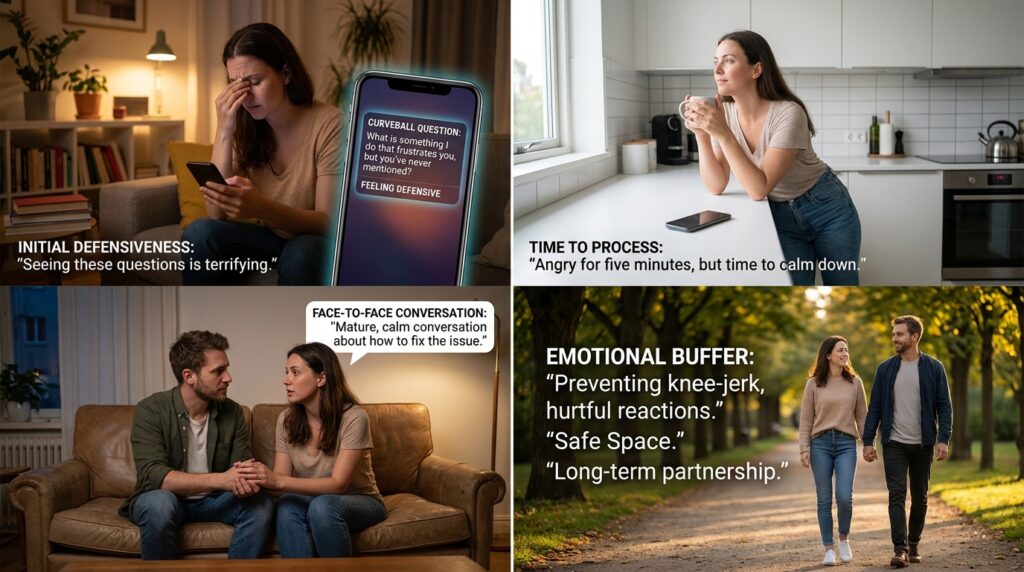
Every once in a while, the app will throw a curveball question. “What is something I do that frustrates you, but you’ve never mentioned?” or “When was the last time you felt unsupported by me?”
Seeing these questions pop up on the screen is terrifying. But again, the asynchronous nature of the app saves the day.
When my partner answers a question like that, I don’t have to react instantly. I am usually sitting alone when I read it. I can feel my initial defensiveness rise up. I can feel my face get hot. I can be angry for five minutes.
But then, because they aren’t standing right in front of me waiting for a response, I have time to calm down. I have time to process their words. By the time we actually see each other face-to-face that evening, the defensive anger has burned off, and I am ready to have a mature, calm conversation about how to fix the issue.
It acts as an emotional buffer, preventing those knee-jerk, hurtful reactions that so often damage long-term partnerships.
The Verdict: Why I Recommend It to Everyone
We have been using this digital tool for over a year now, and the transformation in our household is undeniable.
The silence on the couch is gone. We are no longer just roommates managing a shared schedule. We are two people who are actively curious about each other again. We know each other’s current stressors, random childhood memories, and silly hypothetical survival strategies.
When my friends come to me complaining that their relationships have gone stale, or that they feel like they are just going through the motions, this is the very first thing I recommend.
They always give me the exact same skeptical look I gave my friend a year ago. “An app? Really?”
Yes. Really.
We use technology to track our sleep, balance our budgets, navigate our cars, and organize our careers. It is absolute madness to think we shouldn’t use the same powerful tools to nurture the most important aspect of our entire human experience: our connection to the people we love.
If you are feeling a disconnect, put away the grand, sweeping gestures. Stop waiting for the perfect moment to have a deep conversation. Download the app, ask a simple question, and simply listen to what the person you love has to say. It just might save you years of unnecessary silence.
