
I have a confession to make: I am a recovering goal-setter.
For the better part of my twenties, I was completely obsessed with the ritual of a fresh start. Every December 31st, I would sit down with a brand-new, expensive leather notebook and write out an incredibly ambitious list of resolutions. I was going to learn to speak fluent French, run a half-marathon, read fifty books, and finally launch that side business I had been dreaming about.
For the first two weeks of January, I was an absolute machine. I woke up at 5:00 AM, laced up my running shoes, and felt invincible. I was running on the high of pure, unadulterated motivation.
But then, inevitably, February would arrive.
The mornings got colder. My muscles ached. The initial excitement wore off, replaced by the mundane reality of hard work. One morning, I would hit the snooze button. “Just this once,” I would tell myself. The next day, I skipped my French lesson to watch a movie. By March, that expensive leather notebook was buried under a pile of mail, and my grand ambitions were completely abandoned.
I was stuck in a vicious cycle of intense inspiration followed by profound burnout. I blamed myself, assuming I just lacked the inherent willpower that “successful” people seemed to possess.
It wasn’t until I read a book on behavioral psychology that the truth finally clicked: Motivation is an emotion, and emotions are temporary. You cannot build a long-term goal on the foundation of a temporary feeling. Motivation gets you started, but only systems keep you going.
I needed to build an external system that would hold me accountable on the days when my internal motivation was absolutely zero. Because I always had my smartphone within arm’s reach, I decided to turn it into my personal accountability coach.
Over the past few years, I have tested countless trackers, planners, and digital coaches. If you are tired of watching your own ambitions fizzle out, here are the 5 apps that successfully replaced my fleeting motivation with rock-solid, unbreakable systems.
1. Strides: The Visual Architect of Ambition
The primary reason we fail to achieve our goals is that they are too abstract.
“I want to save more money” or “I want to get in shape” are terrible goals. They are vague, unmeasurable, and lack a clear finish line. When your goal is fuzzy, it is incredibly easy to justify skipping a day.
Strides forced me to completely restructure how I thought about my ambitions by utilizing the SMART goal framework (Specific, Measurable, Achievable, Relevant, Time-bound).
When you open Strides, you don’t just type in a vague wish. The app asks you exactly what type of goal it is. Is it a Target goal (save $5,000 by December 1st)? Is it a Habit (read 20 pages every single day)? Is it an Average (keep my daily caloric intake under 2,000)?
Once you input the parameters, Strides does the math for you. It breaks your massive, intimidating mountain of a goal down into tiny, daily stepping stones. It presents you with a stunning, color-coded dashboard featuring pace lines and progress bars.
If I want to read 50 books in a year, Strides shows me a green line. As long as I am above that line, I am on track. If I fall below it, the line turns a glaring red. As a highly visual person, seeing that red line triggers an immediate psychological response. I want the dashboard to be green. It turns the abstract concept of “success” into a tangible, visual game that I play against myself every single day.

2. Habitica: Turning Real Life into an RPG
Adulting is fundamentally boring. Doing the laundry, responding to emails, and going for a 30-minute jog do not provide the immediate rush of dopamine our brains crave. Video games, on the other hand, are engineered to provide constant, satisfying rewards for completing tasks.
Habitica asks a brilliant question: What if you could apply the addictive mechanics of a role-playing video game to your actual, boring life?
When you join Habitica, you create a little 8-bit digital avatar. Your real-world goals and daily chores become your “quests.”
Every time I finish writing an article, drink eight glasses of water, or survive a brutal workout, I check those tasks off in the app. My little digital character earns gold coins and experience points. I can use that gold to buy a new virtual sword, a pet dragon, or a piece of armor.
It sounds incredibly silly for a grown adult to care about a pixelated dragon, but I cannot overstate how wildly effective this is. Our brains are hardwired to love immediate rewards. When I dive into how these mechanics function, I often point people toward my broader breakdown of (Apps That Keep Me Motivated to Finish Tasks). Habitica taps into that exact psychological loophole.
But the real magic happens when you join a “party” with other real users. You group up to fight a massive digital boss. If I forget to do my daily habits, the boss attacks my friends, and they lose health points. The social pressure is immense. I have literally gotten out of bed at 11:00 PM to do ten pushups just so my real-life friends wouldn’t suffer damage in our virtual game. It is a masterpiece of gamified accountability.
3. Beeminder: The Brutal Sting of Accountability
If positive reinforcement (like earning virtual gold) doesn’t work for you, it might be time to introduce a little bit of negative reinforcement. Human beings suffer from “loss aversion,” meaning the psychological pain of losing twenty dollars is significantly stronger than the joy of finding twenty dollars.
Beeminder leverages this biological quirk with ruthless efficiency.
It is a goal-tracking app with a very sharp sting: if you fail to hit your goal, they charge your actual credit card.
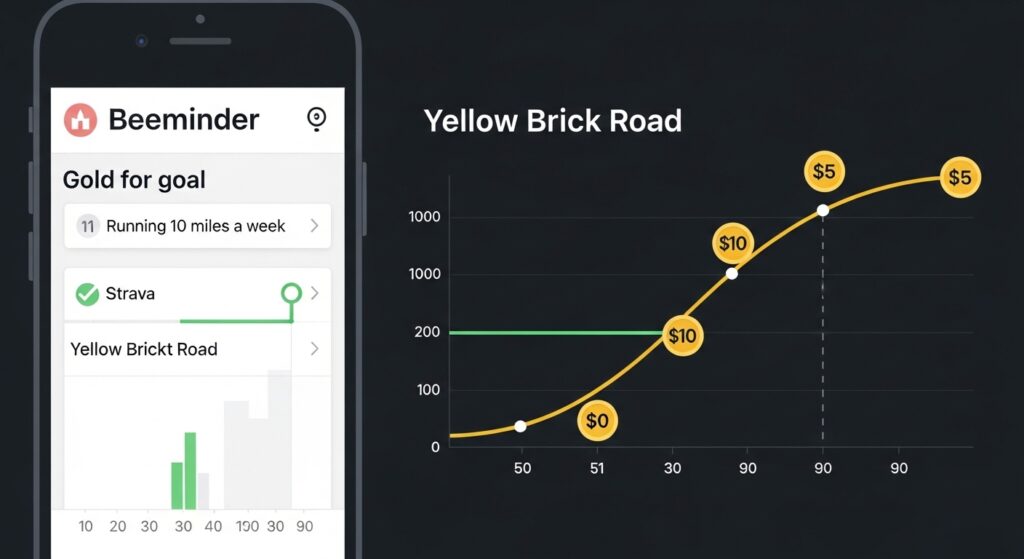
You set up a goal—let’s say, running ten miles a week. You connect Beeminder to your running app, like Strava. Beeminder draws a “Yellow Brick Road” on a graph. As long as your running data keeps your data point on that road, you are safe.
But if you get lazy, and your data point derails off the road, the app charges you $5. If you derail again, it charges you $10, then $30, then $90.
I used Beeminder to force myself to finish writing a screenplay. I was so terrified of losing my hard-earned money to a piece of software that procrastination was no longer an option. This aggressive level of accountability is something I explored deeply in my essay on (How I Use My Phone to Track Goals and Productivity). It isn’t for the faint of heart, but if you have a massive goal that you keep pushing off until “tomorrow,” putting your money on the line will cure your procrastination overnight.
4. Forest: Protecting the Micro-Moments
You can have the best, most structured year-long goals in the world, but they mean absolutely nothing if you cannot focus for the next forty-five minutes.
Motivation often dies not in the grand scheme, but in the micro-moments. You sit down to work on your business plan, you hit a difficult roadblock, and your brain immediately craves an escape. Without even thinking, your thumb swipes over to Instagram, and suddenly an hour is gone.
Forest is my ultimate defense against momentary weakness.
It is essentially a Pomodoro timer, but beautifully gamified. When I need to buckle down and focus on a goal, I open the app and plant a virtual seed. I set a timer for one hour.
As the minutes tick by, the seed slowly grows into a digital tree. However, if I exit the app to check my texts or scroll through a newsfeed, my tree instantly withers and dies, leaving a dead, brown stump on my digital plot of land.
It is shocking how well this works. When the urge to seek a distraction hits me, I look at my phone and see a half-grown pine tree. I simply do not want to be the reason it dies. It provides just enough friction to pause my impulsive behavior, allowing me to take a deep breath and get back to the hard work at hand. Over time, you grow an entire digital forest representing hours of deep, unbroken focus.
5. Fabulous: The Behavioral Science of Routines
Sometimes, the reason we lose motivation is that we are trying to change too much, too fast. We try to go from waking up at 8:00 AM and eating donuts to waking up at 5:00 AM, running five miles, and drinking green juice, all on the exact same day.
Our nervous systems reject the shock, and we rebound back to our old habits.
Fabulous takes a completely different approach. Developed in Duke University’s Behavioral Economics Lab, this app doesn’t want you to conquer the world on day one. It wants you to drink a single glass of water.
The app focuses on building “journeys.” When I first downloaded it, my only goal for the first three days was to drink a glass of water as soon as I woke up. That was it. Once I mastered that, the app celebrated my victory and added a second tiny habit: eat a healthy breakfast.
It uses stunning, immersive artwork and behavioral science to slowly chain habits together into unbreakable routines. This slow-burn approach completely shifted my paradigm, which I discussed in detail when reflecting on the (Strategies I Learned From Productivity Apps That Actually Work). Fabulous understands that massive goals are not achieved through heroic, one-off efforts. They are achieved through the invisible, boring, daily routines that eventually become second nature.

Final Thoughts on Engineering Success
We need to stop romanticizing the concept of motivation. Waiting for a magical wave of inspiration to hit you before you start working on your dreams is a surefire way to remain exactly where you are for the rest of your life.
The most prolific writers, the most successful athletes, and the most effective entrepreneurs do not rely on feeling “motivated.” They rely on their systems. They build environments that make doing the right thing easier than doing the wrong thing.
Your smartphone can be a weapon of mass distraction, constantly pulling you away from your goals. Or, it can be the ultimate engine for your personal growth. The choice comes down entirely to the software you choose to install.
If you are staring down a goal right now and feeling the familiar creep of apathy, don’t beat yourself up. Acknowledge that your willpower is finite, and outsource the heavy lifting to technology. Download Strides to visualize your path, use Habitica to make it fun, or put your cash on the line with Beeminder.
Take the reliance off your own shifting emotions, trust the systems, and watch as your grand ambitions slowly but surely transform into your daily reality.
