
There is a very specific, deeply frustrating psychological trap that I fall into almost every single month. I call it the “90% Illusion.”
It usually happens with big, intimidating projects. I will spend weeks working incredibly hard. I will do all the research, draft the entire outline, and write 90% of the final report. I will feel an immense surge of pride and accomplishment. I am so close to the finish line that I can practically taste it.
And then, inexplicably, I completely stop working.
That final 10%—the proofreading, the formatting, the act of actually attaching the document to an email and pressing “Send”—suddenly feels like climbing Mount Everest. The project will sit on my desk for three days, haunting me, while I aggressively procrastinate by doing literally anything else. I will deep-clean my kitchen, reorganize my bookshelf, and reply to emails from 2019, all to avoid finishing the one task that actually matters.
For a long time, I beat myself up over this. I thought I was just fundamentally lazy. I assumed I lacked the mythical “discipline” that highly successful people seemed to possess in spades.
But after doing some deep reading on behavioral psychology, I realized something important: motivation is not a character trait. Motivation is a neurochemical reaction.
When you start a project, your brain gives you a massive hit of dopamine. But by the time you reach the final 10%, that dopamine has completely worn off. The novelty is gone. The work is just boring, tedious execution. If you rely purely on internal willpower to push through that boredom, you will almost always fail.
You have to manufacture external motivation.
I stopped trying to force myself to care, and I started outsourcing my motivation to my smartphone. I built a digital ecosystem designed to trick my brain into finishing things. If you have a graveyard of half-finished projects weighing you down, here are the incredible apps that actually keep me motivated to cross the finish line.
1. The Gamification Masterpiece: Habitica
Let’s start with the most obvious reality of human nature: we would rather play games than do chores.
If you tell me to fold a massive basket of laundry, my brain immediately shuts down. But if you tell a teenager to spend six straight hours performing repetitive, tedious tasks to level up their character in a video game, they will do it with intense, laser-like focus.
Habitica takes that exact psychological hook and applies it to your real life.
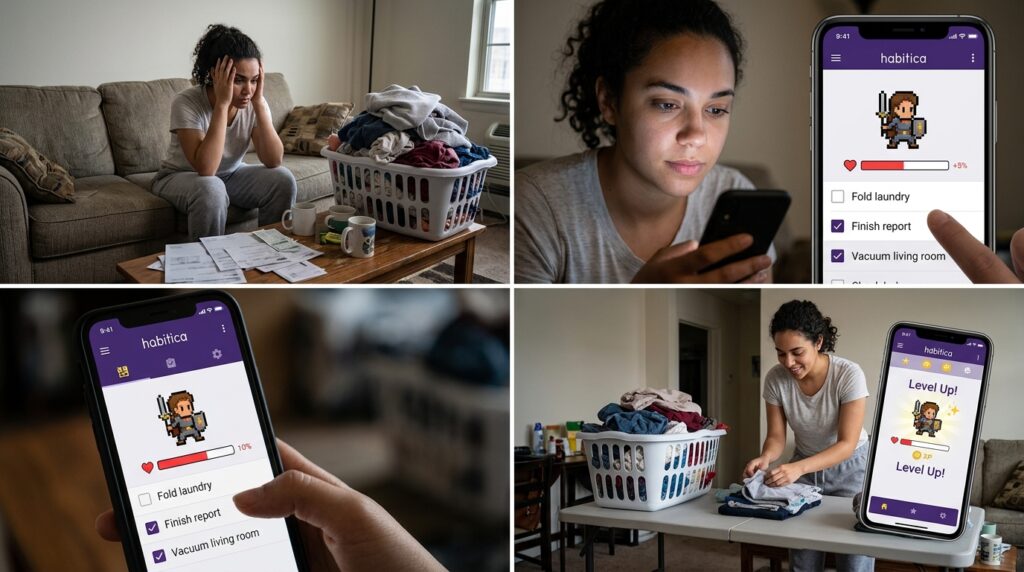
When you download Habitica, you create a tiny, 8-bit pixelated avatar. This character represents you. Then, you input your real-world tasks into the app. You can add things like “Finish the quarterly tax report,” “Vacuum the living room,” or “Reply to the client email.”
Every time you check a task off your list in the real world, your digital character earns experience points and gold coins. You can use that gold to buy your avatar new armor, cool swords, or virtual pets.
But here is where the motivation actually kicks in: if you ignore your tasks and let them become overdue, your avatar literally takes damage and loses health. I discovered that I am incredibly protective of my little digital character. I will legitimately get off the couch at 10:00 PM to fold a basket of laundry just so my avatar doesn’t lose health points.
It sounds childish, but turning mundane adulthood into an RPG completely short-circuits my procrastination. This gamified approach was the exact catalyst I needed, an experience I wrote extensively about in The Productivity App That Changed How I Work Every Day. It injects a burst of fun into the final, boring stretch of a project.
2. The Artificial Consequence: Forest
Sometimes, the reason we can’t finish a task isn’t because the task is hard, but because the distractions around us are simply too easy to access.
When I am struggling to write the final conclusion of an article, my phone sitting on my desk is a siren song. I know that with one swipe, I can escape the mental discomfort of writing and instantly watch entertaining videos.
To finish the task, I have to introduce an artificial consequence for picking up my phone. I use an app called Forest.
Forest is essentially a visual timer, but it weaponizes your empathy. When you are ready to buckle down and finish a task, you open the app and plant a virtual seed. You set the timer for 30 minutes.
As the timer ticks down, the seed slowly grows into a beautiful digital tree on your screen. But if you lose your focus, exit the Forest app, and open Instagram or your text messages, your tree instantly dies. Its withered, brown branches remain in your digital forest forever as a permanent monument to your lack of focus.
I use this app specifically for the “Last 10%” of any project. When I am desperate to procrastinate, I plant a tree. The thought of killing my virtual pine tree just to check a group chat is enough friction to keep me locked onto my computer screen until the task is finally submitted.
3. The Financial Threat: Beeminder
If gamification and virtual trees aren’t enough to motivate you, it is time to bring out the big guns.
Human beings suffer from a psychological condition called “Loss Aversion.” Science dictates that the pain we feel from losing five dollars is significantly stronger than the joy we feel from finding five dollars. We will work incredibly hard to avoid losing what we already have.
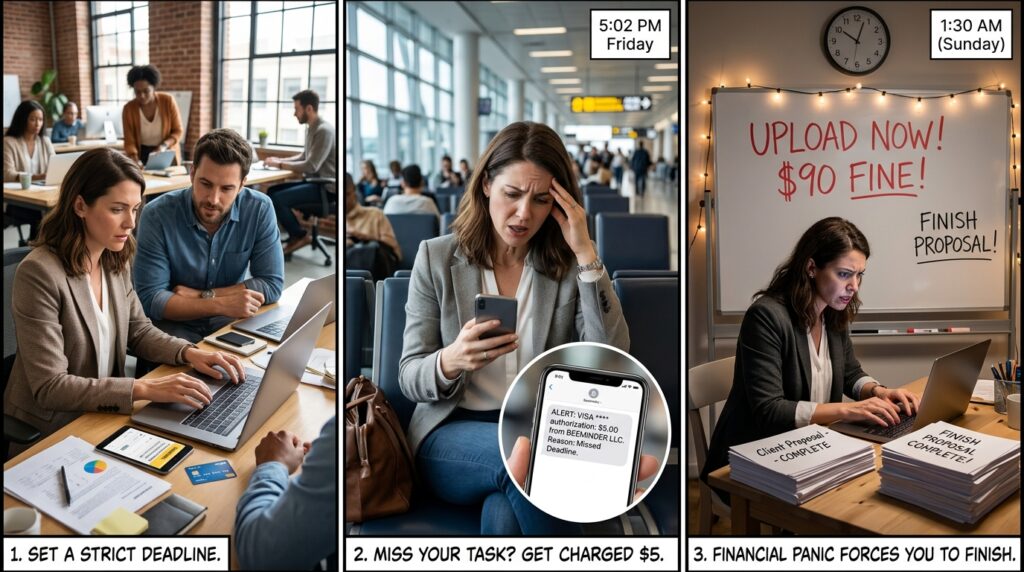
Beeminder is a task-tracking app that legally weaponizes loss aversion by attaching your actual credit card to your to-do list.
Here is how it works: I tell the app that I am going to finish writing a specific client proposal by Friday at 5:00 PM. The app asks for my credit card information. If Friday at 5:00 PM rolls around and I have not uploaded proof that the project is done, Beeminder literally charges my credit card five dollars.
If I fail again the next week, the charge jumps to ten dollars. Then thirty. Then ninety.
It is absolutely terrifying, and it is the single most effective motivational tool I have ever used in my entire life. When I know that my procrastination is going to hit my actual bank account, my writer’s block magically vanishes. I suddenly find the energy to sit down and finish the work.
I don’t use Beeminder for everything—that would be too stressful. I only use it for the massive, incredibly important tasks that I have been avoiding for weeks. It forces me over the finish line through pure, unadulterated financial panic.
4. The Micro-Dopamine Hit: Todoist Karma
When you are staring at a task that says “Build Website,” your brain cannot process where to begin. It is too large. There is no clear entry point, which inevitably leads to paralysis.
To maintain motivation, you have to feed your brain a constant, steady drip of tiny victories.
I rely on Todoist, not just as a list-maker, but as an engine for micro-dopamine hits. When I have a massive project, I refuse to put it on my list as a single item. I break it down into ridiculously tiny, almost insulting sub-tasks.
Instead of “Build Website,” my list says:
-
Open laptop.
-
Create a new folder on the desktop.
-
Download the client’s logo.
-
Pick two brand colors.
These tasks are so small that I cannot possibly fail them. I check off “Open laptop,” and the app gives me a satisfying swoosh sound and a green checkmark. I check off the next one, and I get another swoosh.
Todoist also tracks something called “Karma.” Every time you complete a task, your Karma score goes up. If you miss your daily goals, your Karma goes down. By stringing together five or six microscopic tasks, I build physical momentum. Learning how to properly slice my workload into digestible pieces was the core philosophy I shared in How I Created a Productivity System That Actually Sticks. Before I know it, the inertia is broken, and I am halfway done with the actual project.
5. The Power of “Don’t Break the Chain”: Streaks
There is a famous productivity strategy attributed to comedian Jerry Seinfeld. When asked how he managed to write new jokes consistently, he said he bought a massive wall calendar. Every day he wrote, he put a giant red “X” over that date. After a few days, a chain formed. His only rule was: Don’t break the chain.
The visual representation of your past effort is incredibly motivating. You don’t want to ruin the beautiful streak you have built.
I digitized this concept using an app simply called Streaks.
I use Streaks for the administrative tasks that I hate doing but are necessary to finish my work—like clearing my email inbox to zero at the end of every day, or logging my business expenses.
When you open the app, it shows you a simple circle. You press and hold it when the task is done, and the circle fills in, noting your current streak. If I have a 14-day streak of clearing my inbox, I will literally sit at my desk for an extra twenty minutes on a Friday afternoon just to ensure that circle gets filled. I refuse to let the counter reset to zero.
6. The Social Accountability Hack: Focusmate
Finally, we have to address the isolation of modern work.
When you work in a bustling office, you are surrounded by people. If you start slacking off and watching YouTube at your desk, you feel the social pressure of your coworkers walking behind you. You are motivated to look busy, which eventually translates into actually being busy.
When you work from home, or from a smartphone in a coffee shop, that social pressure completely vanishes. There is no one there to judge you if you abandon your project to take a nap.
To recreate this accountability, I use a platform called Focusmate.
Focusmate is a virtual “body doubling” service. You book a 50-minute session on your phone or laptop. At the exact start time, you are connected via live video to another random person somewhere in the world who is also trying to get work done.
You spend the first 30 seconds saying hello and explicitly stating what you are going to finish during the session. “Hi, my name is Alex. I am going to finish writing this client report.”
Then, you both mute your microphones and work in silence, leaving the cameras on.
It sounds bizarre, but it is pure magic. Knowing that another human being is sitting on the other side of the screen, working quietly alongside you, creates a massive psychological anchor. I use this exclusively for the terrifying tasks I want to avoid. Harnessing this kind of external social pressure is a strategy I frequently advocate for, as I discussed in Apps That Help Me Focus When Working From My Phone. You don’t want to be the person who said they were going to finish a report, only to be seen scrolling on TikTok.

Final Thoughts: Engineering Your Environment
We are often far too hard on ourselves when we fail to finish things.
We assume that a lack of motivation is a personal moral failing. We look at people who constantly crush their goals and assume they must have some superhuman reserve of energy and discipline that we simply lack.
That is almost never the case. Highly productive people don’t have more willpower than you do; they just rely on it less. They engineer their environments so that finishing the work is the path of least resistance.
Your smartphone is the ultimate environmental tool. It can be a slot machine of infinite distraction, or it can be a highly tuned engine of accountability.
Take a look at the half-finished projects currently weighing on your mind. Stop trying to “just push through it.” Download an app that puts your money on the line, gamifies the process into a digital RPG, or pairs you with a stranger who will watch you work.
When you stop relying on your own fleeting, unreliable emotions and start outsourcing your motivation to the software, crossing the finish line stops being a rare victory and finally becomes a daily habit.
