
We have all been there. You are sitting at your desk on a Sunday evening, staring at a chaotic week ahead, and a sudden wave of motivational energy washes over you. You decide that this is the week you finally get your entire life together.
You download three new productivity apps. You spend hours color-coding a complex new digital calendar. You build a massive, multi-tiered database with tags, priorities, and sub-tasks. For the first forty-eight hours, you feel absolutely invincible. You check off boxes with ruthless efficiency, and your digital workspace looks like a masterpiece of modern organization.
But then, Thursday arrives.
A sudden emergency at work derails your morning. You get an unexpected phone call that lasts an hour. A client moves a deadline up by two days. Suddenly, you don’t have time to meticulously log every single task into your beautiful, color-coded database. You start scribbling notes on random pieces of paper again. You leave tasks in your email inbox to “deal with later.”
By Friday afternoon, your perfect digital system is completely abandoned, sitting like a ghost town on your home screen. You feel a familiar sense of guilt and frustration, assuming you simply lack the discipline that “highly effective” people seem to possess naturally.
The truth is, you do not lack discipline. Your system was simply designed for a perfect world—and we do not live in a perfect world.
The ultimate flaw in most modern productivity advice is that it assumes we are robots operating in a vacuum. It encourages us to build rigid, complex workflows that shatter the moment real-life chaos intervenes.
If you are tired of the exhausting cycle of setting up new tools only to abandon them a week later, it is time to fundamentally change your approach. Creating a system that actually sticks requires ignoring the bells and whistles and focusing entirely on psychological friction. Here is the step-by-step framework for building a bulletproof productivity system designed to survive your worst days, not just your best ones.
The Great Digital Purge
The very first step to building a sustainable system is aggressive subtraction. Complexity is the ultimate enemy of consistency.
Every time you have to decide where to put a piece of information, you experience cognitive friction. If you have to pause and wonder, “Does this client note go into my daily planner, my long-term database, or my digital notebook?” you are wasting precious mental bandwidth. More importantly, when you are tired or stressed, you simply won’t do it. You will take the path of least resistance and dump the information somewhere you will immediately lose it.
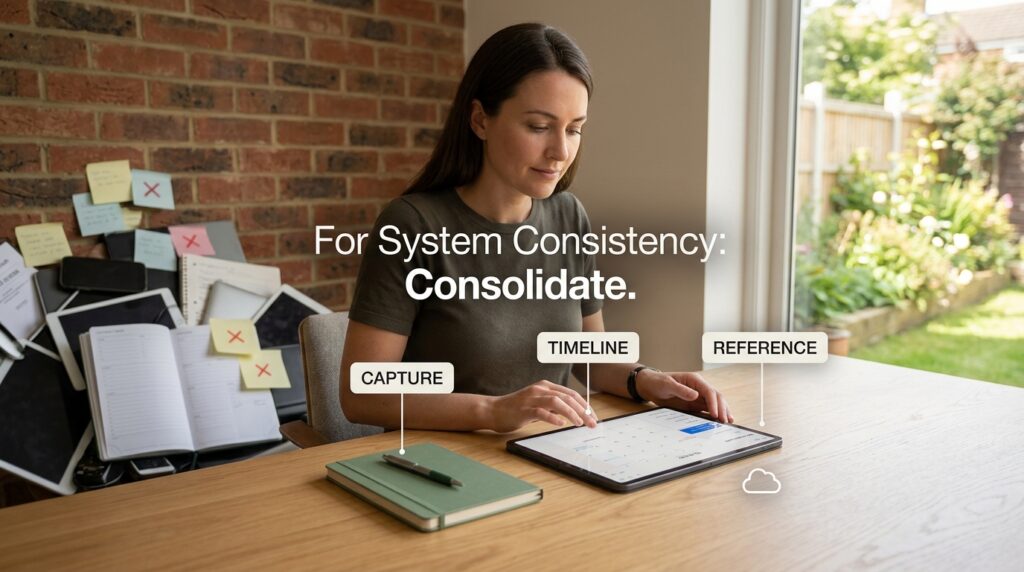
To fix this, you must consolidate your tools.
Look at your smartphone and your computer right now. Identify every app that serves as a storage container for tasks, ideas, or events. Delete the duplicates. You do not need Apple Notes, Google Keep, and Evernote running simultaneously. You do not need a paper planner and a digital calendar.
You only need three foundational pillars:
-
A Capture Tool: A single place for incoming tasks and ideas.
-
A Timeline Tool: A calendar to map reality.
-
A Reference Tool: A digital filing cabinet for non-actionable information.
When you limit your options, you eliminate decision fatigue. If a thought is actionable, it goes in the Capture tool. If it is an event, it goes on the Timeline. If it is a document, it goes in the Reference tool. That is it. No exceptions.
Pillar 1: The Frictionless Capture Habit
Your brain is a spectacular engine for solving complex problems, generating creative ideas, and processing emotions. It is, however, an absolutely terrible storage device.
When you try to use your brain to remember that you need to buy oat milk, email the accountant, and schedule a dentist appointment, you create a constant, low-grade hum of anxiety in the background of your consciousness. You are terrified of dropping the ball.
The foundation of a sticky productivity system is the “External Brain.” You must cultivate an automatic, twitch-reflex habit of getting thoughts out of your head and into your Capture tool the very second they occur.
For this to work, the Capture tool must be entirely frictionless. It should take less than five seconds to record a task. Apps with natural language processing—like Todoist or TickTick—are incredible for this.
If you remember you need to call a vendor while you are standing in line at the grocery store, you shouldn’t have to navigate through five different menus. You should be able to open the app and type: “Call vendor next Tuesday at 3pm.” The software should instantly understand the parameters, schedule it, and get it out of your way.
This level of immediate offloading is critical for professional environments as well. When navigating complex workplace demands, having a rapid-capture system changes everything, a reality that becomes obvious when exploring (Apps That Make Project Management Simple on Mobile). When you trust that your system will remember things for you, your brain finally goes quiet, allowing you to focus deeply on the present moment.
Pillar 2: Confronting Reality with the Calendar
Here is a hard pill to swallow: To-do lists are inherently dangerous.
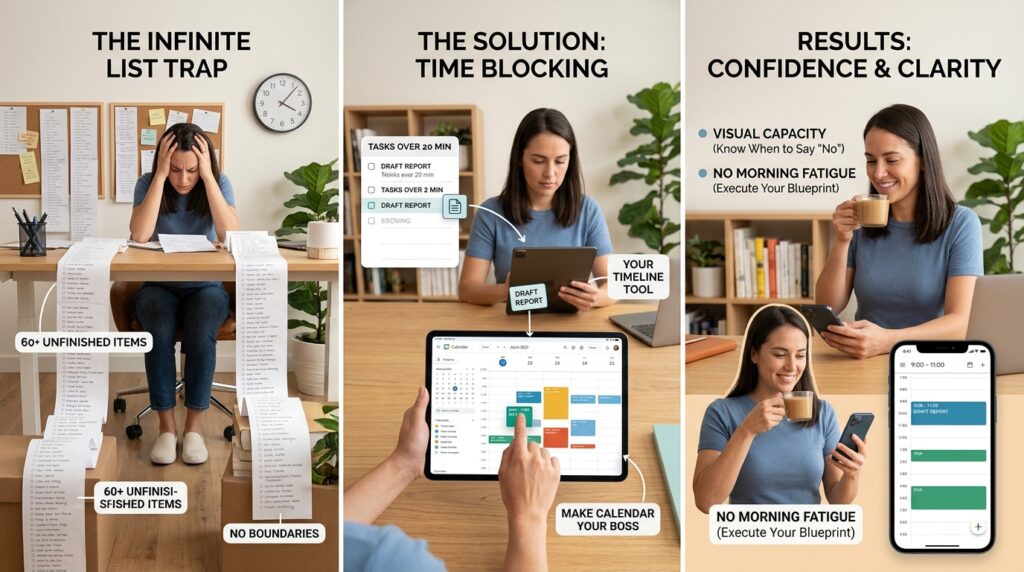
A to-do list is simply an aspirational catalog of things you hope to accomplish. It has no boundaries. You can put sixty items on a piece of paper, but you cannot bend the laws of physics to complete them all in an eight-hour workday.
Relying exclusively on a list guarantees that you will end every day feeling like a failure, because the list will never be finished.
To make a system stick, you have to force your aspirational list to confront physical reality. You must bridge the gap between what you want to do and when you are actually going to do it. This is where your Timeline Tool—your calendar—becomes your boss.
The practice is called “Time Blocking.” If a task in your Capture tool is going to take more than twenty minutes to complete, it must be dragged onto your calendar as a physical block of time.
If you need to draft a quarterly report, do not just leave it on a list. Look at your Tuesday schedule. Find a two-hour window, and create a block from 9:00 AM to 11:00 AM called “Draft Report.”
This does two profound things. First, it forces you to be brutally honest about your capacity. When you look at your calendar and see that it is completely full of colored blocks, you visually understand that you cannot take on another project today. You learn to say “no” with confidence.
Second, it completely eliminates morning decision fatigue. Structuring your hours in advance removes the overwhelming feeling of not knowing where to start, which is the exact framework outlined in (How I Built a Productive Daily Routine Using Apps). You don’t wake up and wonder what to do; you simply look at the calendar and execute the blueprint you already drew for yourself.
Pillar 3: The Weekly Review (The Glue That Holds It Together)
This is the step where 90% of people fail. You can have the best Capture tool and the most beautifully blocked calendar, but if you do not regularly maintain the system, it will rot.
Imagine your physical kitchen. You can organize your pantry perfectly on a Saturday, but if you cook three meals a day and never wipe the counters or put the spices away, the kitchen will be a disaster zone by Wednesday. Your digital system requires the exact same hygiene.
You must establish a non-negotiable Weekly Review.
Pick a specific time every week—Sunday mornings with a cup of coffee is a popular choice. During this thirty-minute window, you act as the manager of your own life.
Step 1: Empty the Inbox. Look at all the random notes, tasks, and ideas you quickly captured throughout the week. Process them. Does this task actually matter, or was it just a fleeting idea? If it matters, schedule it. If it doesn’t, delete it without guilt.
Step 2: Review the Past. Look at your calendar from the previous week. What didn’t get done? Why? Did you underestimate how long a project would take? Roll those incomplete tasks forward.
Step 3: Map the Future. Look at the week ahead. Block in the immovable boulders first—meetings, appointments, and social obligations. Then, take your highest priority tasks and slot them into the remaining white space.
By treating this review as a sacred ritual, you ensure that nothing slips through the cracks. Streamlining your software ecosystem makes this audit significantly faster, a philosophy emphasized in (The Apps That Make My Work Life So Much Easier). The Weekly Review is the engine that keeps the entire machine moving forward, week after week.
Designing for the “Bad” Days
The ultimate test of a productivity system is not how it performs when you are highly caffeinated and deeply motivated. The test is how it performs when you have a headache, you slept for four hours, and your inbox is overflowing.
A sticky system must have built-in grace margins.
When you are time-blocking your calendar, do not schedule every single minute from 8:00 AM to 6:00 PM. That is a recipe for a fragile day. If one task runs fifteen minutes late, the entire schedule collapses like a row of dominoes.
Leave intentional, blank buffer zones. Schedule an hour of “reactive time” every afternoon. This is a dedicated block of time where nothing is planned, acting as a shock absorber for the inevitable chaos of the day. If an emergency pops up, you have the breathing room to handle it without destroying your core deliverables. If no emergency happens, you get an hour of free time to get ahead on tomorrow’s work.
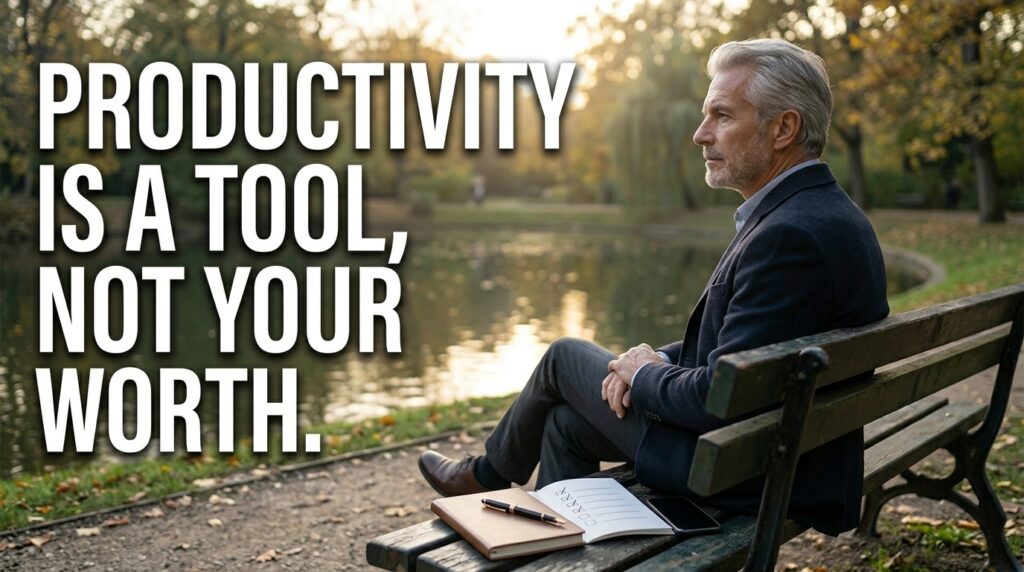
Furthermore, you must detach your self-worth from the completion of the list. Productivity is not a moral imperative; it is simply a tool to help you navigate life. If you have a terrible day and accomplish nothing on your calendar, the system did not fail. The system is just waiting for you to reset it the next morning.
Final Thoughts on Sustainable Momentum
We live in a culture that worships “hacks” and quick fixes. We are constantly searching for the magic app or the secret morning routine that will suddenly turn us into hyper-efficient robots.
But true, lasting productivity is deeply unsexy. It is boring. It is the quiet, repetitive act of capturing a thought, putting it on a timeline, and reviewing it on a Sunday.
Building a system that actually sticks requires accepting your own human limitations. You are going to get distracted. You are going to procrastinate. You are going to have days where you completely ignore your carefully planned schedule.
A resilient system doesn’t try to prevent you from being human; it simply provides a safety net for when you inevitably stumble. It ensures that when you drop the ball, you know exactly where to pick it back up.
Stop searching for the perfect software. Pare down your tools, master the art of capturing your thoughts, let your calendar be the ultimate judge of your time, and commit to a weekly reset. When you remove the friction and embrace the reality of your own schedule, productivity stops being a stressful performance and finally becomes a natural, effortless background process in your life.
