
If you had walked into my apartment a few years ago, you would have assumed I was the most disciplined, ambitious person on the planet.
My living space was a museum of good intentions. I had a massive whiteboard hanging in my kitchen divided into complex daily grids. My desk was buried under a stack of expensive, leather-bound physical planners, each one filled with color-coded highlighters. My bedside table featured a towering stack of self-improvement books with titles promising to unlock my hidden potential.
But if you looked a little closer, the illusion completely fell apart.
The whiteboard hadn’t been updated since February. The physical planners were completely blank after the second week of the year. The books on the nightstand were covered in a thin layer of dust.
I was stuck in a maddening, exhausting cycle. I would get incredibly inspired—usually on a Sunday evening—and declare that I was going to completely overhaul my life by Monday morning. I would vow to wake up at 5:00 AM, run four miles, drink a gallon of water, meditate for an hour, and read a chapter of a dense biography.
Monday would arrive, and through sheer, brutal willpower, I would actually do it. Tuesday, I would struggle through half of the list. By Thursday, I was exhausted, hitting the snooze button six times, and ordering takeout for dinner. By Friday, the entire grand plan was abandoned, replaced by a heavy wave of guilt and self-loathing.
I thought my problem was a lack of character. I thought I was simply a lazy person who lacked the fundamental “grit” that successful people possessed.
It took a major paradigm shift, and a remarkably simple piece of digital software, to realize that my character wasn’t the issue at all. My strategy was broken. This is the story of how a minimalist habit tracker app took me from chronic inconsistency to building a daily routine that actually stuck.
The Problem With Relying on Willpower
Before we get into the software that changed my life, we have to talk about why my previous methods failed so spectacularly.
I was relying almost entirely on motivation and willpower. The problem is, human willpower is not a magic, infinite resource. It is a biological battery.
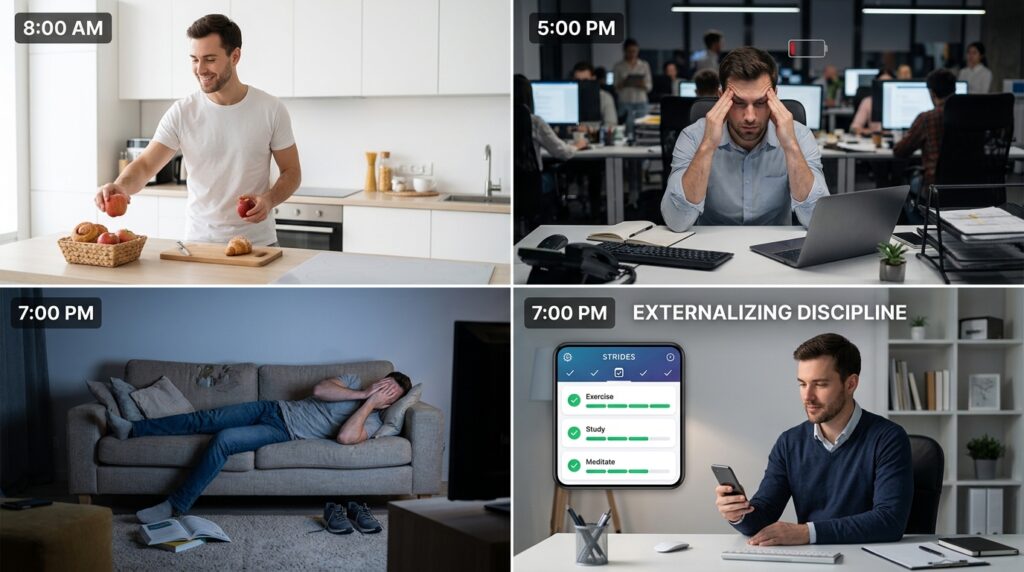
When you wake up after a good night’s sleep, your willpower battery is at 100%. You can easily resist the donut in the breakroom. You can easily choose to take the stairs instead of the elevator. But every single decision you make throughout the day drains that battery. Choosing what to wear drains it. Navigating a stressful email drains it. Dealing with a frustrating commute drains it.
By 7:00 PM, when you finally get home from work, your willpower battery is at 1%. If you are relying on that 1% to force yourself off the couch to go for a run or study a new language, you are going to fail. The couch will win every single time.
I needed a system that didn’t rely on my daily emotional state. I needed to externalize my discipline.
I had explored various systems before, heavily documenting my broader scheduling shifts in my guide on (How I Built a Productive Daily Routine Using Apps). But while a calendar told me what to do, it didn’t help me build the automatic, neurological pathways required for long-term behavior change. For that, I needed a dedicated habit tracker.
Entering the World of Digital Tracking
When I finally decided to look for a technological solution, I opened the app store and was immediately overwhelmed.
There were hundreds of options. Some of them looked like complex video games, complete with digital avatars and health points. Others were heavy, data-driven dashboards that looked like they belonged on a Wall Street trading floor.
I knew from my past failures that complexity was my enemy. If the app was hard to use, I wouldn’t use it.
I eventually settled on a tracker that was famous for its absolute minimalism. When you open the app, there is no flashy animation. There are no social feeds comparing you to your friends. There is just a clean, beautiful grid of habits and a satisfying, tactile checkmark button next to each one.
It was a blank digital canvas. Now, I just had to figure out how to fill it without repeating my past mistakes.
The Secret Weapon: Starting Ridiculously Small
My previous failures always stemmed from taking on too much, too fast. I was trying to run a marathon before I had even learned how to tie my running shoes.
Armed with my new app, I made a strict rule: I was only allowed to track habits that took less than two minutes to complete.
Instead of adding a habit called “Read for 45 minutes,” I added a habit called “Read exactly one page.” Instead of “Work out for an hour,” I added “Do five push-ups.” Instead of “Drink a gallon of water,” I added “Drink one glass of water upon waking up.”
This felt incredibly silly at first. My ambitious brain screamed at me, “Doing five push-ups isn’t going to change your life! You’re wasting your time!”
But I stuck to the two-minute rule. And a fascinating psychological shift happened.
Because the habits were so incredibly small, it became harder not to do them than to actually do them. When I got into bed at night and realized I hadn’t read my one page, I couldn’t use the excuse of “I’m too tired.” Anyone can read one single page, even if they can barely keep their eyes open.
So, I would grab the book, read one page, and check the box in my app.
More often than not, reading that one page would break the initial friction of starting. Once the book was open in my hands, I usually ended up reading ten or twenty pages. But the app only required one.
By setting the bar ridiculously low, I guaranteed my own success. I was finally building consistency, which is the absolute bedrock of any lifestyle change.
The Magnetic Pull of “The Streak”
Once I had my tiny habits established, the core mechanic of the app began to work its magic on my brain.
The app utilizes a concept often attributed to comedian Jerry Seinfeld: “Don’t break the chain.”
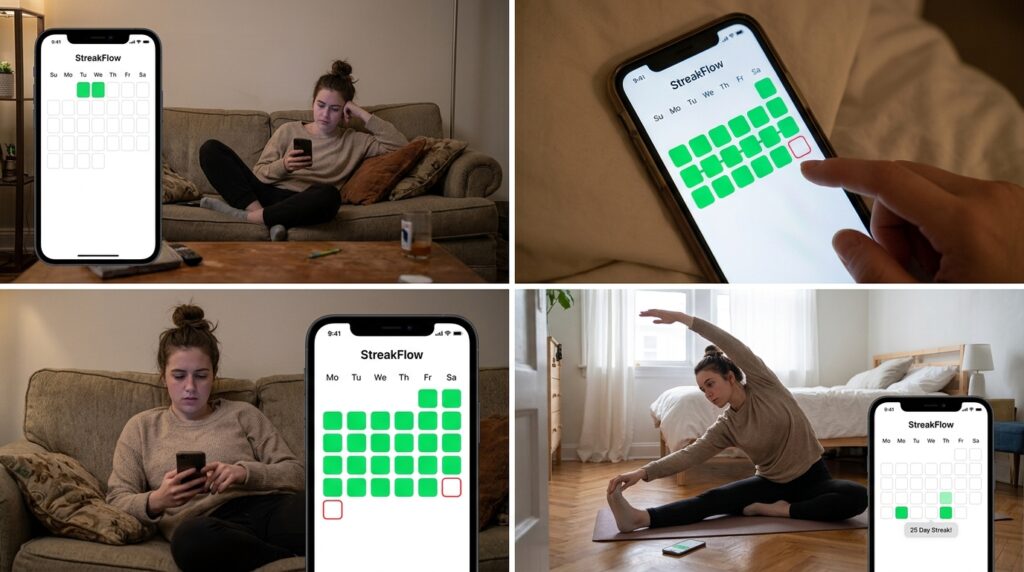
Every time you complete a habit in the app, it fills in a colorful square on a continuous calendar grid. When you do it two days in a row, the squares connect, forming a chain. When you reach ten days, the chain looks solid and unbreakable.
The human brain is uniquely wired to recognize and protect patterns.
There were days when I was exhausted, stressed, and completely unmotivated. I would lie on the couch, staring at the ceiling, actively trying to talk myself out of doing my five minutes of stretching.
Then, I would open my phone. I would look at the app widget on my home screen. I would see a solid, unbroken chain of 24 green squares stretching across the month.
The thought of leaving a glaring, empty red gap in that beautiful pattern actually caused me physical, psychological discomfort. I didn’t get off the couch because I was motivated to stretch; I got off the couch entirely to protect my digital streak.
When you are actively looking for (Apps That Keep Me Motivated to Finish Tasks), you often think you need complex rewards or harsh punishments. But I learned that the simplest visual representation of your past effort is often the strongest motivator you can possibly possess. You don’t want to let your past self down.
Habit Stacking: Building the Sequence
After about a month of flawlessly executing my tiny habits, I was ready to level up. But instead of just adding random new tasks to the app, I used a technique called Habit Stacking.
Habit Stacking is the process of taking a new habit you want to build and firmly attaching it to an existing habit you already do automatically.
I reorganized my app to reflect a very specific morning sequence.
I already had a deeply ingrained habit of brewing coffee every morning. I didn’t need an app to remind me to do that; my caffeine addiction handled it. But I wanted to start a habit of taking my daily vitamins, which I forgot to do constantly.
So, I placed my vitamin bottle physically on top of the coffee grounds container. In my habit tracker app, I dragged the “Take Vitamins” habit to sit directly underneath a customized header called “Morning Coffee Routine.”
The cue for the new habit became the completion of the old habit.
-
Turn on coffee maker.
-
Immediately take vitamins.
-
Open app and check the box.
Once that link was solidified, I stacked another habit on top of it. While the coffee was brewing, I had exactly three minutes of empty time. I added “Empty the dishwasher” to my app’s morning sequence.
My morning routine transformed from a chaotic rush into a smooth, automated assembly line. The app acted as a digital checklist guiding me seamlessly from one action to the next, completely eliminating the decision fatigue of wondering, “What should I do now?”
The Grace of “Vacation Mode” and Forgiveness
If there is one trap that destroys habit building faster than anything else, it is the all-or-nothing mindset.
In my old physical planners, if I got sick and missed three days of my routine, the blank pages stared back at me like a massive failure. I would usually get so discouraged that I would just abandon the planner entirely.
The digital habit tracker I chose had a brilliant feature that completely neutralized this toxic perfectionism: the ability to “Skip” a habit without breaking the streak.
Life is inherently unpredictable. You are going to get the flu. You are going to have to travel for a family emergency. You are going to have days where surviving is the only habit you can manage.
When those days hit, instead of leaving the habit unchecked and turning the calendar red, I could swipe left and select “Skip.” The app would gray out the box. It told the algorithm, “I am pausing this intentionally. I haven’t failed; I am just taking a designated break.”
This feature taught me the most valuable lesson of my entire self-improvement journey: consistency does not equal perfection. You don’t have to be perfect to change your life; you just have to be willing to start again the next day.
The Ripple Effect: From Personal to Professional
As the months rolled by, the impact of the app started to spill out of my personal life and bleed directly into my professional life.
Because I was starting my day with a string of small victories—drinking water, stretching, reading a few pages—I arrived at my desk feeling grounded and in control. My anxiety levels dropped significantly because my personal life was no longer a chaotic mess.
This newfound mental clarity gave me the bandwidth to tackle bigger career challenges. The discipline I cultivated through the app perfectly supported my broader operational systems, particularly during a period when I was heavily focused on (How I Stay Organized While Managing Multiple Projects).
I started using the habit tracker to log professional micro-habits. I added a habit to “Clear email inbox to zero by 5:00 PM.” I added a habit to “Spend 10 minutes planning tomorrow’s tasks before closing my laptop.”
The exact same psychology of protecting the streak worked for my career. The app became the central nervous system for my entire day, blurring the line between personal wellness and professional output.

Reviewing the Data: The Monthly Audit
The final piece of the puzzle that elevated this app from a simple checklist to a life-changing tool was the data analytics it provided.
At the end of every month, I would sit down and look at the “Stats” tab.
The data was incredibly revealing. I realized that my success rate for my “Go for a walk” habit was 95% on weekdays, but dropped to a dismal 20% on weekends.
Instead of feeling guilty, I treated it like an objective scientific experiment. Why was the weekend failing? I realized it was because my weekdays had structural cues (like lunch breaks and ending the workday) that triggered the walk. My weekends lacked structure, so the habit fell apart.
Armed with this data, I adjusted my system. I actively scheduled my weekend walks into my calendar, rather than just hoping they would happen spontaneously.
The app allowed me to iterate and improve my routine based on hard evidence, rather than vague feelings of success or failure.
Final Thoughts on Designing Your Destiny
We like to believe that our lives are defined by massive, dramatic moments—the big promotion, the cross-country move, the sudden epiphany.
But the reality is far less cinematic. Your life is not defined by what you do once in a while. Your life is defined by the things you do every single day, quietly, often when no one is watching.
You are the sum of your daily habits.
If your daily routine feels like an exhausting battle against your own willpower, please put down the complex planners. Stop trying to overhaul your entire personality by Monday morning.
Download a simple, minimalist habit tracker. Add one ridiculously easy task to it. Just one. Drink a glass of water. Read a single paragraph. Do two push-ups.
Check that box every single day. Watch the streak grow. Let the momentum build naturally. You will be absolutely astounded by how completely a string of tiny, tracked victories can transform the entire trajectory of your life.
