
I have a bottom drawer in my office desk that I actively avoid opening. If you were to slide it open right now, you would find a graveyard of beautifully bound, expensive physical notebooks.
There is a thick leather journal with a wrap-around strap that I bought in a boutique stationary shop. There are several sleek, minimalist, dot-grid notebooks. There is even a massive, gold-embossed daily diary that looks like it belongs in a Victorian library.
Every single one of these notebooks shares the exact same tragic story: the first five pages are filled with immaculate, carefully penned handwriting. The rest of the pages are completely, utterly blank.
For the vast majority of my adult life, I desperately wanted to be a “person who journals.” I read all the articles claiming that daily reflection was the ultimate keystone habit for mental clarity, emotional regulation, and personal growth. I wanted that peace of mind. I wanted to capture my memories and untangle my complicated thoughts.
But every time I tried to start the habit, I would crash and burn within a week.
It wasn’t until I completely abandoned the romanticized idea of pen and paper and embraced the reality of my modern, digital life that I finally broke the curse. I downloaded a dedicated digital journaling app, and to my absolute surprise, it became the most vital, grounding tool I have ever used to maintain my mental well-being.
The Paralysis of the Perfect Blank Page
To understand why a digital app finally worked for me, you have to understand why the physical notebooks failed so miserably.
Physical journals suffer from a fatal flaw: they demand perfection. When you open a pristine, $30 hardcover notebook, the sheer beauty of the blank page is deeply intimidating. It feels like whatever you write on that paper needs to be profound, poetic, and historically significant.
If I had a stressful, mundane day where my biggest complaint was that the grocery store was out of my favorite coffee beans and my boss sent an annoying email, writing about it in my beautiful leather journal felt like a waste of the paper. It felt petty.
Furthermore, my handwriting is terrible. After a long day of typing on a keyboard, physically writing out a paragraph made my hand cramp. By the time I finished writing a single sentence, my brain had already moved on to three other thoughts, and my hand simply couldn’t keep up with the chaotic pace of my mind.
Because the friction was so high, and the pressure for perfection was so heavy, I simply stopped doing it. The journals went into the bottom drawer, and the chaotic thoughts stayed trapped inside my head.

Embracing the Messiness of Digital Capture
I realized that if I was ever going to build a sustainable habit of self-reflection, I had to completely remove the friction. I needed a medium that was as fast, messy, and forgiving as my own internal monologue.
I turned to my smartphone.
Now, I know what you might be thinking. Our phones are usually the primary source of our daily anxiety. They are anxiety-delivery devices, constantly pinging with news alerts, work emails, and social media notifications. Bringing a mental health practice into that environment felt counterintuitive at first.
However, I had already spent a significant amount of time aggressively curating my phone’s interface. I had learned how to silence the noise, a process I heavily relied on when researching 10 Apps That Helped Me Declutter My Digital Space. Because my phone was no longer a chaotic minefield of distractions, it was the perfect, frictionless vessel for a new habit.
I downloaded a premium journaling application, and the very first time I opened it, the difference was night and day.
A digital page doesn’t judge you. It doesn’t cost anything if you make a mistake. You can write a single, fragmented sentence about how tired you are, hit “save,” and close the app. You can write a furious, ten-paragraph rant about a frustrating situation, and then immediately delete it if you decide you don’t want to keep it.
The digital format gave me permission to be completely imperfect. It allowed my journal to be exactly what it needed to be: a mental dumping ground.
Conquering “Writer’s Block” with Daily Prompts
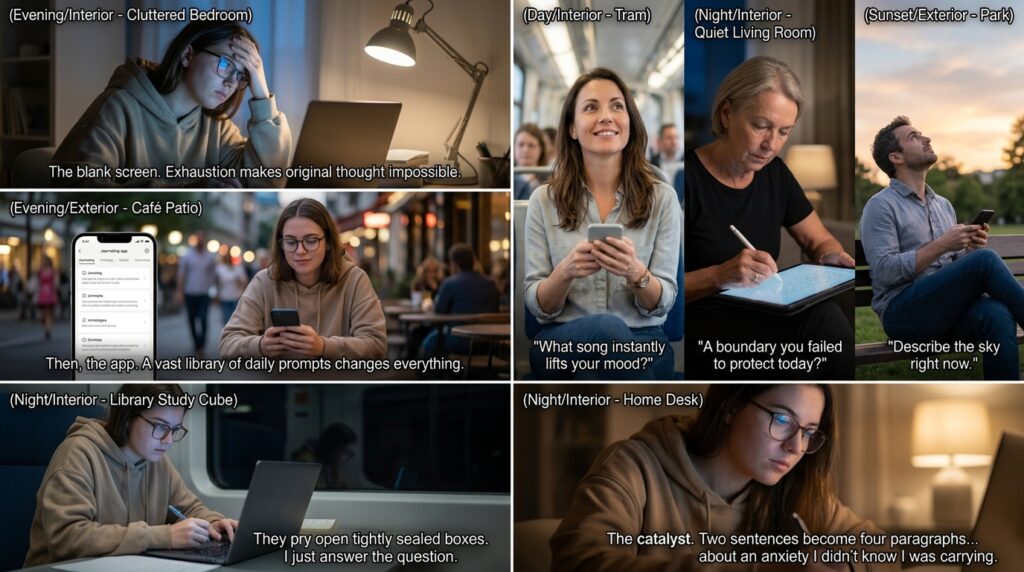
Even with the friction of physical writing removed, staring at a blank digital screen can still be daunting. There are days when your brain is simply too exhausted to formulate an original thought. You know you feel “off,” but you don’t know where to start unraveling the thread.
This is where the software absolutely shines. The app I use features a massive, rotating library of daily prompts.
When I open the app in the evening, I don’t just see a blank cursor. I see a gentle, thought-provoking question waiting for me.
Sometimes the prompts are incredibly lighthearted: “What is a song that always instantly changes your mood for the better?” Sometimes they are deeply introspective: “What is a boundary you failed to protect today, and how did it make you feel?” Sometimes they are purely observational: “Describe the sky right now.”
These prompts act as a crowbar for my emotional state. They pry open the tightly sealed boxes in my brain and give the thoughts a specific direction to flow. I don’t have to carry the burden of figuring out what to write about; I just have to answer the question.
On my worst days, answering a simple prompt is the only mental heavy lifting I can manage. But more often than not, answering that one question acts as a catalyst. I start by writing two sentences about the prompt, and before I know it, I have written four paragraphs about a completely unrelated anxiety that I didn’t even realize I was carrying.
The Multimedia Time Capsule
One of my greatest regrets about my past failures with physical journaling is the sheer volume of memories I have lost. Human memory is terrifyingly fragile. We think we will remember the exact feeling of a perfect Sunday afternoon, but six months later, the details are entirely gone.
A digital journaling app transforms the concept of a diary into a rich, multidimensional time capsule.
Words are powerful, but sometimes they aren’t enough to capture the true essence of a moment. Because the app lives on the same device I use to navigate my entire life, I can seamlessly integrate other forms of media into my entries.
If I am sitting at a café here in Rio, watching a beautiful rainstorm roll in over the mountains, I don’t have to try and eloquently describe the rain. I can just snap a quick photo of my coffee cup against the window and embed it directly into the journal entry.
If I have a profound realization while driving my car, I don’t have to pull over to type it out. I can tap the microphone icon and record a quick, two-minute voice memo that drops right into the timeline. The app even automatically pulls my GPS data and the local weather at the exact moment I create an entry.
When I look back at an entry from exactly one year ago, I don’t just see a block of text. I see the photograph of where I was sitting, I see that it was 82 degrees and sunny, and I can listen to the exact tone of my voice. It is a wildly immersive way to document your own existence.
Tracking the Invisible Data of the Mind
While the app is a phenomenal tool for preserving memories, its true value as a mental health aid lies in its analytical capabilities.
We are notoriously bad at evaluating our own emotional trends. If you have three bad days in a row, your brain will convince you that your entire life is a miserable disaster and you have never been happy. If you have a great week, you forget the struggles of the previous month.
To combat this, the journal app incorporates a simple, low-friction mood tracker. Every time I create an entry, I am prompted to select an emoji that represents my overall emotional state, ranging from “Terrible” to “Rad.” I can also tag the entry with specific activities: “Work,” “Family,” “Exercise,” “Poor Sleep,” etc.
After doing this consistently for a few months, I opened the app’s “Insights” dashboard.
It was a revelation. I was essentially running a data analysis program on my own subconscious.
The app generated a clear, color-coded chart of my moods over the last ninety days. I noticed a massive, undeniable pattern: my mood almost always plummeted on Thursday afternoons, and my entries were overwhelmingly tagged with “Stress” and “Work.”
This wasn’t a coincidence. Thursday was the day I had my weekly, high-stakes project review meeting. The anticipation of that meeting was poisoning my entire afternoon.
Because I could clearly see the data—a concept I learned to value highly when figuring out How I Track My Progress and Stay Motivated Every Day—I was able to take action. I spoke to my team, and we moved that high-stress meeting to Tuesday mornings. My Thursday afternoons instantly improved.
The journal didn’t solve my problem for me, but it held up an objective mirror so I could finally see what the problem actually was.
The Absolute Necessity of Radical Security
There is a distinct difference between the things we post on social media and the things we write in a private journal.
Social media is a curated performance. A journal must be a place of radical, uncomfortable honesty. You have to be able to write down your pettiest grievances, your darkest fears, and your most irrational anxieties. If you are filtering yourself, the journal is useless.
I could never achieve that level of honesty in a physical notebook. I was always harboring a low-grade, paranoid fear that I would accidentally leave it on a coffee table and a friend, a roommate, or my partner would open it out of curiosity.
Because I was writing for a hypothetical audience, I was censoring my own thoughts.
The digital journal app entirely eliminated that fear.
The app I use features end-to-end encryption and is locked behind my phone’s biometric Face ID scanner. The moment I close the app, it locks instantly. Even if someone steals my phone while it is unlocked, they cannot open the journal without my literal face.
This impenetrable layer of security was the key that unlocked my true internal voice. Knowing with absolute, mathematical certainty that no other human being on the planet could ever read my words gave me the ultimate freedom to just be messy. I could complain, I could whine, I could admit when I was wrong, all without the fear of judgment.

Creating a Holistic Ecosystem of Calm
Journaling does not exist in a vacuum. It is just one tool in a broader toolkit for managing the exhausting realities of modern life.
I found that the real magic happened when I began combining my digital journaling habit with my other wellness practices. For instance, I have spent a lot of time learning How to Use Mindfulness Apps to Reduce Stress, but sometimes meditation alone isn’t enough to calm a truly frantic mind.
If my brain is spiraling, trying to meditate feels like trying to hold a beach ball underwater. The thoughts keep forcefully popping up to the surface.
Now, I use my journal app as a “pre-meditation” clearing house.
If I am feeling overwhelmed, I will open the journal and write frantically for five minutes. I do a complete brain dump. Every worry, every chore I need to remember, every lingering frustration goes onto the digital page.
Once the thoughts are safely trapped inside the app, my brain finally relaxes. It no longer has to expend energy trying to remember all those things. The beach ball is deflated. Only then do I close the journal, open my mindfulness app, and actually sit in silence.
The combination of extracting the thoughts (journaling) and then calming the nervous system (mindfulness) is an incredibly powerful one-two punch against daily anxiety.
Final Thoughts on Documenting Your Own Life
We spend an inordinate amount of time consuming the stories of other people. We watch endless hours of television, we read biographies of historical figures, and we scroll through the highlight reels of strangers on the internet.
But how much time do we actually spend engaging with our own story?
Your life is the most important narrative you will ever experience. Your struggles, your tiny victories, your passing thoughts, and your quiet realizations are all inherently valuable. They deserve to be recorded.
Please understand, I am not suggesting that a mobile app is a replacement for professional medical care or therapy. If you are struggling with severe mental health issues, you must seek out a licensed professional.
But for managing the baseline, low-grade stress of everyday existence, for untangling the frustrating knots of a bad day, and for simply bearing witness to your own life, a digital journal is an unparalleled companion.
If you are intimidated by the idea of journaling, if you have a drawer full of blank, guilty-looking notebooks, let them go. Download a secure, well-designed application. Don’t worry about being poetic. Don’t worry about grammar.
Tonight, before you go to sleep, open the app and type exactly one sentence about how your day felt. It is the smallest possible step, but it is the beginning of a conversation with yourself that will absolutely change your life.
