
We all share one brutal, undeniable reality: we all have exactly 24 hours in a day. It is the ultimate equalizer.
So why does it feel like some people are able to effortlessly launch businesses, write novels, learn new languages, and still have time to enjoy their weekends, while the rest of us feel like we are constantly drowning in a chaotic sea of emails, barely keeping our heads above water?
For the first five years of my career, I was a champion of “busyness.” If you asked me how I was doing, my default answer was always an exhausted, “I am just so incredibly busy.”
And I was. I was sitting at my computer for ten hours a day. I was constantly switching between spreadsheets, replying to Slack messages within thirty seconds, and eating my lunch with one hand while scrolling through industry news with the other.
I felt like I was working harder than anyone I knew. But when it came time for my annual performance review, I realized a horrifying truth. I hadn’t actually completed any major, needle-moving projects. I was incredibly busy, but I was entirely unproductive.
I was confusing motion with progress.
I realized that I had absolutely no idea where my time was actually going. I was operating on feelings and assumptions rather than hard data. I decided I needed to audit my own life with the exact same ruthless precision that an accountant audits a business.
I turned to my smartphone and started leveraging software to track my most valuable, non-renewable resource. If you feel like your days are evaporating and you have nothing to show for it, here are the apps that completely changed my relationship with the clock, and how they helped me finally work smarter.
1. The Brutal Honesty of the Stopwatch (Toggl Track)
Human beings are notoriously terrible at estimating time.
If you ask someone how long they spent working on a presentation, they will usually say something like, “Oh, that took me all afternoon. Probably four hours.” But in reality, they worked on it for forty-five minutes, spent an hour looking at shoes online, took a thirty-minute coffee break, and spent an hour complaining about the presentation to a coworker.
To fix my productivity, I had to stop relying on my deeply flawed memory. I needed objective truth.
I downloaded an application called Toggl Track.
Toggl is brilliantly simple. It is essentially a digital stopwatch that syncs across your phone and your computer. When I sit down to start a task—let’s say, writing a blog post—I open the app, type “Writing Blog Post,” assign it to the “Content” project, and hit the giant “Start” button.
The exact second that timer starts ticking, a massive psychological shift happens in my brain. I am “on the clock.” I have made a physical, digital contract with myself that I am only doing this one specific task. If my phone buzzes or I feel the urge to check the news, the ticking timer acts as an anchor, pulling me back to the reality of the work.
Hitting that stop button when the task is finished provides an incredible surge of dopamine. Implementing this exact habit was the foundational bedrock of my entire routine, a transformation I explored deeply in How I Created a Productivity System That Actually Sticks. You cannot optimize a system until you are honest about the data.

2. Revealing the “Invisible” Time Leaks (RescueTime)
Manual tracking with an app like Toggl is fantastic for intentional, deep work. But what about the rest of the day? What about the moments when you are just “taking a quick five-minute break” that mysteriously turns into an hour?
To capture the invisible leaks in my day, I needed passive tracking. I installed an application called RescueTime on my phone and my laptop.
RescueTime runs completely silently in the background. It doesn’t require me to press start or stop. It simply monitors exactly which applications I have open, which websites I am looking at, and exactly how many minutes I spend on them.
At the end of my first week using RescueTime, the software generated a “Productivity Pulse” report and emailed it to me. The data was a punch to the gut.
The software revealed that I was spending an average of two and a half hours a day just inside my email inbox, refreshing it constantly. It showed that I spent 90 minutes a day on social media, usually in tiny, fragmented two-minute chunks scattered throughout the workday.
I was losing almost four hours of my day to digital friction. Once I saw the hard data, the “mystery” of why I was always working late completely vanished. The numbers don’t lie. RescueTime showed me exactly where the holes in my bucket were, allowing me to finally patch them.
3. Gamifying the Focus Sprint (Forest)
Once I knew where my time was going, I had to train myself to actually sit still and focus.
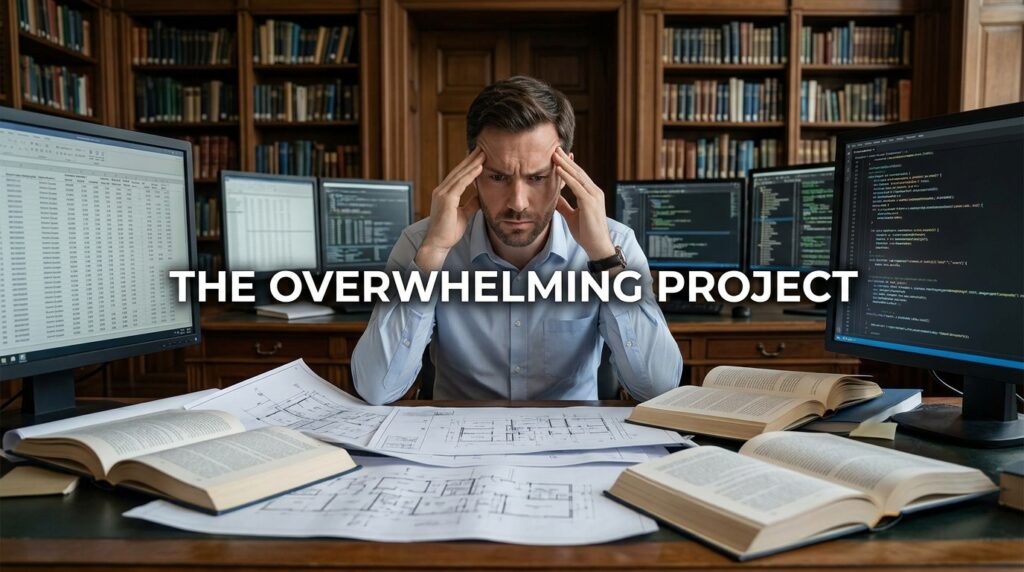
The problem with staring at a massive, complex project is that it feels overwhelming. Your brain naturally seeks an escape route to avoid the mental strain. If you tell yourself you have to work for four straight hours, you will procrastinate.
Instead, I use an app called Forest to chop my time into highly focused, gamified sprints.
Forest is based on the Pomodoro Technique. When I need to tackle a hard task, I open my phone, set the Forest timer for 25 minutes, and plant a virtual seed.
Over the next 25 minutes, if I keep my hands off my phone and focus purely on my work, that seed grows into a beautiful digital tree. However, if I break my focus, exit the app, and open Instagram, my digital tree instantly withers and dies.
It sounds childish, but the desire to not kill a cartoon tree is surprisingly powerful. Utilizing this gamified friction is exactly the strategy I discussed when mapping out Apps That Help Me Focus When Working From My Phone. It trains your brain to sustain its attention by rewarding you with immediate, visual momentum.
4. Merging Time With the To-Do List (TickTick)
A major flaw in how most people work is that they separate their tasks from their time.
They have a massive to-do list written on a piece of paper, and they have a clock on their wall, but the two never interact. You can write down twenty items on a to-do list, completely ignoring the fact that you only have eight physical hours in the day to accomplish them.
To work smarter, I merged the two concepts using an app called TickTick.
TickTick is a robust task manager, but its secret weapon is that it forces you to attach a time estimate to every single item. When I add “Draft Marketing Email” to my list, the app asks me to estimate how long it will take. I input “45 minutes.”
The app then calculates the total required duration of my entire list.
If I wake up on a Tuesday and my TickTick list says my tasks will require 11 hours to complete, the app has just saved me from a nervous breakdown. I know immediately, before the day even begins, that my list is mathematically impossible. I can proactively delete, delegate, or push tasks to tomorrow until the list represents a realistic six hours of work.
5. Discovering Your “Biological Prime Time”
Once I had a month of solid data logged into my time-tracking apps, the true magic happened. I stopped using the apps just to monitor myself, and I started using the data to fundamentally redesign how I work.
I exported my Toggl reports and looked at the timestamps of my most productive, deep-work sessions.
A clear pattern emerged. My fastest, highest-quality work always happened between 8:00 AM and 11:00 AM. After 2:00 PM, my productivity plummeted. Tasks that took me thirty minutes in the morning were taking me an hour and a half in the late afternoon.
I had discovered my “Biological Prime Time.”
I immediately restructured my calendar. I completely blocked out my mornings. No meetings, no phone calls, no email replies. I reserved my peak cognitive energy exclusively for my hardest projects.
Then, I pushed all my low-energy, administrative tasks to the afternoon. Learning how to properly slot my tasks into my natural biological rhythms was a revelation, a strategy I consider the crown jewel of the system I built in The Apps That Make My Work Life So Much Easier. Working smarter simply means swimming with the current of your own energy, rather than fighting against it.
6. The “Clock Out” Boundary
Perhaps the most dangerous aspect of remote work, or having your email connected to your smartphone, is the complete erosion of boundaries.
When your office is in your pocket, the workday never truly ends. You find yourself answering Slack messages at 8:30 PM while watching a movie with your family. You feel a constant, low-grade anxiety that you should be doing more.
Time tracking cured me of this toxic guilt.
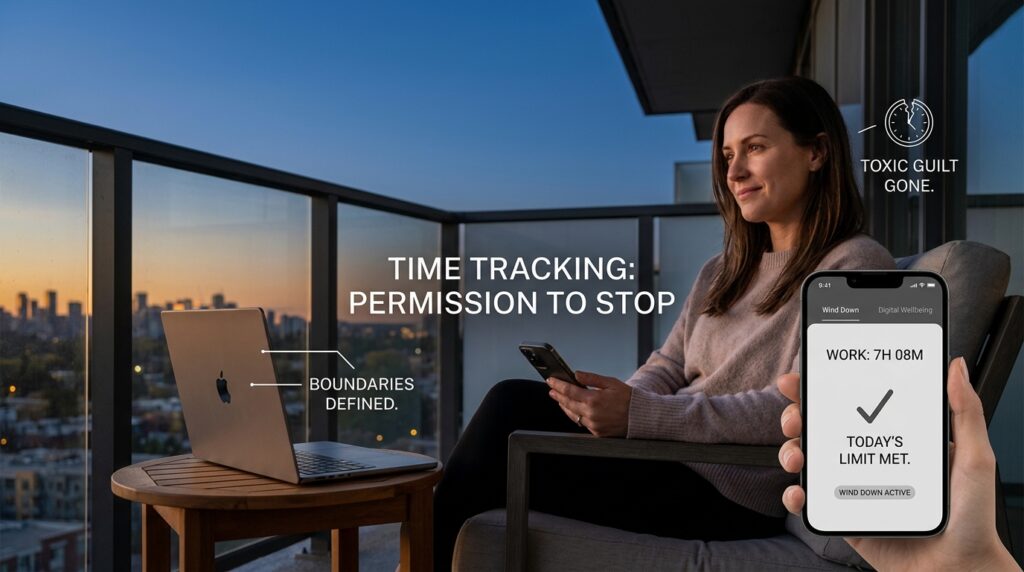
When you track your time meticulously, you know exactly when you have hit your limit. If I look at my dashboard at 5:30 PM and see that I have logged a legitimate, highly focused seven hours of deep work, the software gives me permission to stop.
I can close my laptop with absolute confidence. I know I didn’t waste the day. I know I moved the needle on my career. The data proves it.
I use the native “Digital Wellbeing” features on my phone to enforce this boundary. At 6:00 PM, my phone automatically enters “Wind Down” mode. The screen turns to grayscale, and all work-related apps are locked. The time tracker doesn’t just tell me when to work; it explicitly tells me when to rest.
Final Thoughts: You Cannot Manage What You Do Not Measure
There is an old business adage that states: What gets measured gets managed.
If you are trying to lose weight, you step on a scale. If you are trying to save money, you look at your bank account. Yet, when it comes to the most precious, finite resource we possess—the fleeting hours of our lives—most of us just cross our fingers and hope for the best.
We allow our days to be hijacked by other people’s emergencies, endless meetings, and the bottomless pit of the infinite scroll.
Using apps to track your time is not about turning yourself into a rigid, emotionless robot. It is not about squeezing every single second of joy out of your day for the sake of hyper-productivity.
It is about intentionality.
It is about realizing that when you waste two hours mindlessly staring at your smartphone, you are stealing those two hours away from your hobbies, your family, or your sleep.
Take a single week to track your time honestly. Download a manual tracker or set up a passive background monitor. Don’t judge the data; just observe it. Once you finally see the unfiltered truth of where your days are going, you gain the ultimate power to redirect them. You stop being a victim of the clock, and you finally become its master.
